


History and Composition:
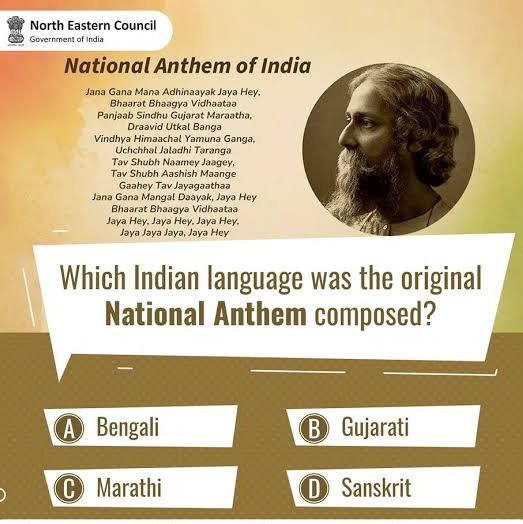
• Originally composed in Bengali by Rabindranath Tagore, Jana Gana Mana was first sung on December 27, 1911, at the Calcutta Session of the Indian National Congress.
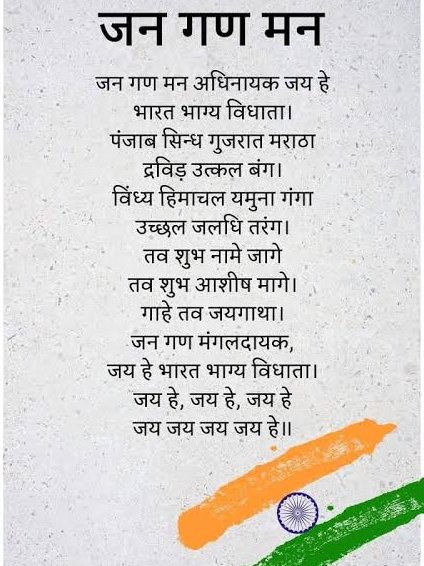
• It was adopted in its Hindi version by the Constituent Assembly as the National Anthem of India on January 24, 1950.
• Originally composed in Bengali by Rabindranath Tagore, Jana Gana Mana was first sung on December 27, 1911, at the Calcutta Session of the Indian National Congress.
• It was adopted in its Hindi version by the Constituent Assembly as the National Anthem of India on January 24, 1950.
Key Milestones:
• 1911: First sung at the Calcutta Session of the Indian National Congress.
• 1912: Published under the title Bharoto Bhagyo Bidhata in Tattwabodhini Patrika, Tagore's own journal.
• 1919: Tagore translated a part of the anthem into English, titled The Morning Song of India.
• 1950: Officially adopted as the National Anthem of India.
• 1911: First sung at the Calcutta Session of the Indian National Congress.
• 1912: Published under the title Bharoto Bhagyo Bidhata in Tattwabodhini Patrika, Tagore's own journal.
• 1919: Tagore translated a part of the anthem into English, titled The Morning Song of India.
• 1950: Officially adopted as the National Anthem of India.
The complete song consists of five stanzas, but only the first stanza is usually sung on official occasions.
Playing Time: Approximately 52 seconds.
• A shortened version consisting of the first and last lines (playing time approximately 20 seconds) is also played on certain occasions.
Playing Time: Approximately 52 seconds.
• A shortened version consisting of the first and last lines (playing time approximately 20 seconds) is also played on certain occasions.
Meaning and Interpretation:
• The anthem is a salutation to the "Eternal Charioteer" of India, symbolizing the nation and its people.
• It celebrates the unity and diversity of India, acknowledging the various regions and cultures that make up the nation.
• It does not mention any specific faith or deity.
• The anthem is a salutation to the "Eternal Charioteer" of India, symbolizing the nation and its people.
• It celebrates the unity and diversity of India, acknowledging the various regions and cultures that make up the nation.
• It does not mention any specific faith or deity.
Official Version and Etiquette:
• The official version of the anthem is the one adopted by the Constituent Assembly.
• When the Anthem is played or sung, everyone present should stand to attention.
• Those in uniform should give the appropriate salute.
• Civilians should stand with their right hands over their hearts.
It is important to adhere to the proper etiquette and respect the National Anthem as a symbol of national pride and unity.
• The official version of the anthem is the one adopted by the Constituent Assembly.
• When the Anthem is played or sung, everyone present should stand to attention.
• Those in uniform should give the appropriate salute.
• Civilians should stand with their right hands over their hearts.
It is important to adhere to the proper etiquette and respect the National Anthem as a symbol of national pride and unity.
Here are some facts:
📍First Public Performance: It was first publicly sung on December 27, 1911, at the Calcutta Session of the Indian National Congress.
📍Misconceptions about its Dedication: There have been some misconceptions about the song being dedicated to King George V, who was visiting India at the time of its first public singing. However, Tagore himself clarified that it was not written for any specific individual.
📍First Public Performance: It was first publicly sung on December 27, 1911, at the Calcutta Session of the Indian National Congress.
📍Misconceptions about its Dedication: There have been some misconceptions about the song being dedicated to King George V, who was visiting India at the time of its first public singing. However, Tagore himself clarified that it was not written for any specific individual.
Loading suggestions...