

🧵 Bhopal Gas Tragedy
337 MT Toxic Waste at Union Carbide Factory moved after 40 years
🔖 What are the rules for Toxic Waste Disposal in India? x.com
337 MT Toxic Waste at Union Carbide Factory moved after 40 years
🔖 What are the rules for Toxic Waste Disposal in India? x.com


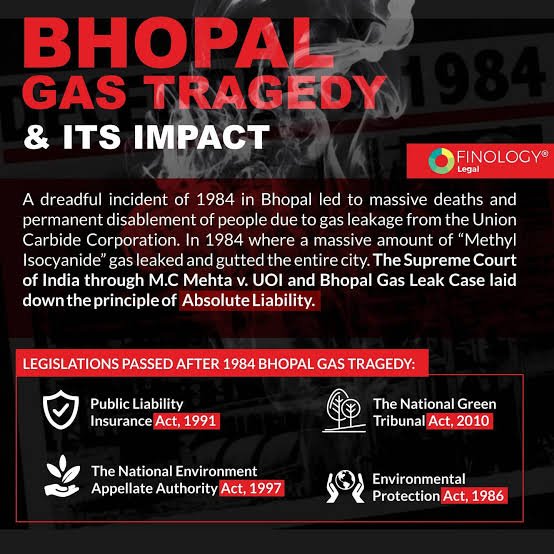
The Bhopal Gas Tragedy, which occurred on the night of December 2-3, 1984, in Bhopal, Madhya Pradesh, is considered the world's worst industrial disaster.
• A catastrophic leak of approximately 40 tonnes of methyl isocyanate (MIC) gas from the Union Carbide India Limited (UCIL) pesticide plant exposed over 500,000 people to the toxic fumes.
• Immediate estimates reported around 3,000 deaths, but subsequent evaluations suggest that the death toll may have exceeded 15,000, with hundreds of thousands suffering from chronic health issues such as respiratory problems, eye irritations, and neurological disorders.
• A catastrophic leak of approximately 40 tonnes of methyl isocyanate (MIC) gas from the Union Carbide India Limited (UCIL) pesticide plant exposed over 500,000 people to the toxic fumes.
• Immediate estimates reported around 3,000 deaths, but subsequent evaluations suggest that the death toll may have exceeded 15,000, with hundreds of thousands suffering from chronic health issues such as respiratory problems, eye irritations, and neurological disorders.

Persistent Health Issues:
• Survivors and their descendants continue to experience serious health problems, including cancer, birth defects, and other chronic conditions, underscoring the long-term impact of the disaster. x.com
• Survivors and their descendants continue to experience serious health problems, including cancer, birth defects, and other chronic conditions, underscoring the long-term impact of the disaster. x.com

Legal and Compensation Battles:
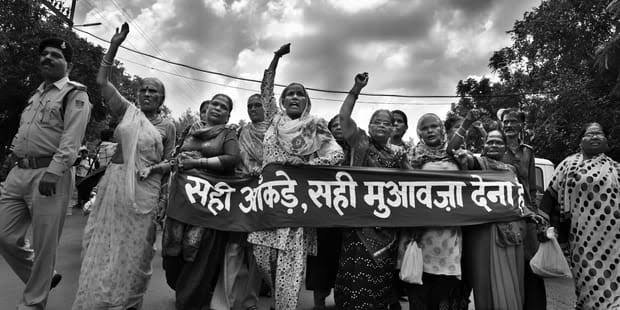
• Victims and advocacy groups continue to seek justice and adequate compensation.
• In 1989, Union Carbide paid $470 million to settle litigation, but many argue that this amount was insufficient given the scale of the disaster.
• Efforts to secure additional compensation have faced legal hurdles, and many affected individuals feel that justice has not been fully served.
• Victims and advocacy groups continue to seek justice and adequate compensation.
• In 1989, Union Carbide paid $470 million to settle litigation, but many argue that this amount was insufficient given the scale of the disaster.
• Efforts to secure additional compensation have faced legal hurdles, and many affected individuals feel that justice has not been fully served.
Environmental Contamination:
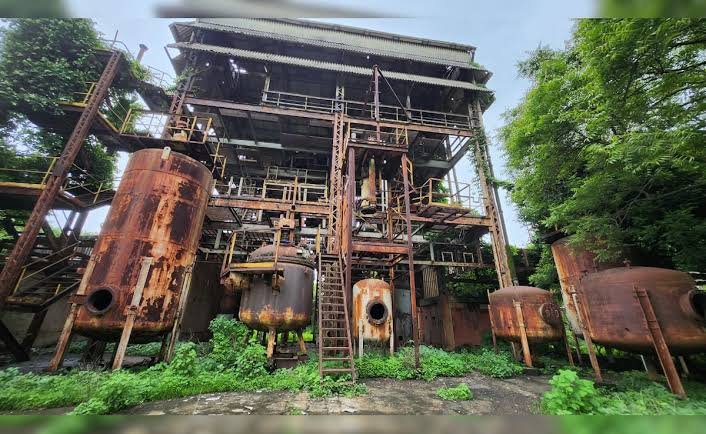
• Approximately 337 metric tonnes of hazardous waste remained stored at the now-defunct plant site.
• Despite the central government allocating ₹126 crore to the Madhya Pradesh government for disposal, the waste was not being adequately addressed, leading to soil and groundwater contamination that poses ongoing risks to local communities.
• Approximately 337 metric tonnes of hazardous waste remained stored at the now-defunct plant site.
• Despite the central government allocating ₹126 crore to the Madhya Pradesh government for disposal, the waste was not being adequately addressed, leading to soil and groundwater contamination that poses ongoing risks to local communities.
Why in the news now?
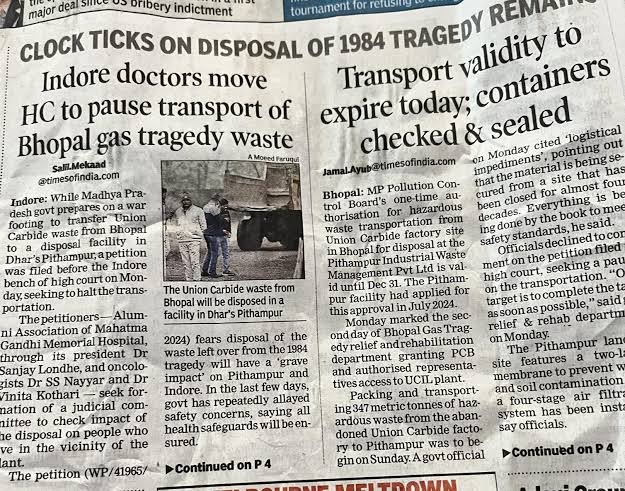
After four decades, the government has initiated the removal of toxic waste from the Union Carbide factory site in Bhopal.
• This action follows a directive from the Madhya Pradesh High Court, which set a four-week deadline for the disposal of the hazardous materials.
After four decades, the government has initiated the removal of toxic waste from the Union Carbide factory site in Bhopal.
• This action follows a directive from the Madhya Pradesh High Court, which set a four-week deadline for the disposal of the hazardous materials.
Where is being disposed?
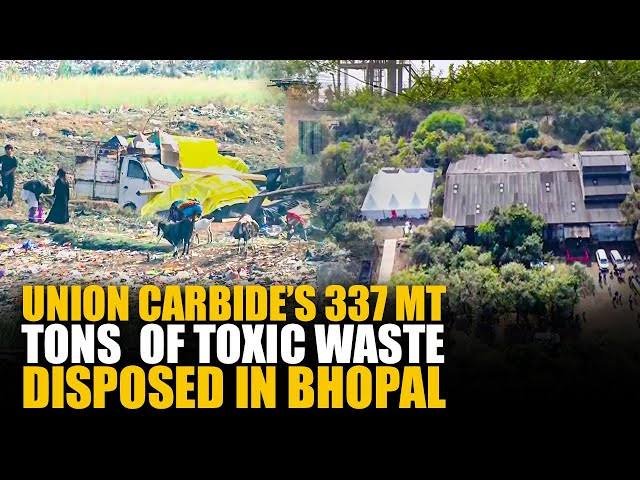
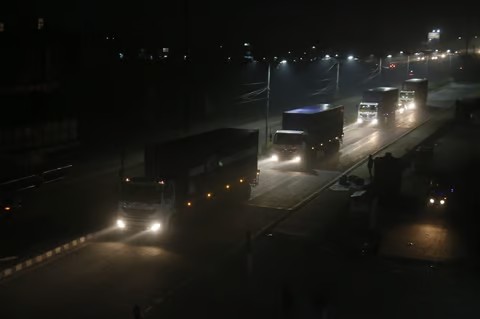
Approximately 337 metric tonnes of toxic waste are being transported to an incineration facility in Pithampur, near Indore, located about 225 kilometers from Bhopal.
• The process began in late December 2024, with specially reinforced, GPS-enabled trucks carrying the waste under police escort to ensure safety.
• The incineration at Pithampur will be conducted under strict environmental controls.
• The facility employs a four-stage filtration system to prevent air pollution, and the resulting solid residue will be securely stored in a landfill designed to prevent any environmental contamination.
Approximately 337 metric tonnes of toxic waste are being transported to an incineration facility in Pithampur, near Indore, located about 225 kilometers from Bhopal.
• The process began in late December 2024, with specially reinforced, GPS-enabled trucks carrying the waste under police escort to ensure safety.
• The incineration at Pithampur will be conducted under strict environmental controls.
• The facility employs a four-stage filtration system to prevent air pollution, and the resulting solid residue will be securely stored in a landfill designed to prevent any environmental contamination.
How long will it take?
• Officials estimate that the disposal process will take between three to nine months, depending on the rate of incineration.
• This development marks a significant step toward addressing the long-standing environmental hazards posed by the residual waste from the 1984 Bhopal Gas Tragedy.
The removal and safe disposal of these toxic materials are crucial for mitigating ongoing health risks and environmental contamination affecting the local population.
• Officials estimate that the disposal process will take between three to nine months, depending on the rate of incineration.
• This development marks a significant step toward addressing the long-standing environmental hazards posed by the residual waste from the 1984 Bhopal Gas Tragedy.
The removal and safe disposal of these toxic materials are crucial for mitigating ongoing health risks and environmental contamination affecting the local population.
What are the rules for Toxic Waste disposal in India?
• The Hazardous and Other Wastes (Management and Transboundary Movement) Rules, 2016 govern the disposal of hazardous waste.
• It is established under the Environment (Protection) Act, 1986.
• These rules aim to ensure the safe handling, generation, processing, treatment, storage, transportation, and disposal of hazardous wastes to prevent environmental and human health hazards.
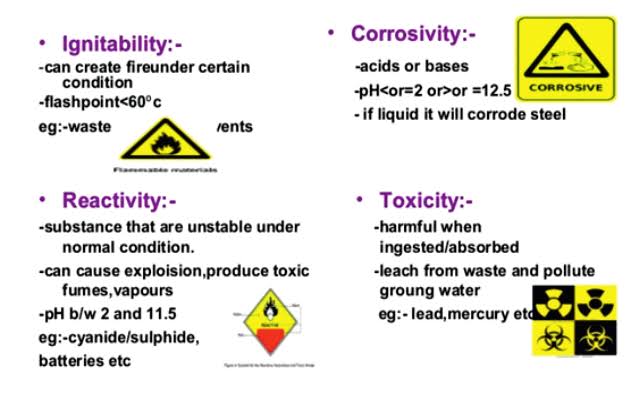
Types of Hazardous Waste 👇
• The Hazardous and Other Wastes (Management and Transboundary Movement) Rules, 2016 govern the disposal of hazardous waste.
• It is established under the Environment (Protection) Act, 1986.
• These rules aim to ensure the safe handling, generation, processing, treatment, storage, transportation, and disposal of hazardous wastes to prevent environmental and human health hazards.
Types of Hazardous Waste 👇
Loading suggestions...