

#Equities have historically outpaced inflation over the long term.
However, within this overarching trend, there are periods where equities, despite rising in nominal terms, fail to keep up with inflation.
Take the S&P 500 (#SPX), adjusted for inflation, as an example:
Between 1966 and 1982, while the SPX rose nominally, it lost significant value when adjusted for inflation.
Although the SPX made a nominal high in 1980, it didn’t surpass its 1966 inflation-adjusted high until 1993—a 27-year wait for investors to truly outpace inflation.
A similar story played out between 2000 and 2009.
In contrast, equities were incredibly cheap in the early 1980s and again in 2009. Investors who bought during these periods benefited from a cycle where equities strongly outperformed inflation, creating generational wealth.
Today, however, the SPX appears to be nearing the end of a Inflation outperformance cycle. Those who invested aggressively after the Global Financial Crisis (GFC) have significantly outperformed inflation. But for new participants entering the U.S. market today, the same opportunities may not exist.
However, within this overarching trend, there are periods where equities, despite rising in nominal terms, fail to keep up with inflation.
Take the S&P 500 (#SPX), adjusted for inflation, as an example:
Between 1966 and 1982, while the SPX rose nominally, it lost significant value when adjusted for inflation.
Although the SPX made a nominal high in 1980, it didn’t surpass its 1966 inflation-adjusted high until 1993—a 27-year wait for investors to truly outpace inflation.
A similar story played out between 2000 and 2009.
In contrast, equities were incredibly cheap in the early 1980s and again in 2009. Investors who bought during these periods benefited from a cycle where equities strongly outperformed inflation, creating generational wealth.
Today, however, the SPX appears to be nearing the end of a Inflation outperformance cycle. Those who invested aggressively after the Global Financial Crisis (GFC) have significantly outperformed inflation. But for new participants entering the U.S. market today, the same opportunities may not exist.
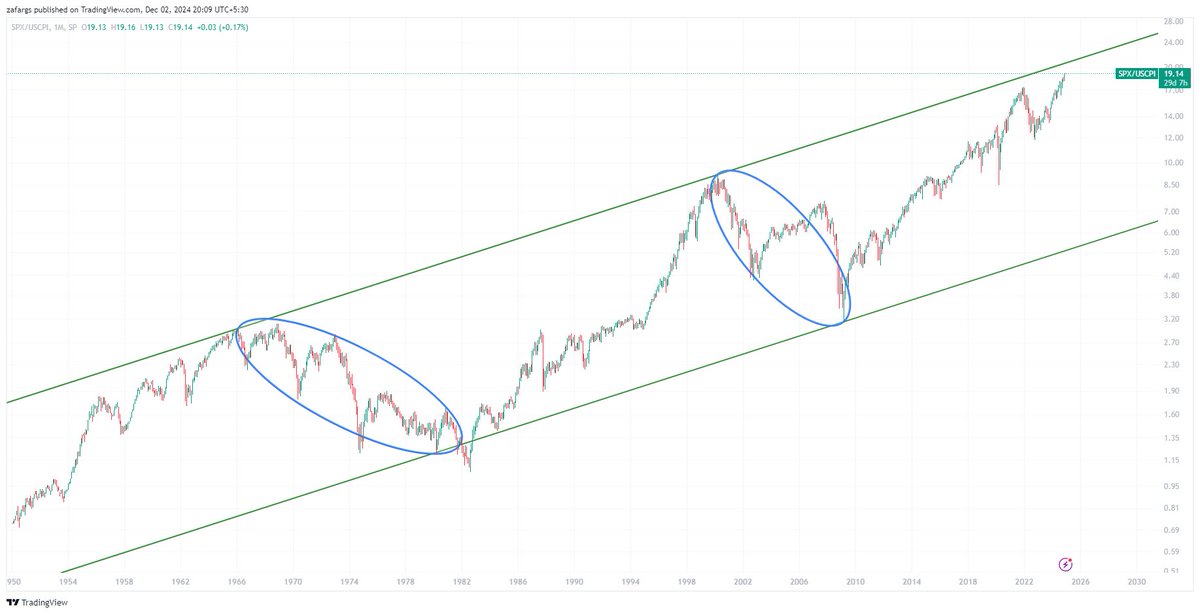
By extrapolation of equity being cheap in 1980,2009 next phase of US being cheap may arrive around 2040, so you may not benefit but tell your son & daughter this story to buy truckload when US equity is cheap on inflation adjusted basis 😉
Loading suggestions...