

What's the connection between catatonia and epilepsy?
In this review, we bring together the evidence: doi.org. @EpilepsyBehavi1 #OpenAccess
Here's a summary and a story of how we made this paper 🧵... (1/14)
In this review, we bring together the evidence: doi.org. @EpilepsyBehavi1 #OpenAccess
Here's a summary and a story of how we made this paper 🧵... (1/14)
Let's start with the basics...
CATATONIA
💠Catatonia is a syndrome that can be a part of a neurological or a psychiatric condition.
💠Features include stupor, catalepsy and mutism. 💠Treatment consists of benzodiazepines and/or electroconvulsive therapy (ECT) (2/14)
CATATONIA
💠Catatonia is a syndrome that can be a part of a neurological or a psychiatric condition.
💠Features include stupor, catalepsy and mutism. 💠Treatment consists of benzodiazepines and/or electroconvulsive therapy (ECT) (2/14)
EPILEPSY
💠Recurrent seizures from a range of causes
💠Wide range of seizure morphology
💠Acutely often respond to benzodiazepines, but for prophylaxis there is a range of antiseizure medications (3/14)
💠Recurrent seizures from a range of causes
💠Wide range of seizure morphology
💠Acutely often respond to benzodiazepines, but for prophylaxis there is a range of antiseizure medications (3/14)
OK, now onto what we know about these 2:
▶️According to a classic review by @MarkOldhamMD, ~2% of cases of catatonia are seizure-related in some ways (pubmed.ncbi.nlm.nih.gov)
▶️3 temporal relationships between catatonia and seizures are reported... (4/14)
▶️According to a classic review by @MarkOldhamMD, ~2% of cases of catatonia are seizure-related in some ways (pubmed.ncbi.nlm.nih.gov)
▶️3 temporal relationships between catatonia and seizures are reported... (4/14)

✅Catatonia can be a presentation of seizures (ICTAL CATATONIA)
✅Catatonia can appear hr-day after seizures (POSTICTAL CATATONIA)
✅Catatonia can occur in epilepsy with no clear temporal relationship to seizures (INTERICTAL CATATONIA) (5/14)
✅Catatonia can appear hr-day after seizures (POSTICTAL CATATONIA)
✅Catatonia can occur in epilepsy with no clear temporal relationship to seizures (INTERICTAL CATATONIA) (5/14)
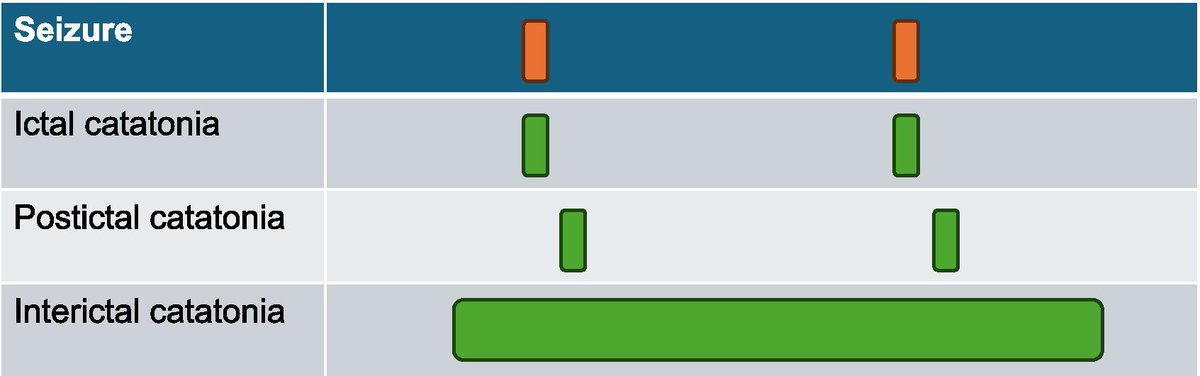
This interictal one is maybe a bit more debatable. Some people have catatonia; some people have epilepsy. Perhaps it's no surprise that some have both.
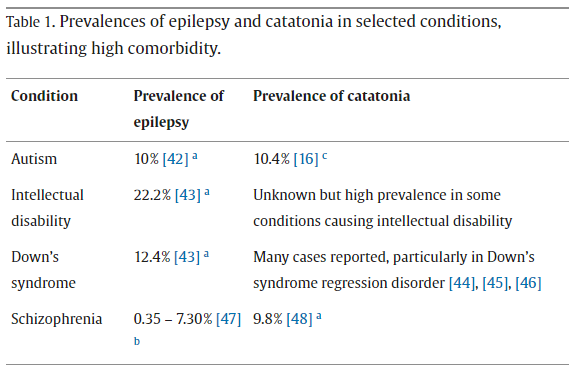
Look at this table though - there are a number of conditions where catatonia and epilepsy are highly comorbid. (6/14)
Look at this table though - there are a number of conditions where catatonia and epilepsy are highly comorbid. (6/14)
Then there are the interesting EEG findings.
@ParisHosseini and others did this meta-analysis (doi.org) not that long ago where we found that EEG abnormalities are pretty common even in 'psychiatric' catatonia, esp. generalised background slowing. (7/14)
@ParisHosseini and others did this meta-analysis (doi.org) not that long ago where we found that EEG abnormalities are pretty common even in 'psychiatric' catatonia, esp. generalised background slowing. (7/14)
I gave a talk on this topic and this is more-or-less where I got up to.
But the paper doesn't end there. (8/14)
But the paper doesn't end there. (8/14)

After the talk, @SShorvon asked a Q. He put it to me that catatonia responds to benzodiazepines, so would we ever know if loads of cases of catatonia were actually due to seizures?
Maybe the seizures are subcortical and aren't even detected by routine EEG? (9/14)
Maybe the seizures are subcortical and aren't even detected by routine EEG? (9/14)
So we got together and wrote this paper with James Luccarelli @MGHPsychiatry.
First off, there are plenty of cases where seizure activity not apparent on scalp EEG is shown on intracranial EEG.
So it's *possible* that this is happening in catatonia. But is it likely? (10/14)
First off, there are plenty of cases where seizure activity not apparent on scalp EEG is shown on intracranial EEG.
So it's *possible* that this is happening in catatonia. But is it likely? (10/14)
A few points:
1. Semiology of catatonia can be identical to some cases of non-convulsive status
2. Both conditions can respond rapidly to benzodiazepines
3. Catatonia can be precipitated by the withdrawal of antiseizure medications
4. Comorbidity ?⇒ shared neurobiology (11/14)
1. Semiology of catatonia can be identical to some cases of non-convulsive status
2. Both conditions can respond rapidly to benzodiazepines
3. Catatonia can be precipitated by the withdrawal of antiseizure medications
4. Comorbidity ?⇒ shared neurobiology (11/14)
So maybe we are missing some cases of epilepsy in catatonia.
But let's not go too far here:
🔴Clozapine is sometimes effective for catatonia (pubmed.ncbi.nlm.nih.gov), but it's very proconvulsant
🔴Some cases of catatonia have a really compelling psych formulation (12/14)
But let's not go too far here:
🔴Clozapine is sometimes effective for catatonia (pubmed.ncbi.nlm.nih.gov), but it's very proconvulsant
🔴Some cases of catatonia have a really compelling psych formulation (12/14)

What about ECT? If cat can be treated by giving someone a seizure, surely seizures are good for catatonia.
Actually - paradoxically - ECT has also been effective on occasions for status epilepticus. So it doesn't rule out a possible effect in seizure-related catatonia. (13/14)
Actually - paradoxically - ECT has also been effective on occasions for status epilepticus. So it doesn't rule out a possible effect in seizure-related catatonia. (13/14)
Let's summarise then:
✅Catatonia can be ictal/postictal/interictal
✅Its EEG is often abnormal, even in 'psychiatric' cases
✅It is possible that epilepsy accounts for more cases of catatonia than we give it credit for, but probs unlikely it's the only thing going on. (14/14)
✅Catatonia can be ictal/postictal/interictal
✅Its EEG is often abnormal, even in 'psychiatric' cases
✅It is possible that epilepsy accounts for more cases of catatonia than we give it credit for, but probs unlikely it's the only thing going on. (14/14)
Loading suggestions...