

Fakhr al-Dīn al-Rāzī in his Tafsir Mafātiḥ al-Ghayb (Keys to the Unseen) elaborated on how [Qurʾān 2:24] proves the miracle of the Qurʾān in four ways | thread 🧵


Regarding the statement of Allah, the Most High: "But if you do not—and you will never be able to—" know that this verse indicates the miraculous nature of the Qurʾān from four perspectives:

The first is that we know through widespread consensus that the Arabs were intensely hostile towards the Messenger of Allah ﷺ and were extremely keen to nullify his message. The fact that they had separated from their lands and families and sacrificed their lives and souls
strongly indicates this. Therefore, when this reprimand is added—"But if you do not—and you will never be able to"—if it had been within their power to produce something like the Qurʾān or even a single chapter from it, they would have done so.
Hence, their failure to produce anything similar demonstrates the miracle of the Qurʾān.
The second aspect is that although he—peace be upon him—was suspected by them in matters related to prophethood, his exceptional intelligence, virtue, and awareness of consequences were well known.
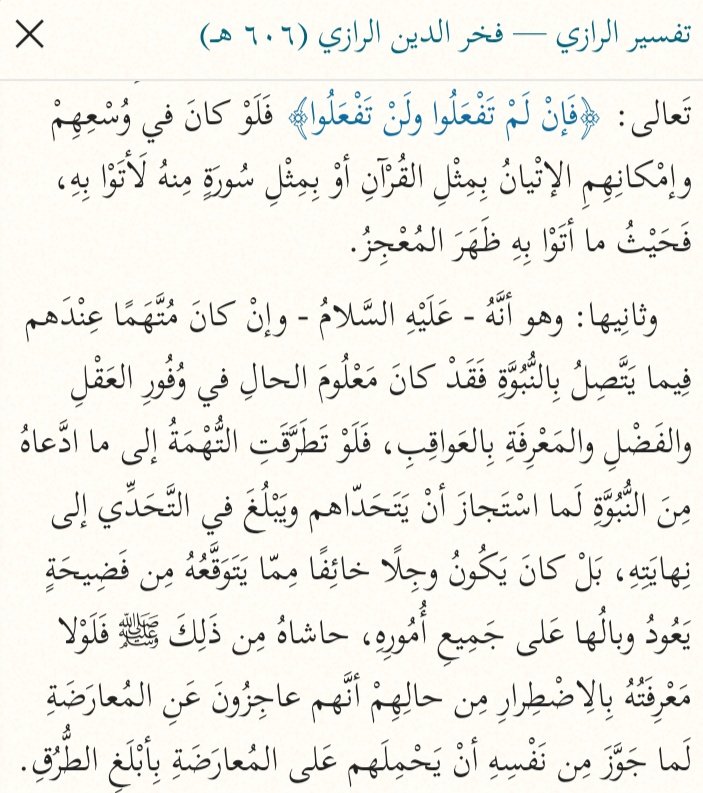
Had there been any valid grounds for suspicion regarding his claim to prophethood, he would not have dared to challenge them so emphatically. Instead, he would have been fearful of the disgrace and repercussions it could bring upon him. Yet, he—peace be upon him—knew
with certainty that they were incapable of opposing him, which is why he felt justified in challenging them in the most profound manner.
The third aspect is that if he—peace be upon him—were not certain of the truth of his prophethood, he would not have decisively claimed that they could never produce something like it.
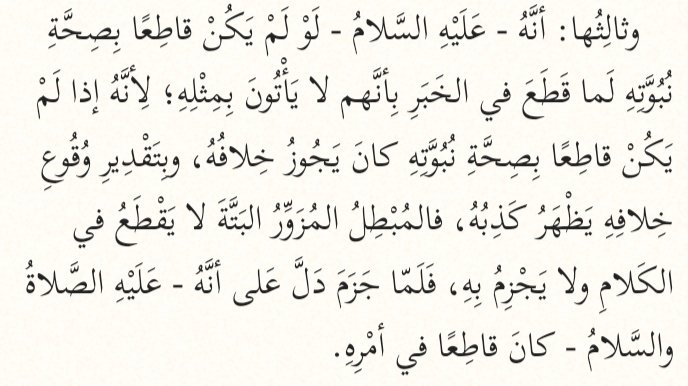
If he were uncertain of his prophethood, there would be a possibility of his claim being refuted, which could expose his falsehood. A deceiver who is not confident in their deception would not assert something with such certainty.
Therefore, his definitive assertion indicates that he—peace be upon him—was absolutely certain of his prophethood.
The fourth aspect is that this claim has consistently held true over time. From his—peace be upon him—days until the present, there has never been a time free from those who oppose religion and Islam, and whose hostility towards it intensifies.

Despite this intense opposition, there has never been a successful challenge to the Qurʾān.
(So here he's saying this is a fullfiled prophecy about what will happen in the future [this is my comment])
(So here he's saying this is a fullfiled prophecy about what will happen in the future [this is my comment])
These four aspects demonstrate the miraculous nature of the Qurʾān, as highlighted by this verse, and refute the erroneous claim of those who assert that the Book of Allah ﷻ lacks evidence and argumentation.
Loading suggestions...