

BIG BREAKING NEWS🚨
Waqf Board Amendment Bill 2024 is Masterstroke or a Mess?
This New Bill Could Change Everything?
Will it Fix the System or Fuel the fire?
A Thread 🧵
Waqf Board Amendment Bill 2024 is Masterstroke or a Mess?
This New Bill Could Change Everything?
Will it Fix the System or Fuel the fire?
A Thread 🧵

Overview of Bill
- Introduction: The Waqf Board Amendment Bill 2024 introduces approximately 40 amendments to the Waqf Act of 1995, aiming to enhance the management of Waqf properties.
- Objective: The bill emphasises accountability, transparency, and inclusivity within the Waqf system.
- Introduction: The Waqf Board Amendment Bill 2024 introduces approximately 40 amendments to the Waqf Act of 1995, aiming to enhance the management of Waqf properties.
- Objective: The bill emphasises accountability, transparency, and inclusivity within the Waqf system.
What is the Waqf Board?
- The Waqf Board is a statutory body established under the provisions of the Waqf Act, 1954 to manage and regulate Waqf properties in India.
- The board operates under the supervision of the state government and is recognised as a legal entity or juristic person.
The Central Waqf Council provides advisory support to ensure the boards function effectively. The primary functions of the board include:
- Maintenance of Waqf Properties: The Waqf Board is responsible for ensuring that waqf properties are properly maintained and utilized for their intended purposes.
- Registration of Waqf Properties: All waqf properties must be registered with the Waqf Board.
- Administration: The Board administers the waqf properties, ensuring they are used for charitable or religious purposes as intended by the donors.
- Supervision and Control: The board supervises and controls the management of waqf properties by mutawallis (custodians).
- The Waqf Board is a statutory body established under the provisions of the Waqf Act, 1954 to manage and regulate Waqf properties in India.
- The board operates under the supervision of the state government and is recognised as a legal entity or juristic person.
The Central Waqf Council provides advisory support to ensure the boards function effectively. The primary functions of the board include:
- Maintenance of Waqf Properties: The Waqf Board is responsible for ensuring that waqf properties are properly maintained and utilized for their intended purposes.
- Registration of Waqf Properties: All waqf properties must be registered with the Waqf Board.
- Administration: The Board administers the waqf properties, ensuring they are used for charitable or religious purposes as intended by the donors.
- Supervision and Control: The board supervises and controls the management of waqf properties by mutawallis (custodians).

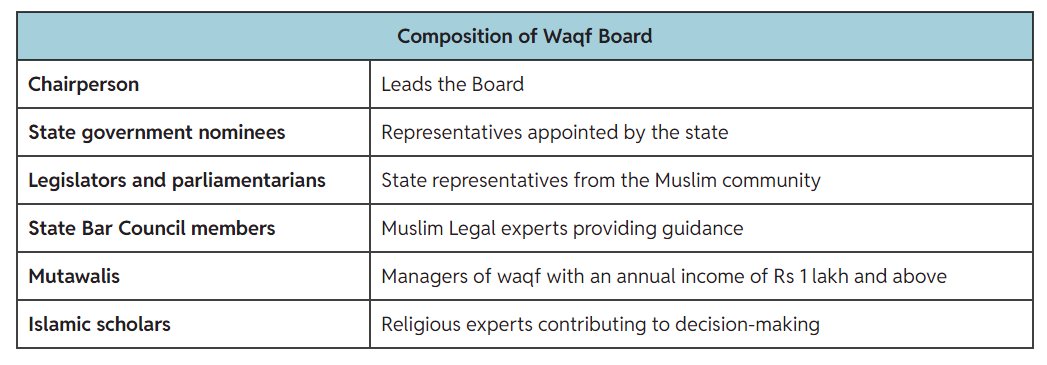
Composition of Waqf Board
- As stated, the Waqf Board is a legal entity that can sue or be sued in a court of law. The members of the board consist of the state government nominees, members from the Muslim community, members of the state Bar Council, mutawalis, and government officials.
- As stated, the Waqf Board is a legal entity that can sue or be sued in a court of law. The members of the board consist of the state government nominees, members from the Muslim community, members of the state Bar Council, mutawalis, and government officials.
Understanding the Waqf Board Act
- Origin: Established in 1954 and updated in 1995, the Waqf Board Act oversees Waqf properties in India, which are donated for religious or charitable purposes under Islamic law.
- Purpose: It ensures that Waqf properties serve the Muslim community’s interests by being used for charitable and religious activities.
- Origin: Established in 1954 and updated in 1995, the Waqf Board Act oversees Waqf properties in India, which are donated for religious or charitable purposes under Islamic law.
- Purpose: It ensures that Waqf properties serve the Muslim community’s interests by being used for charitable and religious activities.

Key Amendments Proposed
- Property Registration: Mandates Waqf Boards to register properties with district authorities for better oversight.
- Property Verification: Introduces mandatory verification for disputed lands to clarify property ownership.
- Board Functioning: Revises Sections 9 and 14 to reform Waqf Boards’ operations and reduce arbitrary powers.
- Inclusivity: Calls for women’s inclusion in Waqf Boards to promote gender equality in governance.
- Property Registration: Mandates Waqf Boards to register properties with district authorities for better oversight.
- Property Verification: Introduces mandatory verification for disputed lands to clarify property ownership.
- Board Functioning: Revises Sections 9 and 14 to reform Waqf Boards’ operations and reduce arbitrary powers.
- Inclusivity: Calls for women’s inclusion in Waqf Boards to promote gender equality in governance.
Implications of the Amendments
- Mismanagement Prevention: Aims to prevent mismanagement of Waqf properties.
- Dispute Resolution: Facilitates more efficient resolution of property disputes.
- Regulatory Enforcement: Enforces stricter regulations to increase transparency and prevent property misuse.
- Mismanagement Prevention: Aims to prevent mismanagement of Waqf properties.
- Dispute Resolution: Facilitates more efficient resolution of property disputes.
- Regulatory Enforcement: Enforces stricter regulations to increase transparency and prevent property misuse.
In Case You Have Any Questions Regarding Your UPSC Preparation and are Moving Out of ORN, I will be Guiding a select Group of Serious Aspirants.
Share Your Number in My DM, I will get in touch with you Personally
Follow For more @deepanshuS27
x.com
Share Your Number in My DM, I will get in touch with you Personally
Follow For more @deepanshuS27
x.com
Loading suggestions...