

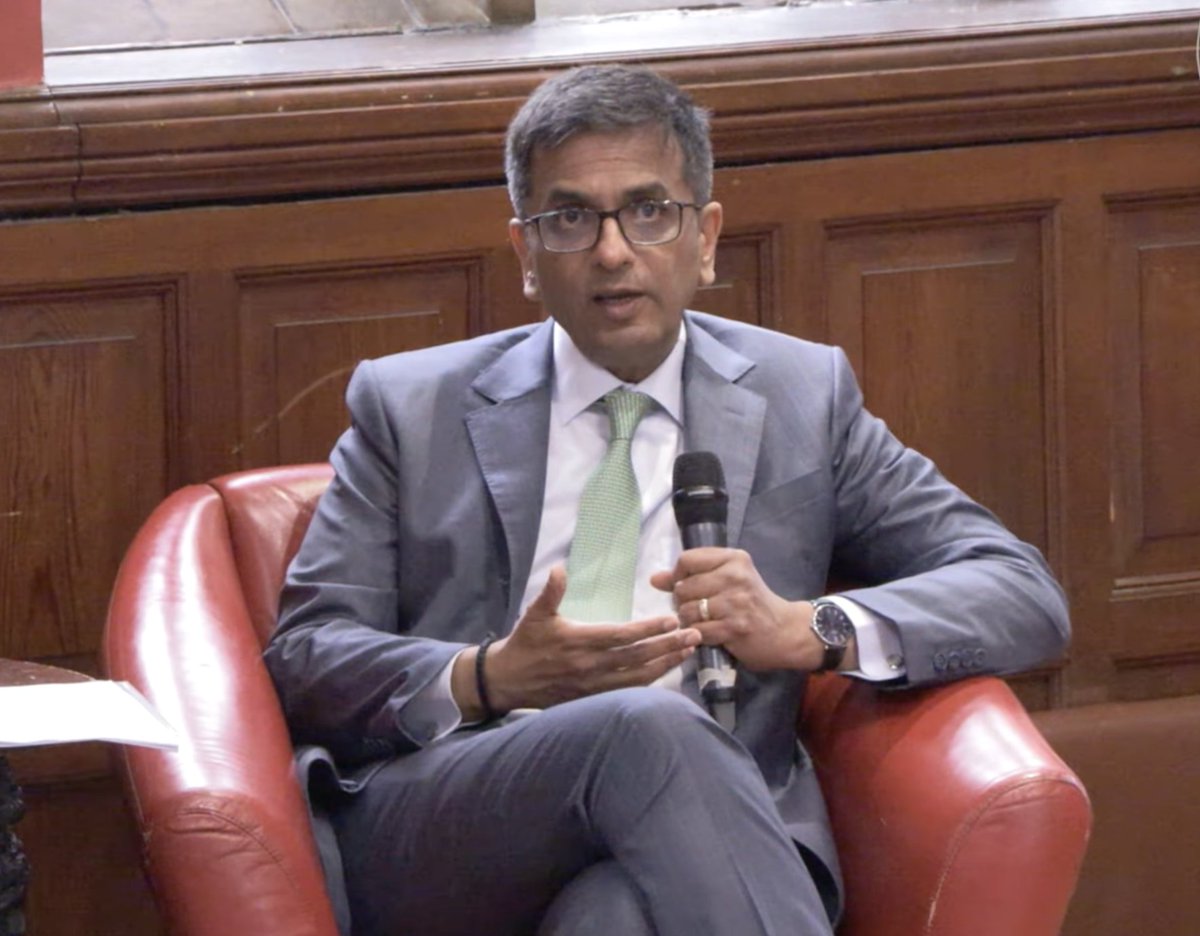
Excerpts from the Q&A session with CJI DY Chandrachud at Oxford Union.
CJI : When a judge is interpreting the law to give effect to constitutional values or focus on the effects of a particular interpretation as opposed to the purpose of the law, the judge is not being an "activist". When you call a judge an "activist", it has a sort of pejorative implication- that the judge is encroaching upon an area reserved for the executive or the legislature. As judges, we are cognizant of the separation of powers.
When judges are interpreting the Constitution, they are not being activists. It is their duty. The work we do is a matter of plain duty and nothing more than that.
CJI : When a judge is interpreting the law to give effect to constitutional values or focus on the effects of a particular interpretation as opposed to the purpose of the law, the judge is not being an "activist". When you call a judge an "activist", it has a sort of pejorative implication- that the judge is encroaching upon an area reserved for the executive or the legislature. As judges, we are cognizant of the separation of powers.
When judges are interpreting the Constitution, they are not being activists. It is their duty. The work we do is a matter of plain duty and nothing more than that.
CJI Chandrachud asked if the "infamous" judgment in the same-sex marriage case, where the Court refused to grant recognition for same-sex marriages, was compatible with the Court's duty to humanise the law.
CJI responds : When you humanise the law, you cannot disregard the law.
CJI says the Special Marriage Act was intended for a particular purpose and the Court could not have read "man" and "woman" used in the said statute as "man" and "man" or "woman" and "woman."
If the Special Marriage Act was struck down, there would have been a situation of no law governing couples of inter-faith.
CJI responds : When you humanise the law, you cannot disregard the law.
CJI says the Special Marriage Act was intended for a particular purpose and the Court could not have read "man" and "woman" used in the said statute as "man" and "man" or "woman" and "woman."
If the Special Marriage Act was struck down, there would have been a situation of no law governing couples of inter-faith.
CJI : When the law (Special Marriage Act) specifically uses the words "man" and "woman", can the Court override the law and read that as "man" and "man" or "woman" and "woman". We said the Court can't do it.
CJI : The entire gamut of marriage is governed by legislation in India. Therefore we felt that if we have to recognize same sex marriage, it has to be done by the Parliament which is entrusted with the duty of law making.
CJI : I believed that the Court should at least recognise the right of same-sex couples to form civil unions until such time the Parliament stepped. But I was in a minority because three of my colleagues who felt that the recognition of same-sex unions was beyond the purview of the Courts.
CJI : What happens in modern-day courts must not be looked at merely from the standpoint of the substantive outcome. The Court is involved in a dialogue, not only with the litigating parties but a dialogue with the wider civil society. That is one of the reasons why we decided to live-stream important constitutional cases.
CJI : As Chief Justice of India, it has been my firm conviction that we need to take the process of justicing to the homes and the hearts of the people. People must understand the smallest of issues that come to the Court attract the most serious of the application of mind.
CJI : Between the day we decriminalised homosexuality and today, there is a wider social acceptance of these relationships. I do think that there is so much to be done by the society iteslf and other wings. You cannot only look to the Courts to resolve the disputes that may arise.
Q : How can India's judiciary balance independence, social justice minority rights in a politically charged atmosphere?
CJI : When you have trained judges deciding disputes, that allows for courts to decide on the basis of settled traditions based on Constitutional precepts as opposed to the passions of the moment.
CJI : When you have trained judges deciding disputes, that allows for courts to decide on the basis of settled traditions based on Constitutional precepts as opposed to the passions of the moment.
CJI asked about the pressures faced by judges due to social media narratives.
CJI : Social media is a reality. In our courts today, we have live-tweeting by minute. Every remark which is said by a judge is conveyed on social media. That is something we need not stop and we cannot stop.
CJI : Social media is a reality. In our courts today, we have live-tweeting by minute. Every remark which is said by a judge is conveyed on social media. That is something we need not stop and we cannot stop.
CJI : Obviously, we are the receiving end on some occassions. Sometimes the criticism is fair, sometimes the criticism is not fair. But I do believe as judges our shoulders are broad enough to accept the critique which people have of the work we do.
CJI : Yes, in social media there is a problem. Because every citizen on social media is a journalist with a view. And very often, we (judges) are at the receiving end. And very often we see comments about what we HAVE NOT said, I say, well we have never said this or we have been misinterpreted.
CJI : But is (social media) in our control? We are living in a society where so much lies beyond our control. I always believe that the power of good prevails over the power of evil.
CJI: Therefore, notwithstanding the flip sides of technology and notwithstanding the sometimes unwarranted criticism of judges, overall, technology allows us to reach out to people and explain to them the seriousness with which we attend to the problems of the common people.
CJI asked about the "political pressure on the judiciary, particularly in the past few years."
CJI : Political pressure, if you ask me in the sense of pressure from the government, I would tell you that in the 24 years I have been a judge, I have never faced a sense of political pressure from the powers that be.
CJI : Judges in India live a life isolated from the political arm of the government.
CJI : If you mean "political pressure" in a broader sense of a judge realising the impact of a decision which may have political ramifications, obviously, judges have to be conversant of the impact of their decisions on the polity at large when you are deciding constitutional cases. That is not political pressure I believe. That is an understanding by the Court of the likely impact of the decision, which the judge must necessarily factor-in in their consideration.
CJI : Social pressure. Many of the cases we decide involve intense societal impacts. As judges, I believe it is our duty to be cognizant of the impact of our decisions on the social ordering which we are ultimately going to affect.
CJI asked about the issue of case pendency.
CJI : Judge to population ratio in India is amongst the lowest in the world. We simply need more judges. We are engaging with the Govt to increase the strength of the judiciary at all levels.
CJI : Judge to population ratio in India is amongst the lowest in the world. We simply need more judges. We are engaging with the Govt to increase the strength of the judiciary at all levels.
CJI : We are trying to ensure that the vacancies in the judiciary are filled up without delay at all levels. The whole issue of judicial backlog is something which concerns the judiciary alone but the society at large. Sometimes, when a law is enacted, it is enacted without a legislative audit of the impact on judicial infrastructure.
CJI cites the example of S.138 NI Act - Dishonour of cheque was once a civil dispute which was converted into a criminal offence. What has happened after that was a tremendous inflow of cases to the Magisterial level.
CJI : I do believe it is important that when new laws are enacted, a legislative audit has to be done of the impact of the laws on the existing judicial infrastructure. If it is going to make a demand on the judicial infrastructure, we simply have to improve the judicial infrastructure.
CJI : We are using AI to categorise cases of a similar nature. Very recently, a colleague of mine decided a land acquisition matter. 750 matters were disposed of by one single judgment.
CJI : A whole host of measures have been taken to ensure expeditious disposal of cases. But that is work in progress.
Question to CJI if there is a perception of public trust of the judiciary in India.
CJI : One indicator of public trust is the number of cases which citizens bring to the Court. Going by the scale of cases which are brought to our courts, I think the level of trust has to be high.
CJI : One indicator of public trust is the number of cases which citizens bring to the Court. Going by the scale of cases which are brought to our courts, I think the level of trust has to be high.
CJI : Trust we command is the number of cases which are filed in our courts.
CJI : Supreme Court was intended to be a people's court. It is not a court which speaks only of Constitutional issues. It is a Court which touches upon the lives of the people and their daily problems.
CJI : But we can do a lot more and we are trying to do a lot more to entrench public confidence in the judiciary. The best way is for the Courts to be transparent and accountable to the people. We are not accountable in that sense to democratic elected institutions like Parliament.
CJI : We can do a lot more to be transparent which we are trying to do and we can add a lot more to our accountability. Transparency can be brought about by deployment of techology which allows people to access the work which is being done in the Courts.
CJI : Somebody asked me, what would I like to be rembered for when I lay down my office. I reflected on that. Have I done something in the course of my work as a judge in dealing with the problems of real human beings, to leave their lives in a better situation? Have we, in working our ways through the complexities of law, ultimately made our society more liveable, more humane, more accessible, more tolerant and more compassionate?
CJI : Have we made a society which finds solutions to disputes through ordered discourse? A South African judge has written a book "Strange Alchemy of Law and Life". He says the great work done by the Constitutional Courts in SA is to substitute what was done by a bullet by reason.
CJI : I think that is the key foundation of our courts. By allowing for diverse strands of conflicting opinions, we have allowed a space for people to engage in reason, to engage in dialogue. By lending our ears to them, we are trying to protect one of the fundamental values of democracy.
Loading suggestions...