

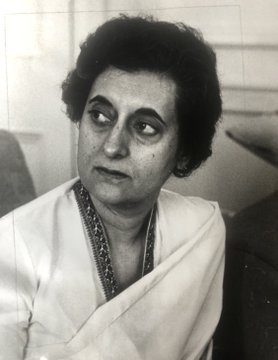
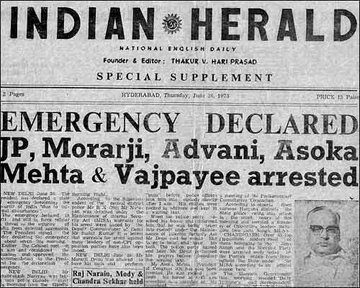
The Emergency is declared in India on this date in 1975, as Indira Gandhi arrests all opposition leaders, suspends fundamental rights and imposes a state of dictatorship. Dark day in modern Indian history.
This is a story of two men from different backgrounds, born on the same date, whose lives came together during the Emergency.
Jayaprakash Narayan and Nanaji Deshmukh
This is a story of two men from different backgrounds, born on the same date, whose lives came together during the Emergency.
Jayaprakash Narayan and Nanaji Deshmukh
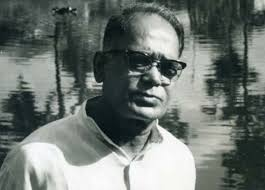
#JayaprakashNarayan was from Bihar’s Saran district, his father was a lower Government official, and he later went on to study in the US too.
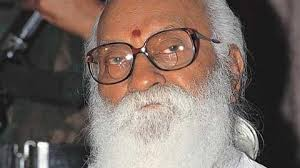
Nanaji on the other hand, was from Maharashtra’s Hingoli district, had a tough childhood., and later rose up the ranks of the RSS.
Nanaji on the other hand, was from Maharashtra’s Hingoli district, had a tough childhood., and later rose up the ranks of the RSS.
Their ideologies too differed, where JP was socialist, left leaning, Nanaji’s was more rooted in the Integral Humanism of the Jan Sangh. And yet their paths came together during the Emergency and events preceeding it.
If JP was the face of the Total Revolution, Nanaji was the brains behind it, as well as the Janata alliance that came later. JP took the Revolution to the masses, Nanaji did the background work of raising funds, coordinating, and the underground movement.
Nanaji was one of the men who built up the Jan Sangh in UP, brick by brick, when the then chief Guru Golwalkar had sent him there as an RSS pracharak to Gorakhpur. Arriving at a place, that had no funds, no base, no organization, he undertook the task of building it from scratch
Within 3 years there were 250 Shakhas just in Gorakhpur itself, the also established the first Saraswati Shishu Mandir there in 1950. If BJP has a solid base in Gorakhpur, the reason is the foundation laid by Nanaji there.
He was one of the trilogy, who spread the Jan Sangh in UP, the others being Deen Dayal Upadhyaya and Atal Bihari Vajpayee. Upadhyaya provided the ideological soul of the Sangh, Vajpayee took the message to the masses, while Nanaji was the one who did the background work.
#NanajiDeshmukh
He was one of the trilogy, who spread the Jan Sangh in UP, the others being Deen Dayal Upadhyaya and Atal Bihari Vajpayee. Upadhyaya provided the ideological soul of the Sangh, Vajpayee took the message to the masses, while Nanaji was the one who did the background work.
#NanajiDeshmukh
Even when RSS was banned following the assassination of Mahatma Gandhi, it was Nanaji who kept things going, with publications from the underground. On the other hand, JP’s trajectory was somewhat different.
In a sense like Nanaji, he did have to work hard for his education. Nanaji sold vegetables as a young boy to support himself, while as a student in US, JP did a whole lot of odd jobs from picking grapes, washing dishes, as a mechanic at a garage to even a slaughter house.
In a sense like Nanaji, he did have to work hard for his education. Nanaji sold vegetables as a young boy to support himself, while as a student in US, JP did a whole lot of odd jobs from picking grapes, washing dishes, as a mechanic at a garage to even a slaughter house.
Unable to pay the fees at Berkeley, JP had to transfer from one University to another in US, before graduating in sociology finally. It was his experiences with the working class, that attracted JP to the Leftist ideology, especially the works of Marx and M.N.Roy.
Even when he joined the Congress, during the Freedom struggle, JP was part of the Congress Socialist Group, a left wing group within the party, that included Ram Manohar Lohia, Ashok Mehta and was headed by Acharya Narendra Dev.
One of the more inspiring anecdotes relates to the Quit India struggle, when he went underground, and had a daring escape from the Hazaribagh Central Jail, and walked to Gaya, along with his associate Yogendra Shukla whom he carried on his shoulders. #JayaprakashNarayan
One of the more inspiring anecdotes relates to the Quit India struggle, when he went underground, and had a daring escape from the Hazaribagh Central Jail, and walked to Gaya, along with his associate Yogendra Shukla whom he carried on his shoulders. #JayaprakashNarayan
Though on the other side of the political divide, Nanaji Deshmukh, enjoyed a respect and support across the entire political spectrum. By 1957 he had established the Jan Sangh across UP, and it soon became a powerful political force in it’s own right.
The first ever non Congress Govt in UP, was due to the efforts of Nanaji, who forged an alliance with Chaudhary Charan Singh and Ram Manohar Lohia, the first ever such coalition.
The first ever non Congress Govt in UP, was due to the efforts of Nanaji, who forged an alliance with Chaudhary Charan Singh and Ram Manohar Lohia, the first ever such coalition.
Jan Sangh was to the Right, Conservative, while Lohia represented the more Left liberal aspect, and Charan Singh represented the farming community. Nanaji in fact outwitted Chandra Bhanu Gupta, considered a political giant, not once but thrice. #NanajiDeshmukh
He first managed to get Gupta’s nominee defeated in the Rajya Sabha, and then forging an alliance with other socialist groups defeated him twice in Lucknow and Maudaha later. Gupta had immense respect for Nanaji, whom he called a modern day “Nana Phadnavis”.
At some point of time, these two great men would find their paths intersecting. And it came in 1974 during the Sampoorna Kranti( Total Revolution) launched by JP against Indira Gandhi’s misrule, the ever increasing corruption and rising inflation.
At some point of time, these two great men would find their paths intersecting. And it came in 1974 during the Sampoorna Kranti( Total Revolution) launched by JP against Indira Gandhi’s misrule, the ever increasing corruption and rising inflation.
And it was during a rally at Patna, where #JayaprakashNarayan was leading a huge rally on the streets against Indira Gandi's rule. As he led the procession, he began to be brutally lathicharged by the police.
It was Nanaji who shielded JP from the police blows, leading him away to safety then.
It was Nanaji who shielded JP from the police blows, leading him away to safety then.
When Emergency was imposed on June 25, 1975, JP was among those arrested, it was Nanaji who kept the Underground movement alive.
He managed to get together a small group that consisted among others Subramaniam Swamy, M.L.Khurana, Ravindra Verma and Dattopant Thengadi.
He managed to get together a small group that consisted among others Subramaniam Swamy, M.L.Khurana, Ravindra Verma and Dattopant Thengadi.
Nanaji was himself a wanted man, and managed to give the Government a slip during the Emergency.
Publishing underground news bulletins and pamphlets, setting up of underground cells, staging protest demonstrations, raising funds, helping the families of those detained. All this was coordinated by #NanajiDeshmukh during Emergency.
Publishing underground news bulletins and pamphlets, setting up of underground cells, staging protest demonstrations, raising funds, helping the families of those detained. All this was coordinated by #NanajiDeshmukh during Emergency.
Nanaji himself was arrested later on June 29, 1979, but by then he had put the entire network into place, which ensured, that the underground movement would not die out. Both JP and Nanaji were arrested during the Emergency, but their spirit would be the guiding force.
It was therefore not a surprise that when Indira lifted the Emergency and elections were held in 1977, Nanaji once again came to the forefront as the architect of the Janata alliance, which he put together using his contacts,that consisted of Jan Sangh, Janata Party.
“Singhasan Khali Karo ke Janata aati hai” thundered JP during the Ramlila rally of 1975, that quote was from the famous poet Ramdhari Singh Dinkar. JP was greatly influenced by Dinkar’s works, and the latter was a great admirer of JP, both these men shared a close bonding.
It is said, that when JP was seriously ill, Dinkar had gone to Tirupati to pray for his health, saying that if there was a life to be taken it was his. Coincidentally, Dinkar passed away just when JP was recovering from his illness. #JayaprakashNarayan
JP was detained at Chandigarh, he however was later release due to a kidney problem was on dialysis for long. He managed to see his dream come true, of the Janata Government come into power, and Indira defeated. #JayaprakashNarayan
However he would be saddened by the way, the Janata leaders wasted the mandate with their internal squabbles and ego clashes. Maybe it was for this reason, that Nanaji did not want to be a part of the Government.
At a later stage in his life, Nanaji often remarked that he admired the Vanavasi Ram, more than the Raja Ram. He actually walked the talk, of retiring from politics, and dedicating his life to social service.
At a later stage in his life, Nanaji often remarked that he admired the Vanavasi Ram, more than the Raja Ram. He actually walked the talk, of retiring from politics, and dedicating his life to social service.
Nanaji knew what poverty was, he had grown up with it, and the upliftment of the poorer sections was his life long aim. The Deen Dayal Research Institute was set up by Nanaji to promote grass roots level development in 1969.
The motivation was a visit to Chitrakoot, a place that was holy due to it’s association with the Ramayana, where Lord Ram, had spent his exile in. The place that Nanaji visited though was a far cry from what he had read, steeped in backwardness, illiteracy and superstition.
#NanajiDeshmukh
The motivation was a visit to Chitrakoot, a place that was holy due to it’s association with the Ramayana, where Lord Ram, had spent his exile in. The place that Nanaji visited though was a far cry from what he had read, steeped in backwardness, illiteracy and superstition.
#NanajiDeshmukh
Moved by it’s condition, Nanaji made a resolve to change the face of Chitrakoot and also make it the base for his social reforms. “Har Haath ko denge Kaam, har Kheth ko denge Paane” ( Work to All, Water to every field) was his motto.
He did pioneering studies in anti poverty programs, cottage industry and rural development. Gonda in UP, and Beed in Maharashtra, two of the country’s most backward districts, was where Nanaji focused his efforts on.
He did pioneering studies in anti poverty programs, cottage industry and rural development. Gonda in UP, and Beed in Maharashtra, two of the country’s most backward districts, was where Nanaji focused his efforts on.
And that led to the establishment of the Chitrakoot Grameen Viswavidyalaya, which he named after Mahatma Gandhi. It was India’s first ever rural University, and Nanaji was it’s first chancellor.
Neither #JayaprakashNarayan
nor #NanajiDeshmukh
are around now, but their legacy and spirit will always continue to inspire. Two men who were true karmayogis, for whom power was not an end in itself. Two men, who led others to power, but did not accept it themselves. #Naman
nor #NanajiDeshmukh
are around now, but their legacy and spirit will always continue to inspire. Two men who were true karmayogis, for whom power was not an end in itself. Two men, who led others to power, but did not accept it themselves. #Naman

Loading suggestions...