

Today is #TamilNewYear day. But which year? For e.g. it is 2024 in English Calendar. What is it in Tamil Calendar? It is 5125 years in Kaliyuga. This Kali epoch has a very special astronomical significance which is detailed in this thread. 1/n
x.com
x.com
In short, a unique conjunction of all visible planets happened in Aries (Mesha) 5125 years before. Hence Yugadi (start of Yuga) and the solar transition into Mesha which heralds #TamilPuthandu happened on that day. If so why are they celebrated on different days now? 2/n
Due to relative speeds of revolution of Earth and Moon every lunar year is 11 days shorter than a Solar year. This is the reason for the drift. But there are times when both #Ugadi & #TamilNewYear were celebrated on the same day. One such occurence was in the year 1983. 3/n

Unlike English Calendar there is also a name for this year. It is Krodhi. We also know that there are 60 years with a distinct name and after one set of 60 years is over, they repeat again. So the next obvious question is why only 60 years? 4/n
Traditionally time keeping is one of the important activities performed by human beings. In English Calendar starting from seconds, we have minutes, hours, months, years, decades & centuries. It is interesting to note that decades and centuries are grouped in multiples of 10. 5/n
But the other time scales in English like 60 seconds, 24 hours & 12 months are in multiples of 6. In Indian calendars, grouping of years into a 60 year cycle fits into an order based on multiples of 6. But the question still remains why 60, why not any other multiple of 6? 6/n
We have seen that the Indian Calendaring systems of days, months, years are entirely based on astronomical conjunctions. Hence we need to look at other conjunctions to solve this riddle. so we will have to look at those planets that have a longer period of revolution. 7/n
Jupiter and Saturn are the major planets in the solar system that are much larger than that of Earth, have a significant gravitational effect and fits nicely into scheme of things for a larger grouping of years. So let us explore if their periodicities provide a clue 8/n
Let us first look at Jupiter which takes approximately 1 year to move through a constellation. So it takes 12 years for one complete revolution. Just like there are 12 months in a year, we can imagine one Solar year as a month in the Jupiter year. Set of 5 such cycles is 60. 9/n
Adding Saturn into the mix makes things interesting. Saturn takes about 2.5 years to move from one constellation to other and takes about 30 years to complete one full revolution around the Sun. So we have 12 years for Jupiter & 30 years for Saturn to complete a revolution. 10/n
Thus for Jupiter & Saturn to meet again at the same constellation would take LCM of 12 & 30 which is 60. Thus if Sun, Moon, Jupiter & Saturn all started from Aries it would take about 60 years to meet there again. But this is assuming the revolutions to be whole numbers. 11/n
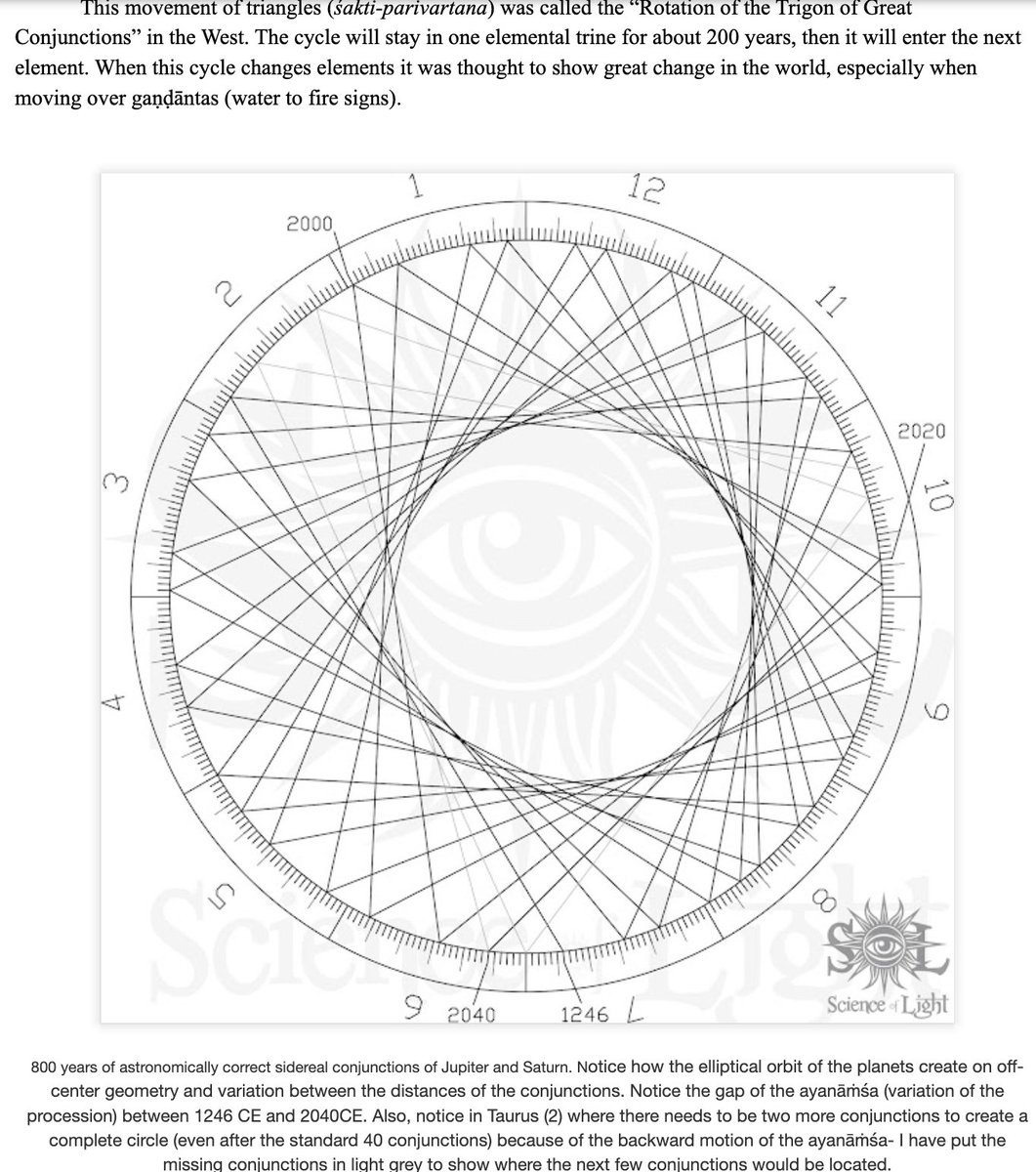
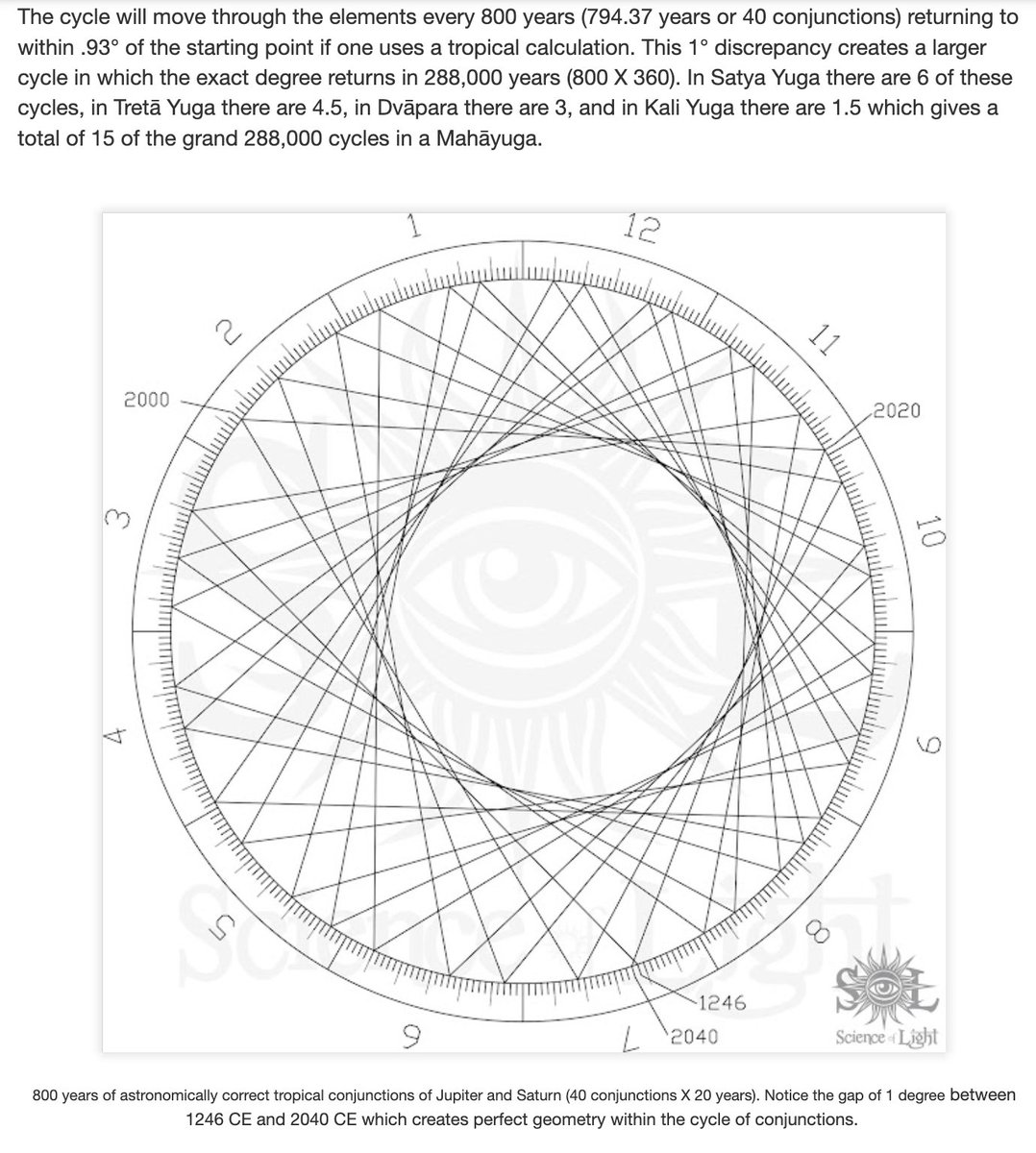
Over long period of time considering the precession of equinox & actual orbital speeds of Jupiter & Saturn, this conjunction happens at a place in sky slightly different from where it happened last time. We can see this when considering the conjunction of Saturn & Jupiter. 12/n
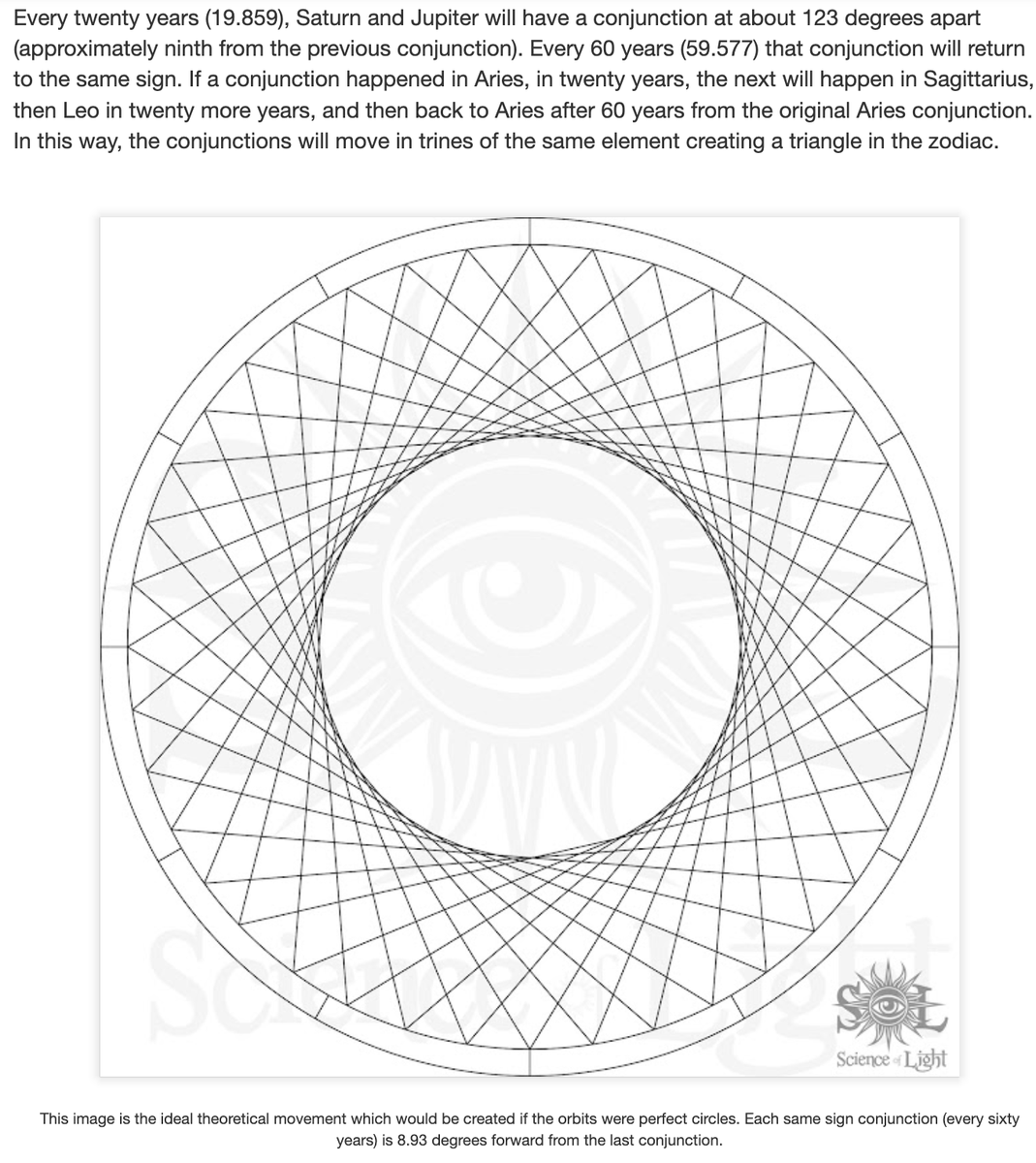
Every 20 years, conjunction of Jupiter & Saturn happens almost 120 degrees away. After 3 such conjunctions they meet almost close to where they started off. This three sets of 20 yrs constitute a 60 yr period which is basis for Tamil Calendar cycle. 13/n
svatantranatha.blogspot.com
svatantranatha.blogspot.com

During the times of yore when timekeeping was integrally tied to observing the planets, stars & correlating them with weather & seasons these may have been important but why care about them now? We can look at two different perspectives 1.Scientific 2.Civilizational memory 14/n
For human sustenance, we need to have a much longer perspective of the changes to #Climate. We need to investigate if there are intrinsic cycles created because of the interaction between various objects in the solar system. Found a research that is relevant in this context 15/n
Apparently there is a 60 year temperature cycle. Researchers while trying to investigate the cause have found Jupiter & Saturn influencing interplanetary dust which in turn modulates the formation of the clouds, thus, driving climate changes. 16/n
agupubs.onlinelibrary.wiley.com
agupubs.onlinelibrary.wiley.com

The 60 year climate cycle may or may not be related to the ancient calendar. Given the scientific advancement, those who value research would try to find if there is correlation between planetary conjunctions and Earth's climate, weather systems & its influence 17/n
But in TN, in the name of rationalism what we are seeing is trivializing of civilizational memories by creating memes on allegorical stories, alter history for political reasons, rather than use the codified astronomical observations for long term benefit of humans 18/n
Most festivals in India are based on astronomical events, but unfortunately discussions are centred on North vs South rather than understanding the basis of festivals. In a way our ancestors integrated astronomical observations into our day to day life through festivals. 19/n
Just as TN celebrates #TamilPuthandu we have #Vishu, #Baisakhi, #RongaliBihu, #PohelaBoishakh in other parts of the country. The names may be different but the occassion is the same. So it is better we focus on understanding the unity in diversity 20/n.
x.com
x.com
Interestingly the epoch of Kali which signifies a special conjunction was preserved in India, that too in TN. But it is in TN where a sustained effort is undertaken to break the connect with the past. #TamilPuthandu is a civilizational memory that should be preserved. 21/n
جاري تحميل الاقتراحات...