

Putting this🧵out to clear some misconceptions on #farmerprotest2024 and its demand for a legal backing to #MSP. Will it bankrupt the exchequer? Do only rich farmers benefit from MSP? Will it drive away private buyers?
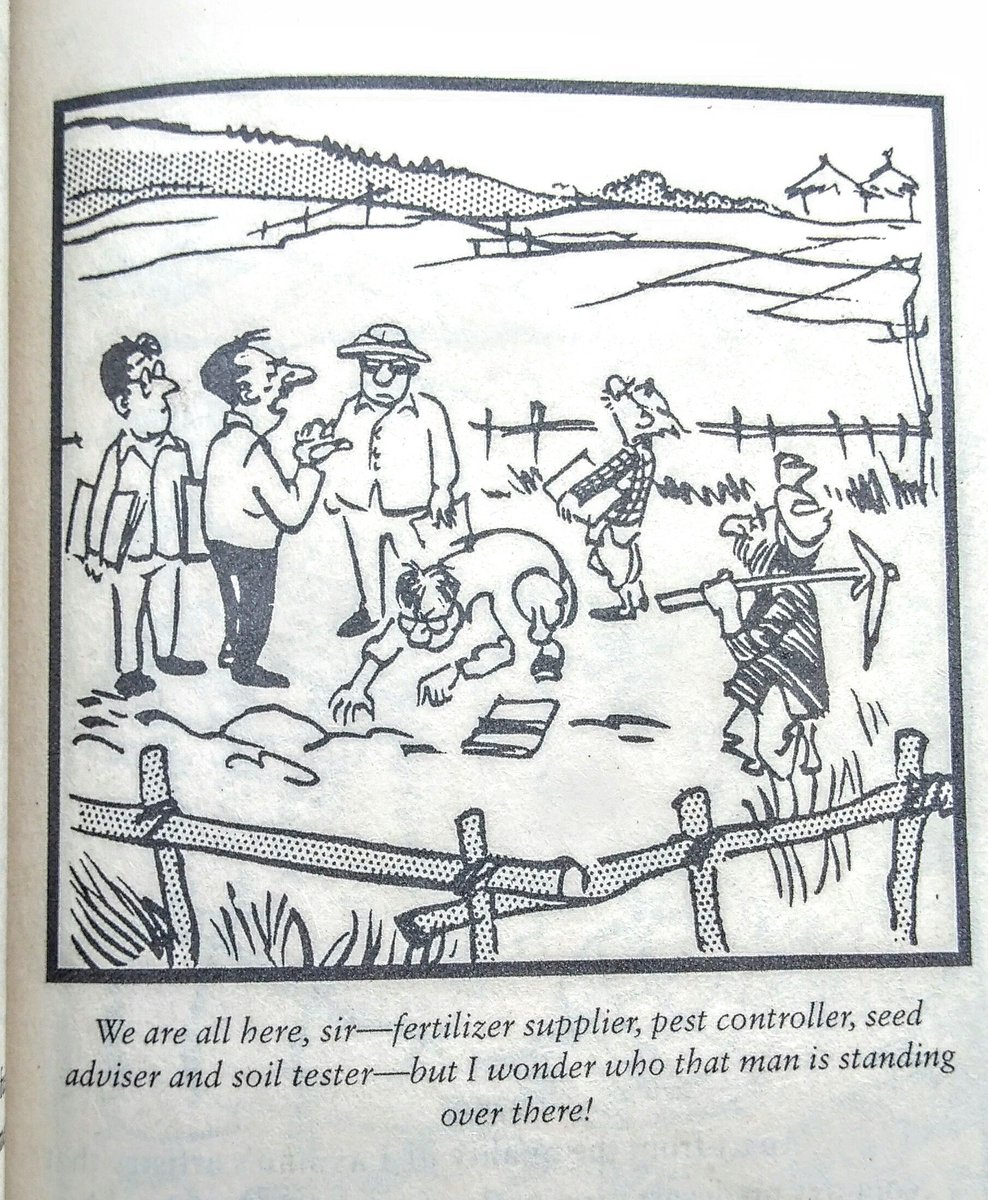
Illustration: Where the Indian Farmer stands (aside)… from the great R K Laxman
Illustration: Where the Indian Farmer stands (aside)… from the great R K Laxman
Why guarantee a minimum price and why it is important?
Minimum Support Price or MSP is calculated to ensure a reasonable return over cost of production. Making it statutory is a recognition that trade below this minimum price is UNFAIR and EXPLOITATIVE. Think of it as statutory minimum wages which are already in place. A responsible food company, trader and the government are expected to pay this minimum price to the farmer. The government had a stated goal to double farmer incomes— its expected that farmers will expect a fair price.
With a population of over 1.4 billion, food security is too important for India to leave to private markets. When the Ukraine war broke out and pushed wheat prices to record highs, India could tame consumer prices reasonably by using public food stocks, MSP purchases from farmers and export curbs. MSP was critical to the green revolution strategy which pulled India out of a terrible food shortage. It is needed today to guard against future shortages arising out of repeated climate shocks.
A minimum price guarantee ensures that farmers do not lose interest and the country has enough supplies of different food commodities. With regular climate shocks our public stocks are no longer overflowing. Which is why the government had to step in and curb rice and wheat exports. Farmers paid a price for this— they would have earned more if were allowed to supply freely to international markets. They did not hit the streets then. They are doing it now to ensure fair prices in the future.
Minimum Support Price or MSP is calculated to ensure a reasonable return over cost of production. Making it statutory is a recognition that trade below this minimum price is UNFAIR and EXPLOITATIVE. Think of it as statutory minimum wages which are already in place. A responsible food company, trader and the government are expected to pay this minimum price to the farmer. The government had a stated goal to double farmer incomes— its expected that farmers will expect a fair price.
With a population of over 1.4 billion, food security is too important for India to leave to private markets. When the Ukraine war broke out and pushed wheat prices to record highs, India could tame consumer prices reasonably by using public food stocks, MSP purchases from farmers and export curbs. MSP was critical to the green revolution strategy which pulled India out of a terrible food shortage. It is needed today to guard against future shortages arising out of repeated climate shocks.
A minimum price guarantee ensures that farmers do not lose interest and the country has enough supplies of different food commodities. With regular climate shocks our public stocks are no longer overflowing. Which is why the government had to step in and curb rice and wheat exports. Farmers paid a price for this— they would have earned more if were allowed to supply freely to international markets. They did not hit the streets then. They are doing it now to ensure fair prices in the future.
Will a legal backing to MSP drain govt finances?
No. When prices dip below MSP, the government has to step in buy a small quantity to lift market prices higher. It does not have to buy the entire produce. Here’s a simple example: Suppose farmers produced 100 kg of lentils in a year and total demand is 95 kg. Due to excess production, market price dips below MSP. If the government steps in to buy, say just 10 kg, it will lift market prices higher. Not all farmers have to sell to the government, they will automatically benefit from these higher market prices. The stocks can be sold by the govt during off-season when market prices are higher. MSP, therefore, is an excellent food policy tool for both consumers and farmers.
A calculation by CRISIL research shows that in 2022-23 the government would have spent about Rs 21,000 crore to implement this policy. The amount is low because many crop prices are now above MSP. In years when more crop prices plummet the expenses will go up, say Rs 35-40,000 cr but not to astronomical highs like Rs 10-15 lakh cr as some are claiming.
No. When prices dip below MSP, the government has to step in buy a small quantity to lift market prices higher. It does not have to buy the entire produce. Here’s a simple example: Suppose farmers produced 100 kg of lentils in a year and total demand is 95 kg. Due to excess production, market price dips below MSP. If the government steps in to buy, say just 10 kg, it will lift market prices higher. Not all farmers have to sell to the government, they will automatically benefit from these higher market prices. The stocks can be sold by the govt during off-season when market prices are higher. MSP, therefore, is an excellent food policy tool for both consumers and farmers.
A calculation by CRISIL research shows that in 2022-23 the government would have spent about Rs 21,000 crore to implement this policy. The amount is low because many crop prices are now above MSP. In years when more crop prices plummet the expenses will go up, say Rs 35-40,000 cr but not to astronomical highs like Rs 10-15 lakh cr as some are claiming.
Isn’t the govt already spending lakhs of crores in MSP subsidies?
The govt is estimated to spend Rs 2 lakh crore in 2022-23 for the food security scheme. Most of this money goes to the 80 cr consumer beneficiaries, not farmers. Let’s understand this with a simple example: say, market price of rice is Rs 23 per kg and MSP is Rs 25 per kg. The govt buys 100 kg from farmers at MSP, to supply to poor consumers for free. So, its spending on farmers is just Rs 200 (Rs 25- Rs23 X 100 kg). Of the total food subsidy bill of Rs 2,500, the chunk of it—Rs 2300—goes to consumers. The govt could have purchased 100 kg at MSP and sold it in the market at a loss of Rs 200—which is the producer subsidy going to farmers.
The govt is estimated to spend Rs 2 lakh crore in 2022-23 for the food security scheme. Most of this money goes to the 80 cr consumer beneficiaries, not farmers. Let’s understand this with a simple example: say, market price of rice is Rs 23 per kg and MSP is Rs 25 per kg. The govt buys 100 kg from farmers at MSP, to supply to poor consumers for free. So, its spending on farmers is just Rs 200 (Rs 25- Rs23 X 100 kg). Of the total food subsidy bill of Rs 2,500, the chunk of it—Rs 2300—goes to consumers. The govt could have purchased 100 kg at MSP and sold it in the market at a loss of Rs 200—which is the producer subsidy going to farmers.
Do only rich farmers from Punjab and Haryana benefit from MSP?
Farmers from Punjab and Haryana benefit disproportionately from MSP purchases of rice and wheat. But data from NSO’s Situation Assessment Survey for the year 2018-19 show that 15-19% of paddy growers from across India benefited from MSP purchases. In a poor state like Chhattisgarh, 75% of paddy farmers benefited from MSP. The rural economy of Madhya Pradesh got a facelift with MSP based wheat purchases.
Farmers from Punjab and Haryana benefit disproportionately from MSP purchases of rice and wheat. But data from NSO’s Situation Assessment Survey for the year 2018-19 show that 15-19% of paddy growers from across India benefited from MSP purchases. In a poor state like Chhattisgarh, 75% of paddy farmers benefited from MSP. The rural economy of Madhya Pradesh got a facelift with MSP based wheat purchases.
Why are Punjab farmers at the forefront of these protests?
Rice wheat cycle has depleted soils and groundwater. They want to move to less intensive crops like pulses and oilseeds. But there is no assured MSP based purchase for these crops. They want assured MSP for a wider range to crops to ensure future viability of farming.
Rice wheat cycle has depleted soils and groundwater. They want to move to less intensive crops like pulses and oilseeds. But there is no assured MSP based purchase for these crops. They want assured MSP for a wider range to crops to ensure future viability of farming.
What about MSP’s impact on food inflation?
There is a risk to higher food inflation following more MSP based interventions. But recent experience shows its not unmanageable. Post Covid, the govt doubled foodgrain supplied under the food security scheme. It did not lead to chaos. In fact, MSP interventions and public food stocks allowed the govt to manage inflation better.
There is a risk to higher food inflation following more MSP based interventions. But recent experience shows its not unmanageable. Post Covid, the govt doubled foodgrain supplied under the food security scheme. It did not lead to chaos. In fact, MSP interventions and public food stocks allowed the govt to manage inflation better.
Finally, will a legal guarantee to MSP chase private buyers away?
Just because there is a minimum wage law does not mean that the private sector stops hiring workers. For sugar, a statutory minimum price is already in place. And large private sugar mills pay this minimum price to farmers. Of course, in glut years dues to farmers pile up—but the costs of settling those dues are not astronomically high. Food manufacturers already pay a price higher than MSP for premium produce like organic staples.
Enforcing a statutory MSP is not easy—it needs government agencies to be agile and step in when needed. Like they tend to when consumer prices shoot up. Implementation may not be perfect. But acknowledging that farmers need a viable minimum price to continue will mark a beginning. One cannot build a prosperous nation riding on someone else’s misery—be it gig workers or indebted farmers.
Just because there is a minimum wage law does not mean that the private sector stops hiring workers. For sugar, a statutory minimum price is already in place. And large private sugar mills pay this minimum price to farmers. Of course, in glut years dues to farmers pile up—but the costs of settling those dues are not astronomically high. Food manufacturers already pay a price higher than MSP for premium produce like organic staples.
Enforcing a statutory MSP is not easy—it needs government agencies to be agile and step in when needed. Like they tend to when consumer prices shoot up. Implementation may not be perfect. But acknowledging that farmers need a viable minimum price to continue will mark a beginning. One cannot build a prosperous nation riding on someone else’s misery—be it gig workers or indebted farmers.
Loading suggestions...