

The final day of #JanuAirway 2024 and we've gone back to where it all started in 2021; Oxygen. The meaningful delivery of adequate oxygen is the fundamental aim of all airway management. Here’s a #OnePager covering the basics of oxygen physiology 1/7
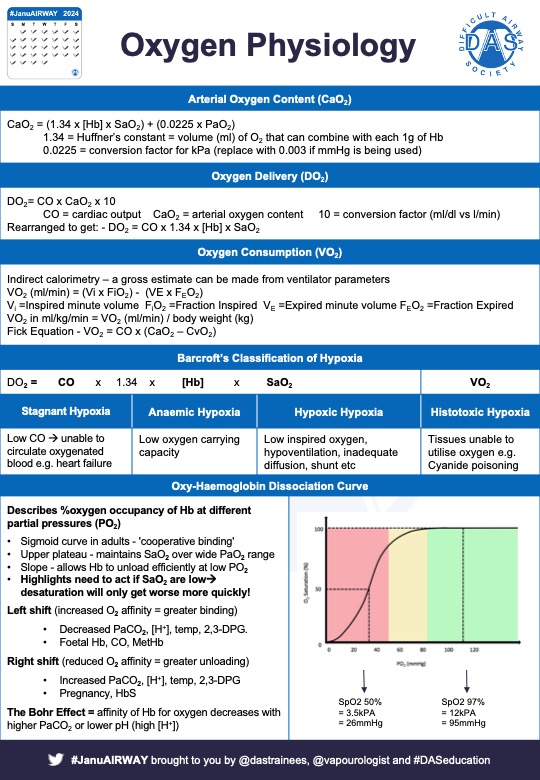
Knowledge of the three basic equations for oxygen physiology is essential: -
1. Arterial Oxygen Content
2. Oxygen Delivery
3. Oxygen Consumption
They can steer us towards various physiological parameters that we can manipulate to treat hypoxia / hypoxaemia. 2/7
#JanuAIRWAY
1. Arterial Oxygen Content
2. Oxygen Delivery
3. Oxygen Consumption
They can steer us towards various physiological parameters that we can manipulate to treat hypoxia / hypoxaemia. 2/7
#JanuAIRWAY
Oxygen cascade shows levels & processes involved & differentials for hypoxia/hypoxaemia: -
1. Oxygenation (e.g. low O2)
2. Diffusion (e.g. pulm fibrosis)
3. Ventilation (bullae)
4. Perfusion (low cardiac output)
5. O2 carriage (anaemia)
6. O2 demand / use (sepsis)
#JanuAIRWAY 3/7
1. Oxygenation (e.g. low O2)
2. Diffusion (e.g. pulm fibrosis)
3. Ventilation (bullae)
4. Perfusion (low cardiac output)
5. O2 carriage (anaemia)
6. O2 demand / use (sepsis)
#JanuAIRWAY 3/7
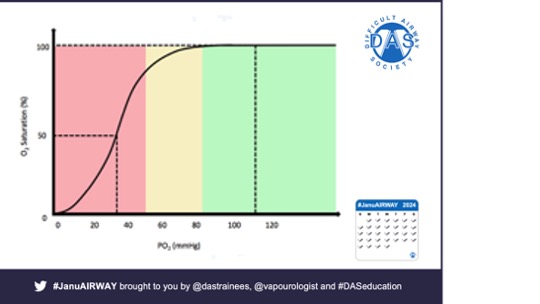
Oxy-Hb curve shows why the focus in desaturation must be getting oxygen in, when SpO2 starts to fall, it’s slow to start then precipitous. The benefit is, often a little oxygen going back in, in general means a rapid rise back to safety. 4/7
#JanuAIRWAY
#JanuAIRWAY
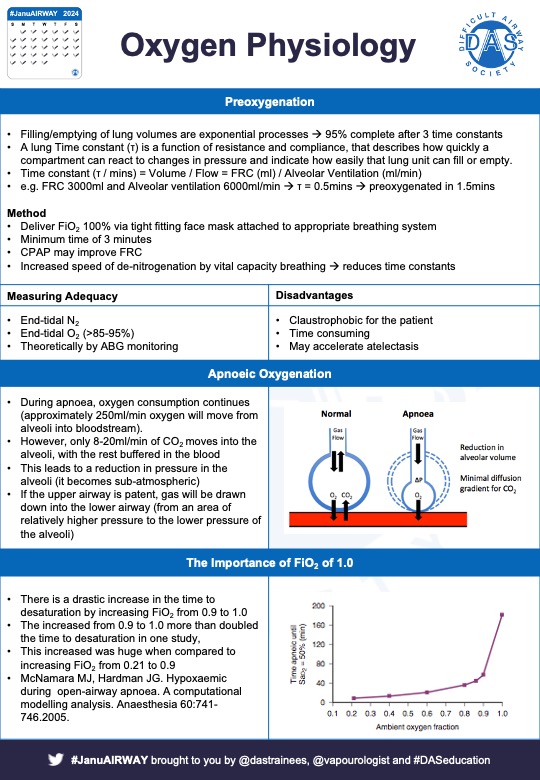
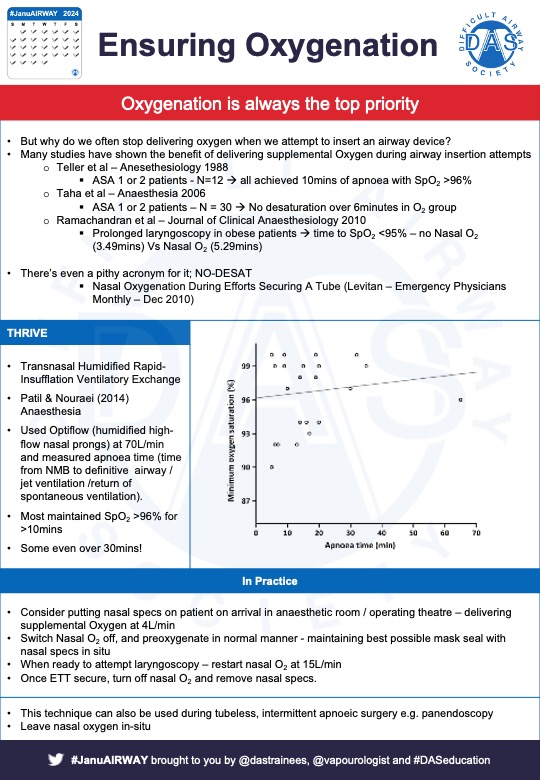
Pre/apnoeic oxygenation are key weapons, but must be done well. Patience, vital capacity breaths +/- high flow nasal oxygen are key. Here are #OnePagers on pre-oxygenation and NO-DESAT by @airwaycam & THRIVE by Anil Patel and @larynxUK. #JanuAIRWAY 5/7
Here are some articles that might be of interest: -
a) pubmed.ncbi.nlm.nih.gov
b) pubmed.ncbi.nlm.nih.gov
c) epmonthly.com
If you have any others of interest, tweet them to us for inclusion next time
a) pubmed.ncbi.nlm.nih.gov
b) pubmed.ncbi.nlm.nih.gov
c) epmonthly.com
If you have any others of interest, tweet them to us for inclusion next time

epmonthly.com/article/no-des…
NO DESAT! | Emergency Physicians Monthly
A simple modification in practice can protect your patients from hypoxia during emergency intubation...

pubmed.ncbi.nlm.nih.gov/16029221/
Hypoxaemia during open-airway apnoea: a computational modelling analysis - PubMed
Hypoxaemia during open-airway apnoea, e.g. during brainstem death testing, may cause organ damage. T...

pubmed.ncbi.nlm.nih.gov/25388828/
Transnasal Humidified Rapid-Insufflation Ventilatory Exchange (THRIVE): a physiological method of increasing apnoea time in patients with difficult airways - PubMed
Emergency and difficult tracheal intubations are hazardous undertakings where successive laryngoscop...
That's it for #JanuAIRWAY2024. Thanks for joining us. Check out the compilation& once @vapourologist has recovered more content will be added! 7/7
*Disclaimer:Inclusion of content (equipment, techniques and scoring systems etc.) in #JanuAIRWAY does not constitute DAS endorsement
*Disclaimer:Inclusion of content (equipment, techniques and scoring systems etc.) in #JanuAIRWAY does not constitute DAS endorsement

Loading suggestions...