

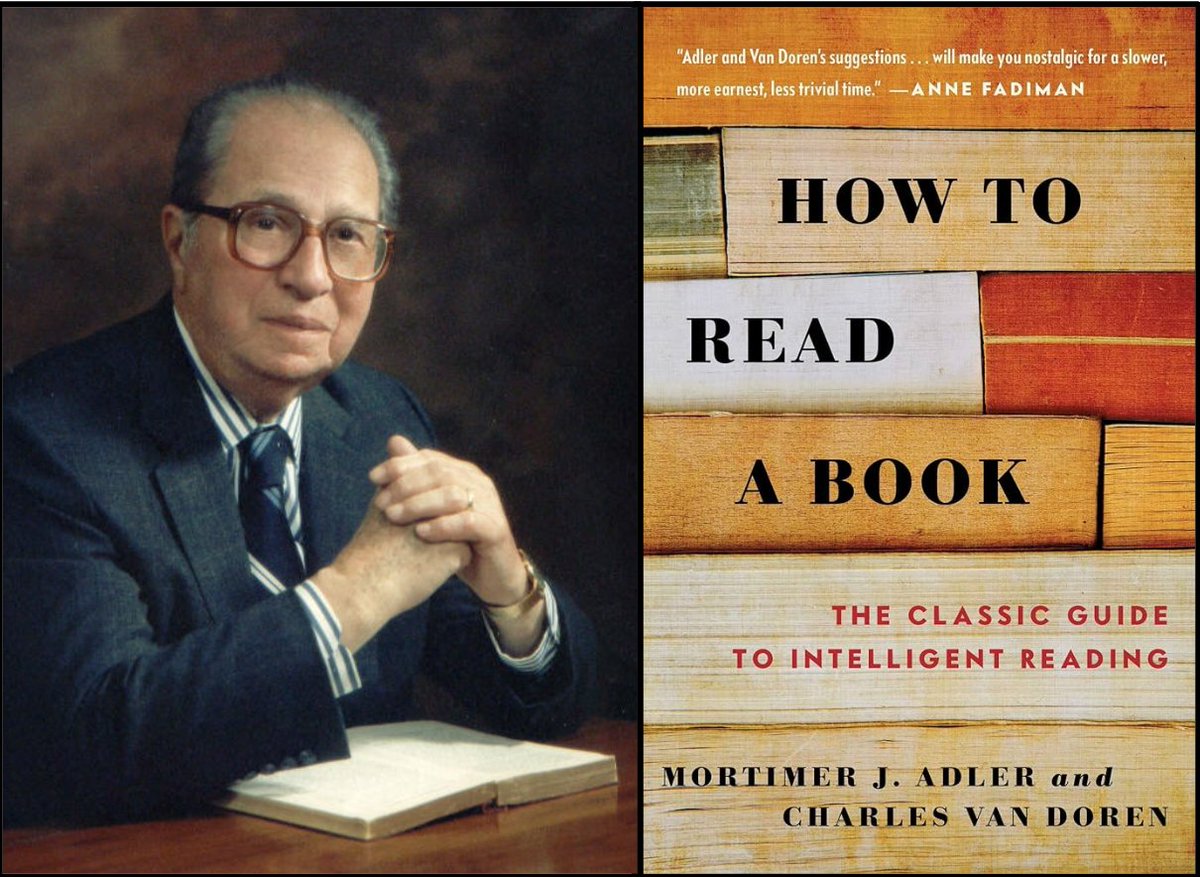
Mortimer Adler literally wrote the book on how to read a book.
Here are 27 powerful reading tips from him:
1) In the case of good books, the point is not to see how many of them you can get through, but rather how many can get through to you.
2) It’s the hard books that count. Raking is easy, but all you get is leaves; digging is hard, but you might find diamonds.
3) Every book should be read no more slowly than it deserves and no more quickly than you can read it with satisfaction and comprehension.
4) Ask questions while you read–questions that you yourself must answer in the course of reading.
5) Read not to contradict and confute; nor to believe and take for granted; nor to find talk and discourse; but to weigh and consider.
6) A good book can teach you about the world and about yourself. You learn more than how to read better; you also learn more about life.
7) The great authors were great readers, and one way to understand them is to read the books they read.
8) A good book deserves an active reading. The activity of reading does not stop with the work of understanding what a book says. It must be completed by the work of criticism, the work of judging.
9) If a book is easy and fits nicely into all your language conventions and thought forms, then you probably will not grow much from reading it. It may be entertaining, but not enlarging to your understanding.
10) The truly great books are the few books that are over everybody's head all of the time.
11) If you never ask yourself any questions about the meaning of a passage, you cannot expect the book to give you any insight you don't already possess
12) You will not improve as a reader if all you read are books that are well within your capacity. You must tackle books that are beyond you, or, as we have said, books that are over your head. Only books of that sort will make you stretch your mind. And unless you stretch, you will not learn.
13) Reading is like skiing. When done well, when done by an expert, both reading and skiing are graceful, harmonious, activities. When done by a beginner, both are awkward, frustrating, and slow.
14) The reader who fails to ponder, or at least mark, the words he does not understand is headed for disaster.
15) In tackling a difficult book for the first time, read it through without ever stopping to look up or ponder the things you do not understand right away.
16) If you ask a book a question, you must answer it yourself. In this respect a book is like nature or the world. When you question it, it answers you only to the extent that you do the work of thinking and analysis yourself.
17) When we speak of someone as ‘well-read,’ we should have this ideal in mind. Too often, we use that phrase to mean the quantity rather than the quality of reading. A person who has read widely but not well deserves to be pitied rather than praised.
18) There are, of course, many books worth reading well. There is a much larger number that should be only inspected. To become well-read, in every sense of the word, one must know how to use whatever skill one possesses with discrimination—by reading every book according to its merits.
19) A good book does reward you for trying to read it. The best books reward you most of all.
20) There is no book so bad but something good may be found in it.
21) Reading a book should be a conversation between you and the author. Presumably he knows more about the subject than you do; if not, you probably should not be bothering with his book.
22) Marking a book is literally an expression of your differences or your agreements with the author. It is the highest respect you can pay him.
23) Do not try to understand every word or page of a difficult book the first time through. Race through even the hardest book. You will then be prepared to read it well the second time.
24) Great speed in reading is a dubious achievement; it is of value only if what you have to read is not worth reading.
25) Full ownership of a book only comes when you have made it a part of yourself, and the best way to make yourself a part of it—which comes to the same thing—is by writing in it.
26) To use a good book as a sedative is a conspicuous waste.
27) The most important thing to remember about any practical book is that it can never solve the practical problems with which it is concerned...a practical problem can only be solved by action itself.
Here are 27 powerful reading tips from him:
1) In the case of good books, the point is not to see how many of them you can get through, but rather how many can get through to you.
2) It’s the hard books that count. Raking is easy, but all you get is leaves; digging is hard, but you might find diamonds.
3) Every book should be read no more slowly than it deserves and no more quickly than you can read it with satisfaction and comprehension.
4) Ask questions while you read–questions that you yourself must answer in the course of reading.
5) Read not to contradict and confute; nor to believe and take for granted; nor to find talk and discourse; but to weigh and consider.
6) A good book can teach you about the world and about yourself. You learn more than how to read better; you also learn more about life.
7) The great authors were great readers, and one way to understand them is to read the books they read.
8) A good book deserves an active reading. The activity of reading does not stop with the work of understanding what a book says. It must be completed by the work of criticism, the work of judging.
9) If a book is easy and fits nicely into all your language conventions and thought forms, then you probably will not grow much from reading it. It may be entertaining, but not enlarging to your understanding.
10) The truly great books are the few books that are over everybody's head all of the time.
11) If you never ask yourself any questions about the meaning of a passage, you cannot expect the book to give you any insight you don't already possess
12) You will not improve as a reader if all you read are books that are well within your capacity. You must tackle books that are beyond you, or, as we have said, books that are over your head. Only books of that sort will make you stretch your mind. And unless you stretch, you will not learn.
13) Reading is like skiing. When done well, when done by an expert, both reading and skiing are graceful, harmonious, activities. When done by a beginner, both are awkward, frustrating, and slow.
14) The reader who fails to ponder, or at least mark, the words he does not understand is headed for disaster.
15) In tackling a difficult book for the first time, read it through without ever stopping to look up or ponder the things you do not understand right away.
16) If you ask a book a question, you must answer it yourself. In this respect a book is like nature or the world. When you question it, it answers you only to the extent that you do the work of thinking and analysis yourself.
17) When we speak of someone as ‘well-read,’ we should have this ideal in mind. Too often, we use that phrase to mean the quantity rather than the quality of reading. A person who has read widely but not well deserves to be pitied rather than praised.
18) There are, of course, many books worth reading well. There is a much larger number that should be only inspected. To become well-read, in every sense of the word, one must know how to use whatever skill one possesses with discrimination—by reading every book according to its merits.
19) A good book does reward you for trying to read it. The best books reward you most of all.
20) There is no book so bad but something good may be found in it.
21) Reading a book should be a conversation between you and the author. Presumably he knows more about the subject than you do; if not, you probably should not be bothering with his book.
22) Marking a book is literally an expression of your differences or your agreements with the author. It is the highest respect you can pay him.
23) Do not try to understand every word or page of a difficult book the first time through. Race through even the hardest book. You will then be prepared to read it well the second time.
24) Great speed in reading is a dubious achievement; it is of value only if what you have to read is not worth reading.
25) Full ownership of a book only comes when you have made it a part of yourself, and the best way to make yourself a part of it—which comes to the same thing—is by writing in it.
26) To use a good book as a sedative is a conspicuous waste.
27) The most important thing to remember about any practical book is that it can never solve the practical problems with which it is concerned...a practical problem can only be solved by action itself.
PS: If you enjoyed this post and are looking for
-awesome book recommendations
-insightful book summaries
-tips to read more books
Join 35,000+ readers here:
alexandbooks.beehiiv.com
-awesome book recommendations
-insightful book summaries
-tips to read more books
Join 35,000+ readers here:
alexandbooks.beehiiv.com

جاري تحميل الاقتراحات...