
Politics
International Relations
Human Rights
Military Conflict
War Crimes
International Humanitarian Law

In Gaza, Israel has waged what may be the 21st century's most destructive war, a new visual investigation by The Post has found, destroying more buildings in seven weeks than in Aleppo in three years or in Mosul or Raqqa in one year.
Free link: wapo.st
Free link: wapo.st

The Post also found that Israel has repeatedly bombed near hospitals, which are protected under the laws of war. Satellite imagery showed dozens of craters near 17 of northern Gaza's 28 hospitals, including 10 suggesting the use of 2,000-pound bombs, the largest in regular use.
“There’s no safe space. Period,” Mirjana Spoljaric Egger, the president of the International Committee of the Red Cross, told us. Egger visited Gaza on Dec. 4. “I haven’t passed one street where I didn’t see destruction of civilian infrastructure, including hospitals," she said.
The Post used U.N. satellite data to assess the destruction, structure by structure, during the first 7 weeks of the Israeli war in northern Gaza, the Russian and Syrian battle for Aleppo (2013-2016), and the U.S.-led bombing of Mosul and Raqqa (2017). Here’s what we found.

We used northern Gaza for comparison because it's home to Gaza City and was the subject of the most intense fighting and Israeli bombardment. In northern Gaza alone, 8,561 structures were completely destroyed, among 29,732 overall structures damaged.
Nearly twice as many structures were destroyed in northern Gaza in 7 weeks as were destroyed in Aleppo over 3 years, or in Mosul in 1 year, even though Mosul and Aleppo are both around 1.5 times as big.

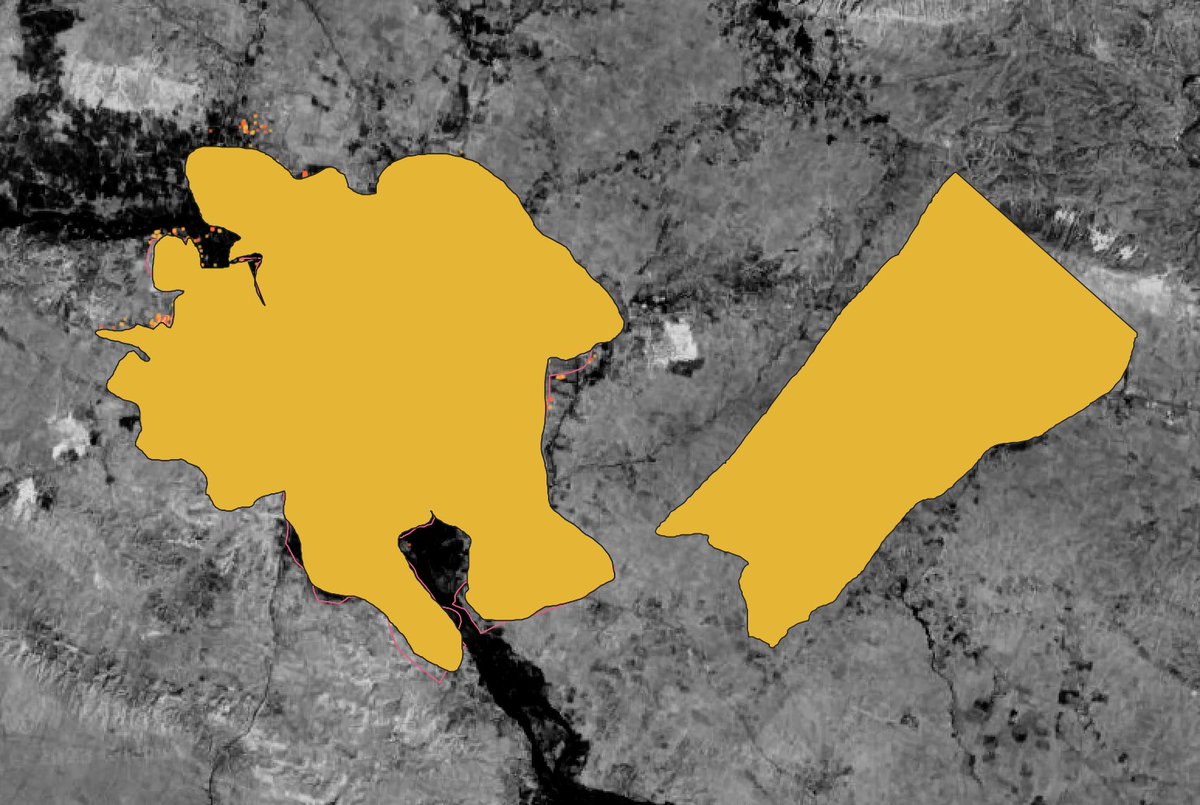
In 2016, U.N. Secretary-General Ban Ki-moon called Aleppo a “synonym for hell.” In 2017, the commander of the U.S.-led coalition said the fighting in Mosul was “the most significant urban combat” since World War 2. Northern Gaza suffered more destruction, in less time, than both.
(The U.N. did not collect complete data covering the Russian bombardment of Mariupol, but its partial data suggested that the percentage of buildings damaged in northern Gaza had already exceeded Mariupol in the first seven weeks of war.)
One hallmark of indiscriminate 21st-century air campaigns, as in Syria and Ukraine, has been the bombing of hospitals, which can't be attacked unless they're being used to “commit acts harmful to the enemy.” The Israeli military said it saw Gaza’s hospitals as military targets.
“Hamas systematically exploits hospitals as a key part of its war machine,” Hagari, the military spokesman, said on Nov. 5. “We will not accept Hamas’s cynical use of hospitals to hide their terror infrastructure.” idf.il
To assess destruction around hospitals, we analyzed U.N. satellite imagery data within 180 meters, the distance at which 250lb bombs can make a building uninhabitable and 2,000lb bombs can damage it beyond repair. We found damage within 180m of all of northern Gaza’s hospitals.
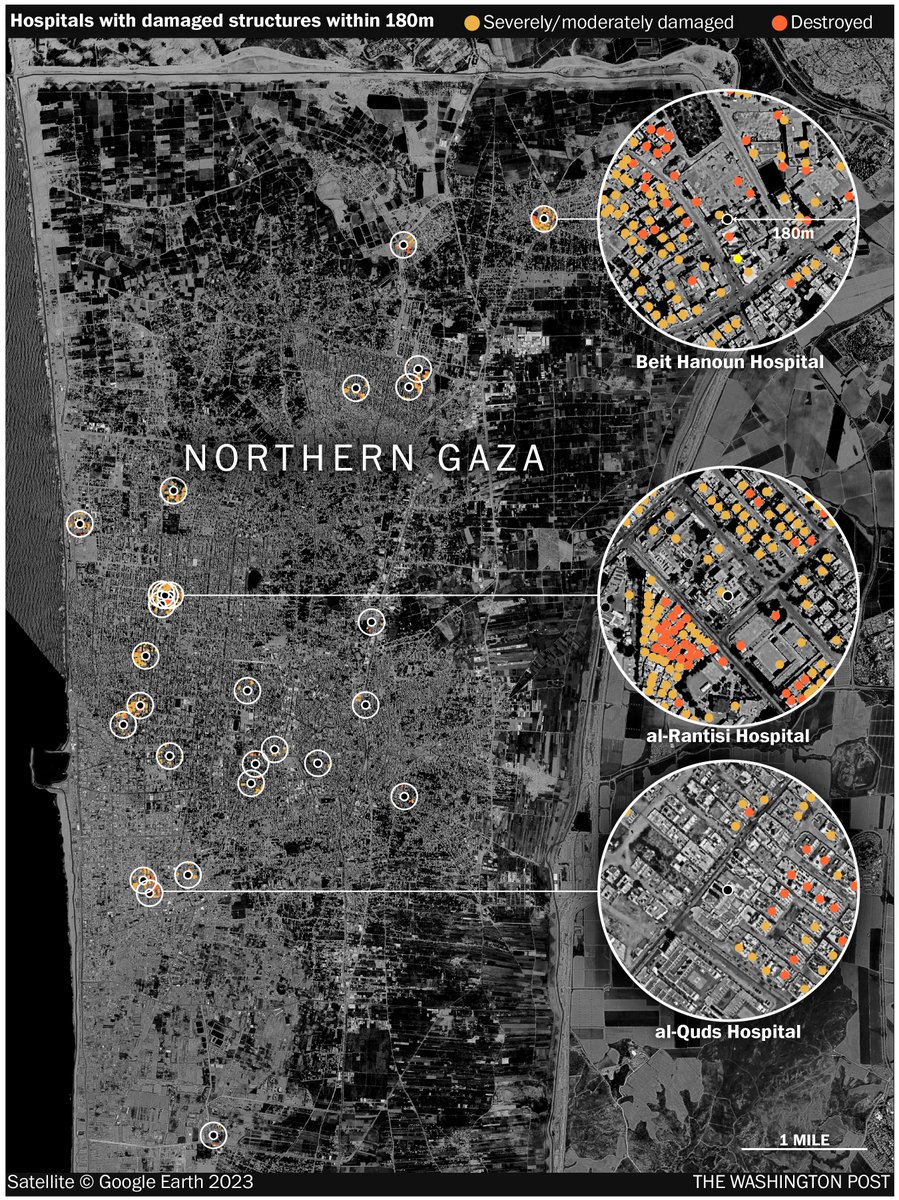
Across northern Gaza, visual evidence and other accounts showed how Israeli forces shot at, bombed, besieged and raided hospitals.
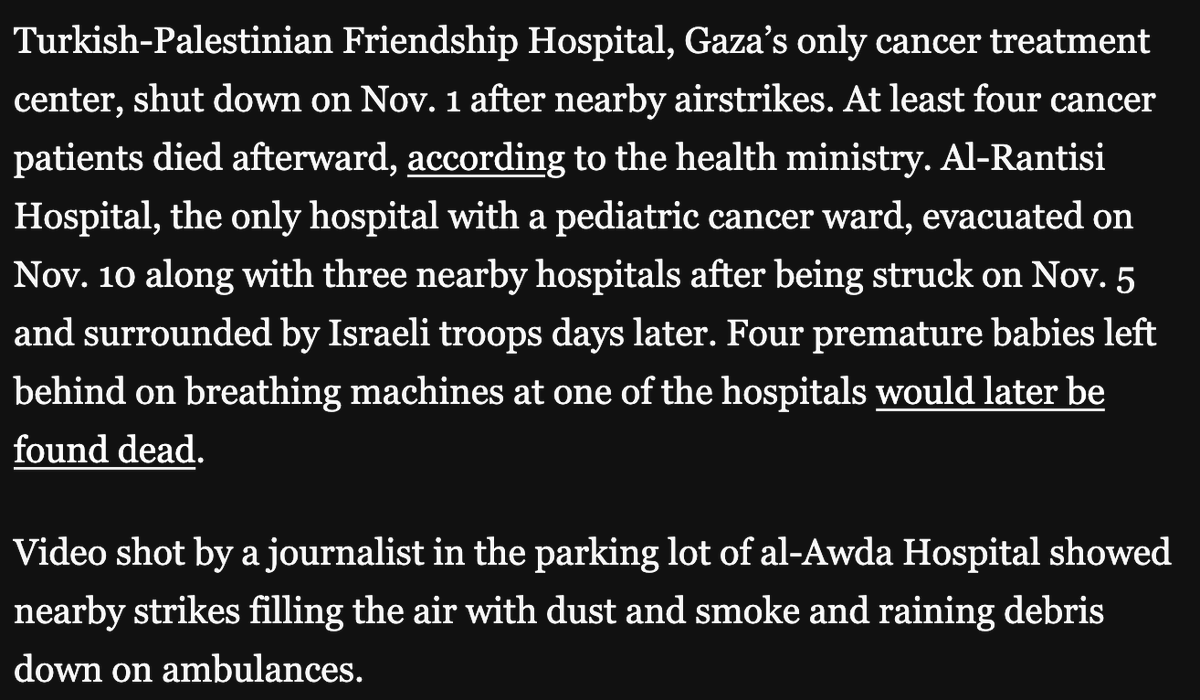
Video shot by journalist Feraj al-Ajrami in the parking lot of al-Awda Hospital and posted on Nov. 10 showed nearby strikes filling the air with dust and smoke and raining debris down on ambulances. Israeli forces raided al-Awda in mid-December.

In Gaza City, imagery and U.N. data showed how Israeli strikes had destroyed much of the neighborhood surrounding al-Quds Hospital, operated by the Palestine Red Crescent Society. On Nov. 12, the hospital ceased operating.
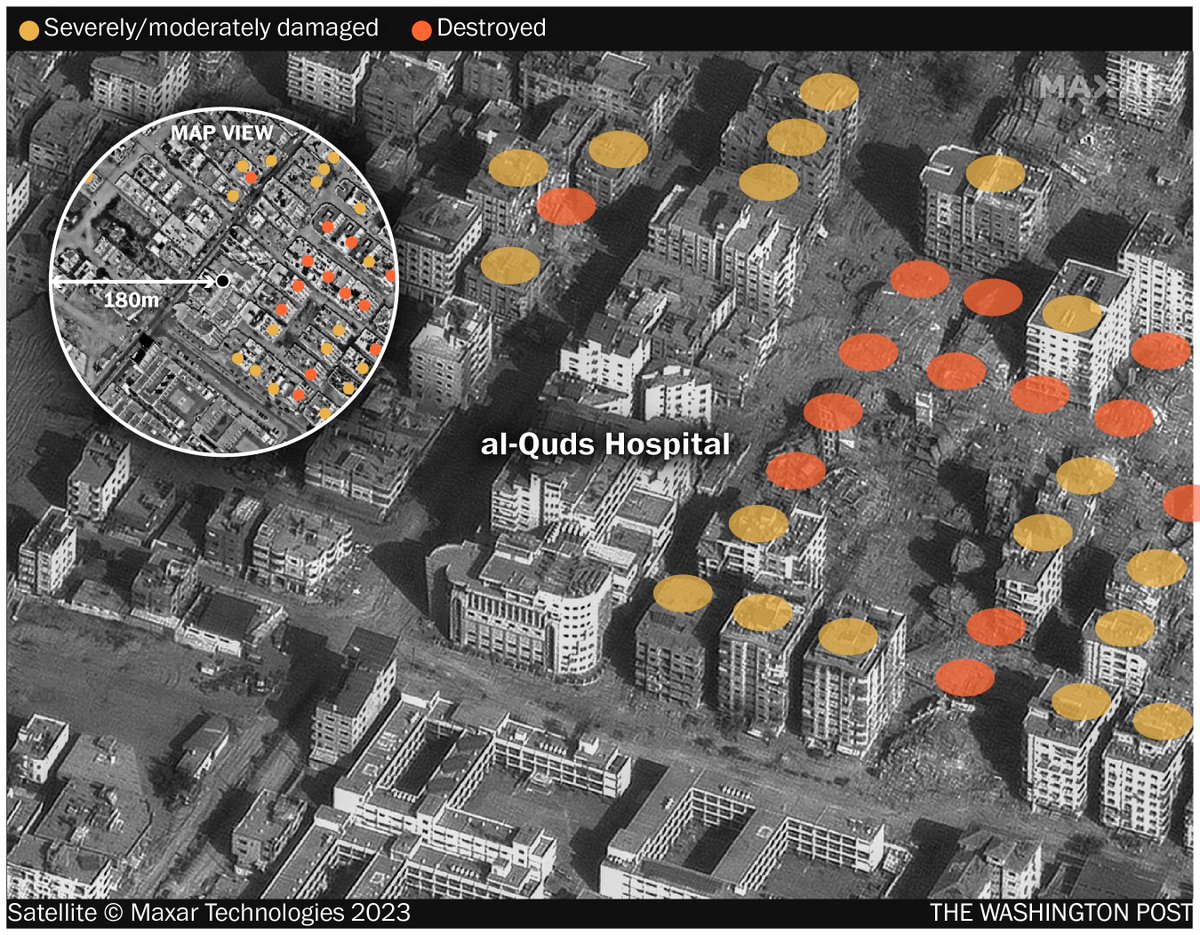
The Post reviewed nearly 100 satellite images taken between Oct. 8 and Dec. 10 and found about three dozen apparent craters within 180 meters of 17 of the 28 hospitals in northern Gaza. We asked five satellite imagery analysts to review images of the largest craters.
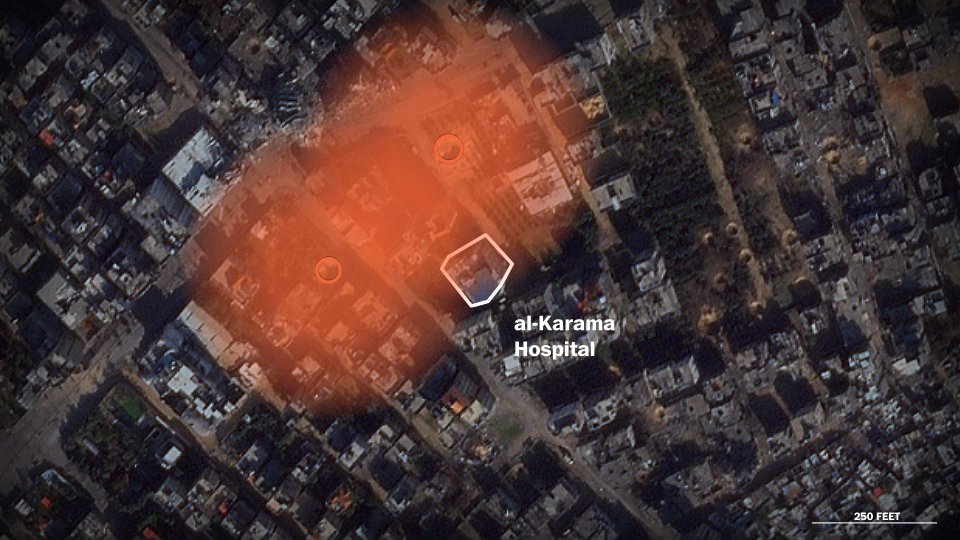
Ten large craters identified by The Post near hospitals suggested the use of bombs weighing 2,000 pounds, the largest in regular use. The large craters were seen near eight hospitals, more than a quarter of all the hospitals in northern Gaza:

In 3 locations, like here at al-Karama Hospital, we found 2,000lb-bomb craters about 90 meters or less from hospitals, the distance at which buildings inside the blast radius could be destroyed.
These craters appear on an Oct. 15 image. Al-Karama was forced to close on Oct. 17.
These craters appear on an Oct. 15 image. Al-Karama was forced to close on Oct. 17.
“What we have been witnessing is a campaign that was planned, it was a plan, definitely, to close down all the hospitals in the north,” said Léo Cans, head of mission for Palestine with Doctors Without Borders.
“For me, personally, this is without a doubt the worst I’ve seen,” said Tom Potokar, an ICRC chief surgeon working in Gaza for the 14th time. Potokar has previously worked during conflicts in South Sudan, Yemen, Syria, Somalia, Ukraine and elsewhere.
Preliminary data provided to The Post by @airwars suggested that strikes in Gaza were killing civilians at twice the rate of the U.S.-led campaign in Raqqa.
Director Emily Tripp said that the data they provided The Post was “just a fraction” of the strikes they were researching, which averaged about 200 per week. In 10 years of work, Tripp said, Airwars had never documented more than about 250 civilian casualty strikes per month.
The former head of the department responsible for advising the IDF on the laws of war told The Post that Hamas represented an existential threat to Israel, which should be factored into deciding whether strikes that kill civilians are justified.
That premise should be "rejected," @AdHaque110 told me: "If you think that only the permanent and total destruction of Hamas will prevent this existential threat, then you can talk yourself into accepting a tremendous amount of civilian harm."
Zaher @sahloul, who worked in Aleppo while it was besieged, told me Israel's war in Gaza was "beyond any disaster that I’ve witnessed at least in the last 15 years or so" and that he believed that attacks on hospitals and other protected sites were intentional.
“People in Syria told me they can tolerate bombs and missiles, but if there’s no doctors in town and no hospitals, they usually leave. So I would have to assume that if it is intentional, the goal is to force the population to leave. And when they leave, they don’t come back.”
Loading suggestions...