

1/7
🤔What is the hemodynamic response to a chronic hemoglobin of 1.5 g/dL.
A fascinating 1963 study published in @CircAHA provides some interesting answers. Let's have a look at Patient One.
ahajournals.org
🤔What is the hemodynamic response to a chronic hemoglobin of 1.5 g/dL.
A fascinating 1963 study published in @CircAHA provides some interesting answers. Let's have a look at Patient One.
ahajournals.org

@CircAHA 2/
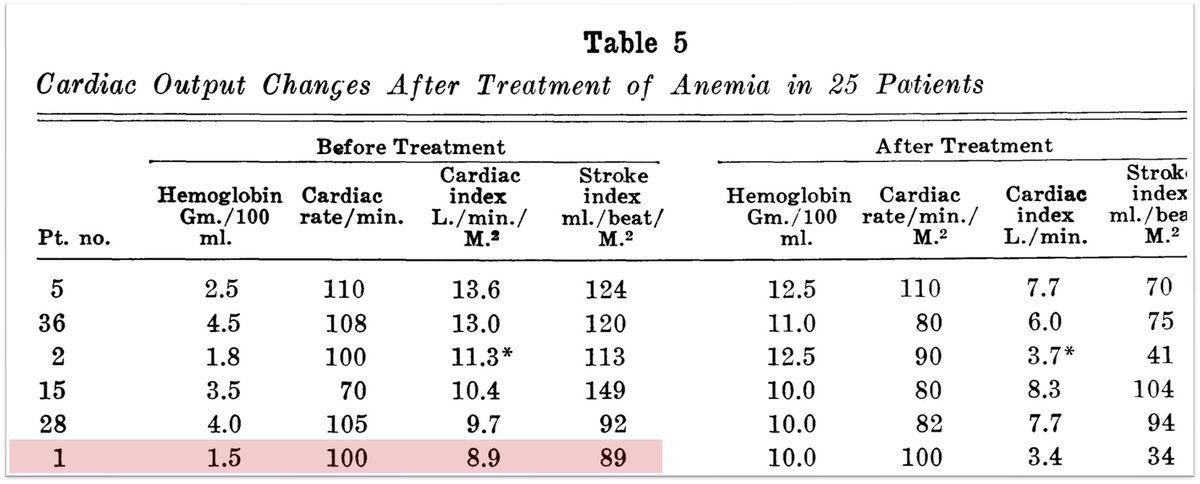
Patient One had chronic anemia with a hemoglobin 1.5 g/dL. You'll see that before receiving blood they had the following cardiac parameter:
• HR 100 (elevated)
• Cardiac index 8.9 (elevated)
• Stroke index 89 (elevated)
Patient One had chronic anemia with a hemoglobin 1.5 g/dL. You'll see that before receiving blood they had the following cardiac parameter:
• HR 100 (elevated)
• Cardiac index 8.9 (elevated)
• Stroke index 89 (elevated)

@CircAHA 3/
After transfusion to a hemoglobin of 10 g/dL, the following changes were noted:
• HR 100 (elevated but unchanged)
• Cardiac index 3.4 (decreased and now normal)
• Stroke index 34 (decreased and now normal)
After transfusion to a hemoglobin of 10 g/dL, the following changes were noted:
• HR 100 (elevated but unchanged)
• Cardiac index 3.4 (decreased and now normal)
• Stroke index 34 (decreased and now normal)

@CircAHA 4/
It is fascinating to observe that the did not change after aggressive transfusion.
The normalization of cardiac output was purely a result of a decease in stroke volume.
It is fascinating to observe that the did not change after aggressive transfusion.
The normalization of cardiac output was purely a result of a decease in stroke volume.
@CircAHA 5/
The other interesting observation from Patient One was the change in pulmonary capillary wedge pressure.
• At hemoglobin 1.5 g/dL ☞ 14 mmHg
• At hemoglobin 10 g/dL ☞ 5 mmHg
The other interesting observation from Patient One was the change in pulmonary capillary wedge pressure.
• At hemoglobin 1.5 g/dL ☞ 14 mmHg
• At hemoglobin 10 g/dL ☞ 5 mmHg

@CircAHA 6/
Though we don't know if Patient One was in high output heart failure before transfusion, their filling pressures certainly decreased.
Though we don't know if Patient One was in high output heart failure before transfusion, their filling pressures certainly decreased.
جاري تحميل الاقتراحات...