

Only a handful of investors have outperformed the market over decades.
One of them is Walter Schloss.
He achieved an Annual Return of 21% over 47(!) years.
A $10,000 Investment turned into $52,000,000
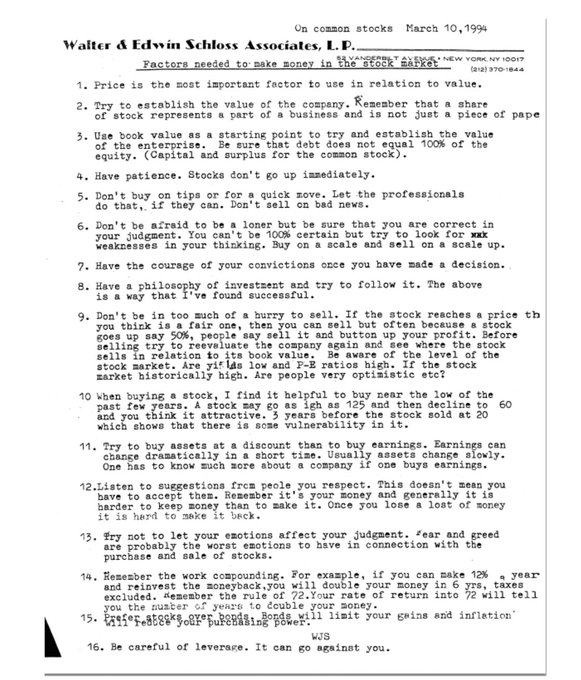
Here are the Key Points of his Investment Strategy (+ Free Checklist)👇
One of them is Walter Schloss.
He achieved an Annual Return of 21% over 47(!) years.
A $10,000 Investment turned into $52,000,000
Here are the Key Points of his Investment Strategy (+ Free Checklist)👇

1. Correctness of Judgment
Most people fail to test their decisions regularly.
How you respond to new info on your investments is critical for an accurate judgment.
You shouldn't need to convince yourself of an investment.
It should be convincing because of the facts.
Most people fail to test their decisions regularly.
How you respond to new info on your investments is critical for an accurate judgment.
You shouldn't need to convince yourself of an investment.
It should be convincing because of the facts.
2. Never Sell on Bad News
How you react to news is essential.
BUT generally, selling on bad news loses money.
Of course, you should sell when your thesis changes.
However, the worst moment is when bad news just broke out.
Statistically, stocks recover shortly after.
How you react to news is essential.
BUT generally, selling on bad news loses money.
Of course, you should sell when your thesis changes.
However, the worst moment is when bad news just broke out.
Statistically, stocks recover shortly after.
3. Talking to Management
This is a controversial topic for investors.
Many swear on talking to management to get an idea of how they think and behave.
Schloss rarely talked to management.
He didn’t trust his ability to judge character and therefore avoided these talks.
This is a controversial topic for investors.
Many swear on talking to management to get an idea of how they think and behave.
Schloss rarely talked to management.
He didn’t trust his ability to judge character and therefore avoided these talks.
4. Focus on Numbers
Because he didn't talk to management and invested in very cheap stocks, he focused on numbers.
His favorite metric was book value.
“Asset values fluctuate more slowly than earnings do.”
He preferably bought at 1/2 or 2/3 of book value.
Because he didn't talk to management and invested in very cheap stocks, he focused on numbers.
His favorite metric was book value.
“Asset values fluctuate more slowly than earnings do.”
He preferably bought at 1/2 or 2/3 of book value.
5. Diversification
Schloss didn't dig too deep into his investments.
He bought very cheap stocks, a lot of them (60-100 positions).
Not all of them will be winners, but the low price was his Margin of Safety.
And the winners drove the performance.
Schloss didn't dig too deep into his investments.
He bought very cheap stocks, a lot of them (60-100 positions).
Not all of them will be winners, but the low price was his Margin of Safety.
And the winners drove the performance.
6. Averaging In
Schloss also believed you could not know an investment if you’re watching from the sidelines.
That’s why he established many small positions to observe them.
Over time, he averaged into these positions and built them up.
Schloss also believed you could not know an investment if you’re watching from the sidelines.
That’s why he established many small positions to observe them.
Over time, he averaged into these positions and built them up.
7. The Math of Investing
Through his investment strategy, he benefited from two simple principles.
7.1. Losses weigh more than gains.
If you lose 30%, you need to gain more than 30% to get back to zero.
Solution: Focus on the Downside.
Through his investment strategy, he benefited from two simple principles.
7.1. Losses weigh more than gains.
If you lose 30%, you need to gain more than 30% to get back to zero.
Solution: Focus on the Downside.
7.2 Compound Interest Frequency
By buying and selling undervalued companies, he compounded faster than he would by buying great companies.
Of course, it’s more work to find many undervalued companies, but the higher frequency is very profitable.
Buffett used to do the same.
By buying and selling undervalued companies, he compounded faster than he would by buying great companies.
Of course, it’s more work to find many undervalued companies, but the higher frequency is very profitable.
Buffett used to do the same.
Here's the promised checklist published in 1994.
More Investing Resources like this are for Free on my Website:
More Investing Resources like this are for Free on my Website:
That's it for today!
If you enjoyed it, please Like and Retweet this Thread so more people can see it!
Follow me @MnkeDaniel to learn more about Investing.
Have a great day!
If you enjoyed it, please Like and Retweet this Thread so more people can see it!
Follow me @MnkeDaniel to learn more about Investing.
Have a great day!
جاري تحميل الاقتراحات...