

🗒️Real Madrid's 4132/4312 high-pressing structure/shape:
An in-depth thread where I try to break down the intent, roles, tactical advantages and disadvantages of Carlo Ancelotti's new look high-pressing structure.
[THREAD]
An in-depth thread where I try to break down the intent, roles, tactical advantages and disadvantages of Carlo Ancelotti's new look high-pressing structure.
[THREAD]

Starting from goal-kicks, Madrid start with a 4132/4312ish shape with the two frontmen (Vinicius/Rodrygo) on the two opposition CBs. Bellingham sits on the opp #6 while the two CMs (Kroos and Valverde here) have players in their cover shadows starting out.

Tchouameni acts as a screener in these situations while the #8s have a player with them/in their cover shadow. The fullbacks tuck in, keeping the wingers on their shoulder, while a CB marks the ST and the other CB acts as the free man to intercept long balls into space/in behind.
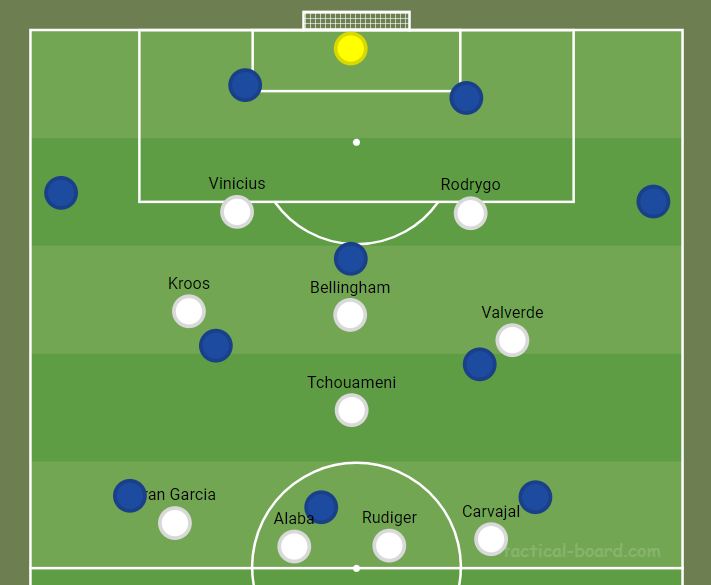
Ancelotti wants a +1 at the back in defensive situations (Alaba and Rudiger vs ST here) as a counter-measure because as much as you'd want the opp team to play out the press, the reality is that 75% of teams would try to hit the channels or try to find a runner with a long ball.
While Madrid start with the front two against the two CBs, they immediately don't press as the ball moves into a CBs feet. After a pass into the CB the forwards (Vinicius or Rodrygo depending on which CB receives) angle their press to the force opposition to play wide (the FB).
For example: If the first pass is into the CB Vinicius has in his area, he doesn't initiate the press immediately. He angles it in a way where the next pass is to the RB (with Bellingham already sitting on the #6 and #8s on the opp CM's all central lanes are blocked)
The CB to FB pass acts as trigger for the ball side CM to engage and the rest of the team adjusts accordingly. The #6 (Tchouameni here) moves against the player the #8 (Kroos) was initially marking. Ball side FB (Garcia) stays tight while FB and CM on the opposite side tuck
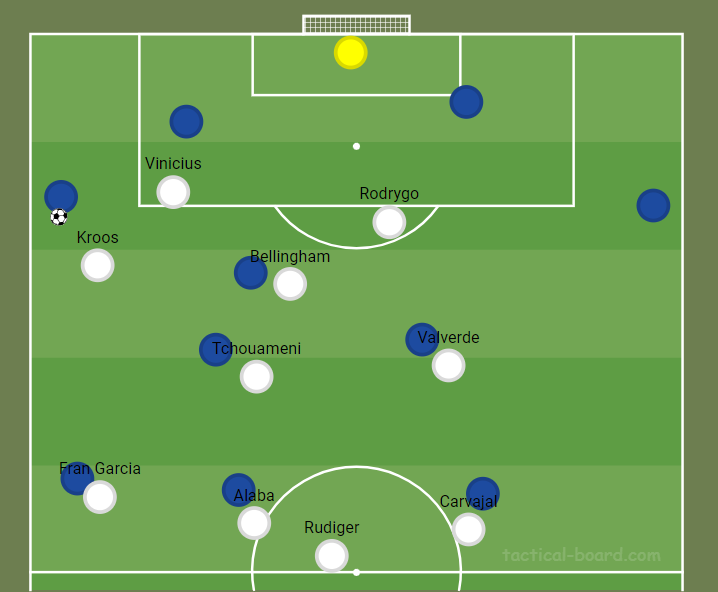
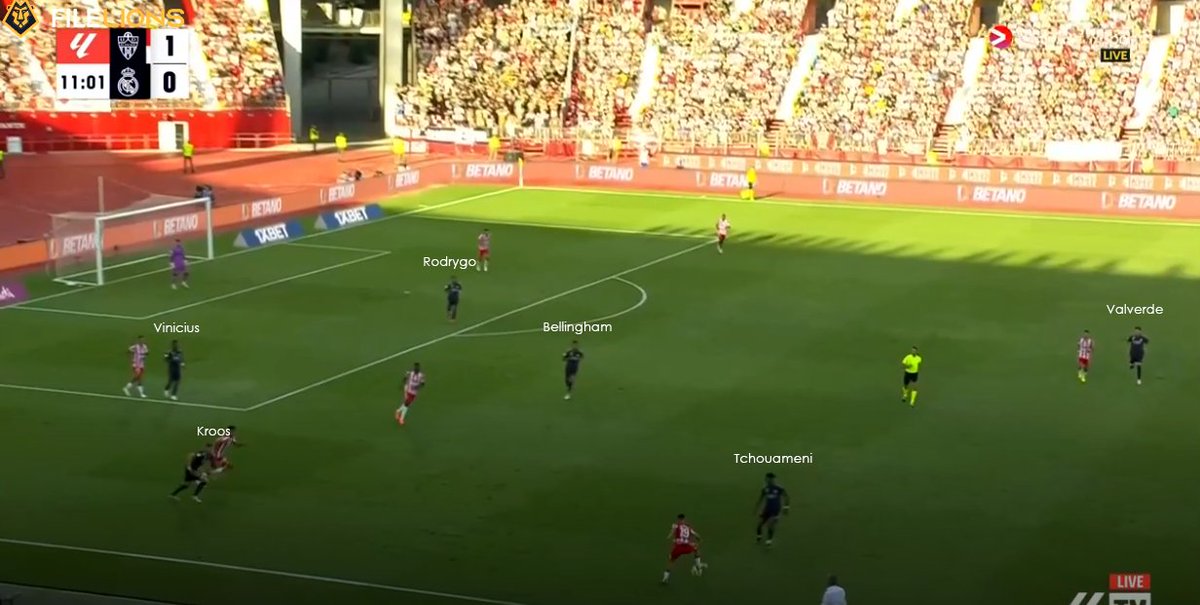
inside to provide compactness. This congests all nearby options for the opposition to play out whilst also making it easier for Real to pick up loose touches or head into duels & harm the ability to circulate effectively as players remain in close proximity to each other.
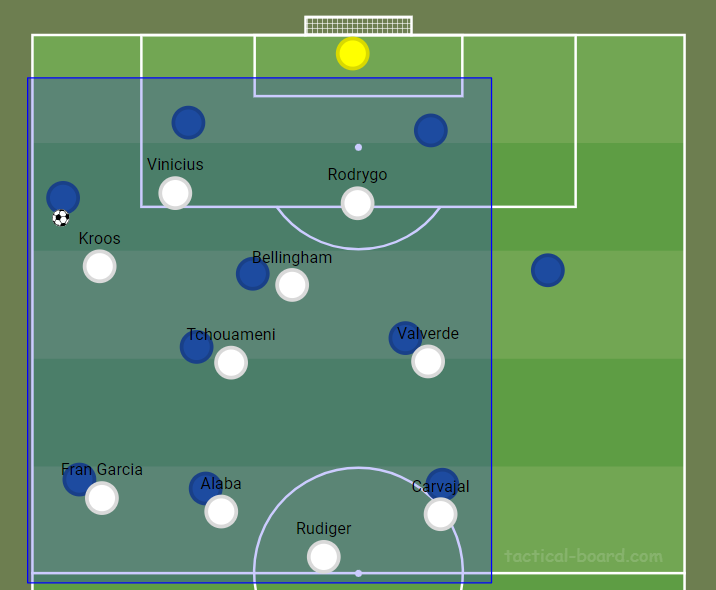
This 4132/4312 pressing shape offers excellent spacing when Madrid try to press high from goal-kicks as each central lane is typically occupied. That means that Madrid's players can engage (close proximity) if the opp tries to break the press by combination play/through dribbles.
To put it very briefly, the aim, intent or approach behind this shape is to force the opposition into the wide areas, congest the ball side area/creating compactness by having the entire team tuck inside and to force turnover of play.
While this looks rigid with fixed roles, Ancelotti wants this shape to be as zonal as possible (you can often find the player closest to the ball engaging than the assigned player) which might lead you into confusion on the shape or the marking, but the idea remains the same.
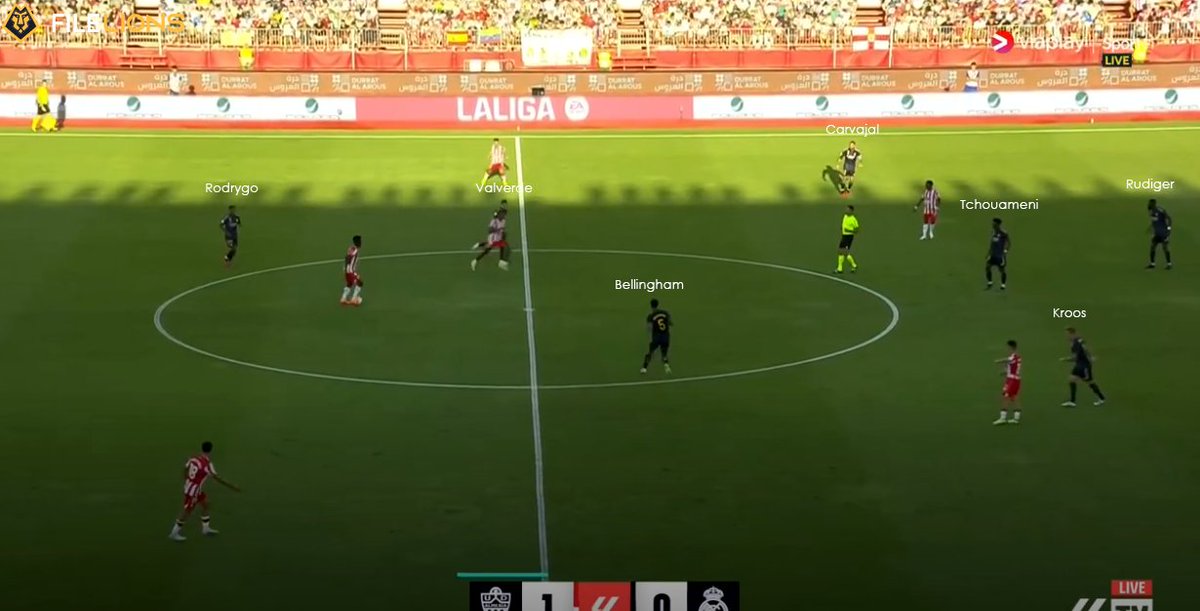
Here is an example where Tchouameni is pressing upfront alongside Valverde and Rodrygo. You'd ideally want Bellingham there along side Valverde according to the on-paper pressing shape but the reality is that players cannot be everywhere against the speed of the ball.
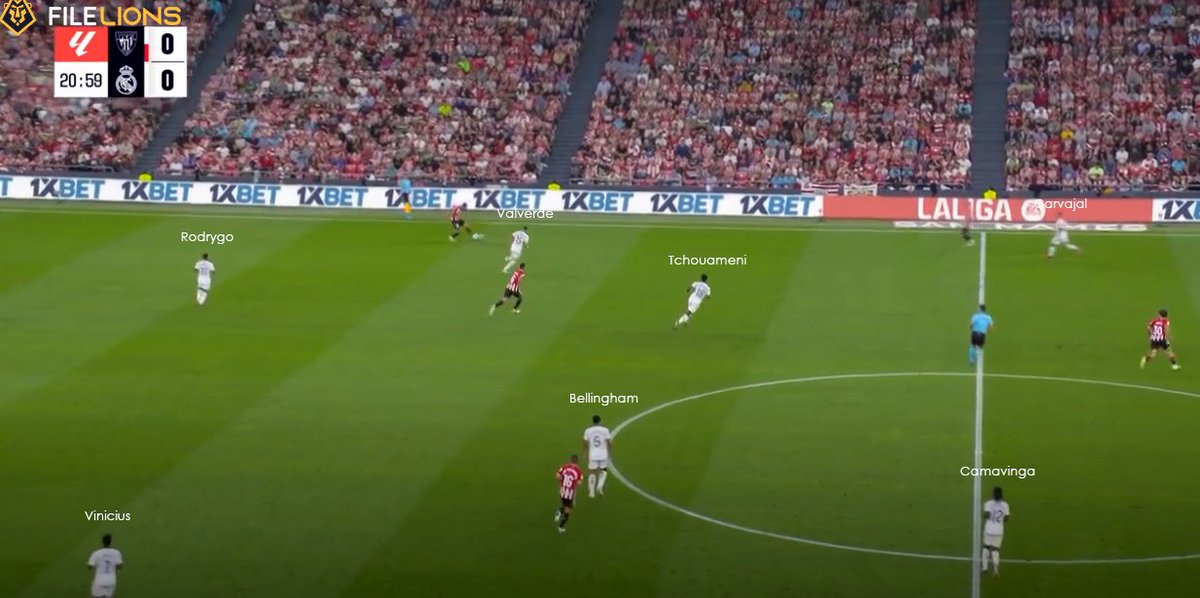
Irrespective of the opposition shape, the roles intent and the idea behind the press remains the same.
Here's an example below of how the initial shape would look from goal-kick and how it'd look after the press is triggered vs a standard 442.
Here's an example below of how the initial shape would look from goal-kick and how it'd look after the press is triggered vs a standard 442.
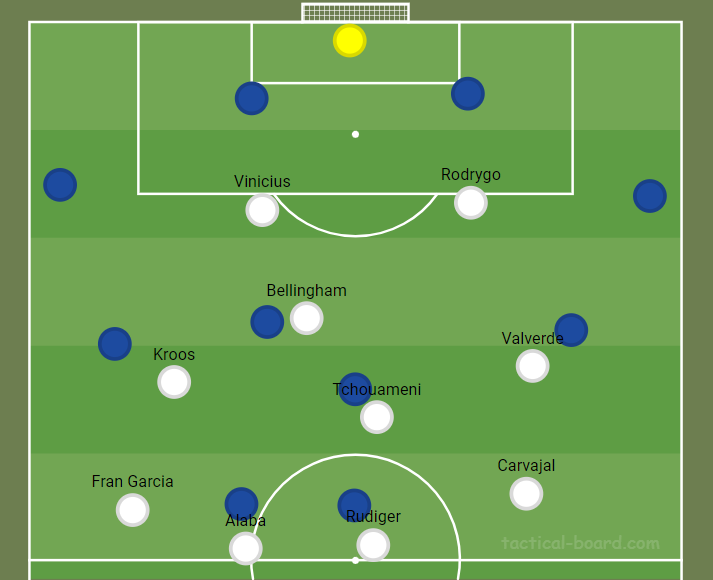
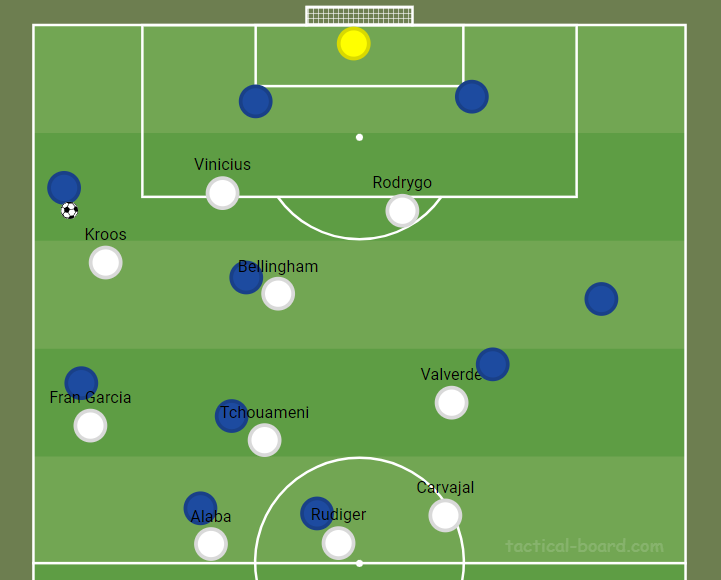
When a team leaves the opposition with a spare player in the build-up (opposition FB here), they will have to press with complete intensity and aggression because the entire press is built upon the idea of compressing the field and cutting off lanes.
Combined with the far side FB tucking inside and playing a high-line, you could find yourself with the opposition FB or a runner with 50 yards in front of him in the blink of an eye if the team doesn't close down in time. Switches of play become very easy when it isn't executed.
The press isn't bulletproof as Ancelotti wants it to be as a the spare men + space on the opposite side of the pitch is there for the taking. Presses like this depend on intensity a lot for compactness due to the reasons mentioned above, so rotation could be key factor in this.
As good as Madrid's press was, there were still patches in the game where Madrid looked lax pressing wise in both the games vs Athletic Club & Almeria. Madrid pressed extremely well in patches but the intensity faded and dropped off with time.
The easiest and most logical explanation is to point towards fitness, but the reason here is that the outside midfielders/WMs/#8s in this setup have too much ground to cover, especially at the intensity at which they press.
A typical press 4132/4312 press like this would have the FB pushing up against the opposition FB and rest of the team adjusting but Ancelotti has the ball side #8s pushing against the FBs while the CM on the other side tucks inside, almost near the centre of the pitch.
This isn't just for the high-press btw. The CMs/8s are tasked with this role in every phase of defensive play (highpress-midblock-lowblock) because Ancelotti likes his FB to stay conservative for defensive security. Keep in mind the intensity at which they have to close down.
Another flaw in this shape is that it could be exploited with the free man and runner (as explained above) OR if the team is technical and connects passes through the middle or if a marker pulls the CM deep.
Let me explain the last bit a little more here. As we already know the #8 is tasked with engaging on the opposition FB, so what happens when the #8 isn't present to engage the opp FB on the ball upon a switch of play or pass-connect in the first place? The FB ventures deep into
the pitch, unengaged, without pressure and with time and space on the ball, potentially to even pick out a final ball.
So until a player closest engages or until the team adjusts itself, the FB would've already gained some valuable yards.
So until a player closest engages or until the team adjusts itself, the FB would've already gained some valuable yards.
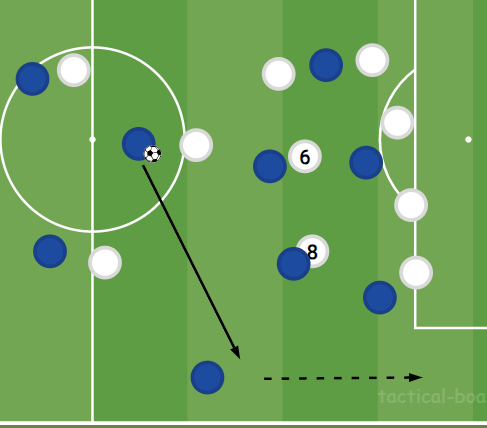
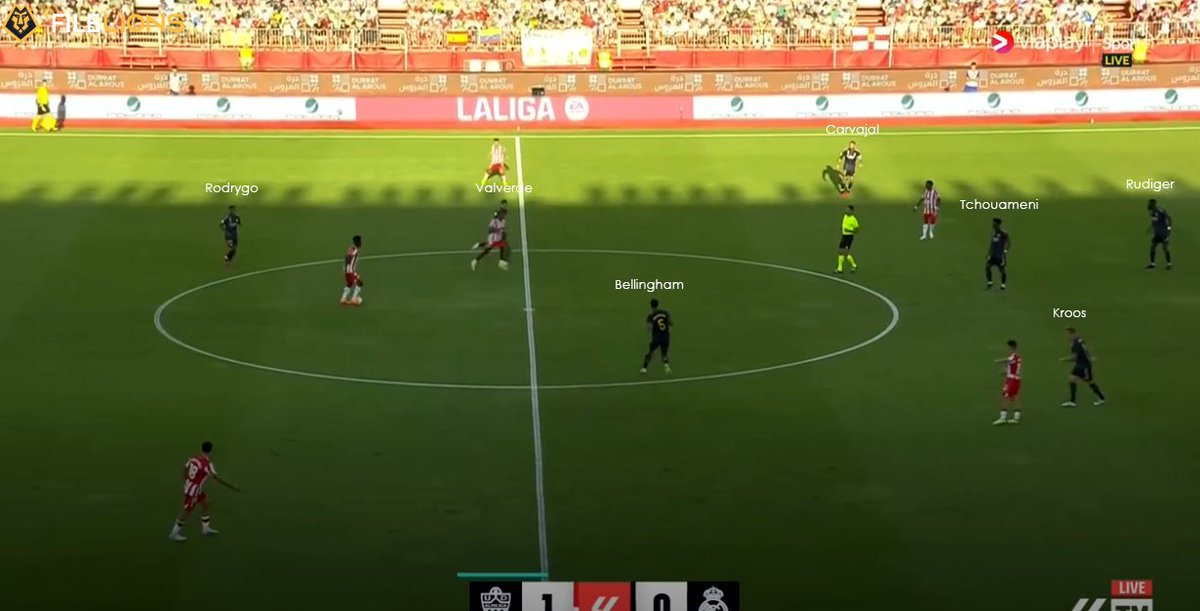
An example showing where Kroos is pulled deep by Arribas.
(A scenario which happened multiple times over the course of the Almeria game) Madrid often looked confused on how to adjust or lost valuable time until they adjusted & then engaged in scenarios like this.
(A scenario which happened multiple times over the course of the Almeria game) Madrid often looked confused on how to adjust or lost valuable time until they adjusted & then engaged in scenarios like this.
I will be adding all the defensive shapes/structures in accordance to phases (High press-midblock-lowblock) to this thread in parts to help better understand the intent of the complete defensive setup.
all likes/RT's appreciated.
all likes/RT's appreciated.
Credit to @GauravAnlyst for the video in the first tweet.
Loading suggestions...