

Heading back to Egypt for the rest of the summer.
Over the past 18 months or so, the Egyptian currency has been cut in half relative to the dollar.
So my little wad of cash that I had lingering from last time that I will be bringing with me is worth less.
1 USD = 31 EGP
A🧵
Over the past 18 months or so, the Egyptian currency has been cut in half relative to the dollar.
So my little wad of cash that I had lingering from last time that I will be bringing with me is worth less.
1 USD = 31 EGP
A🧵

Egypt needed an IMF loan to keep their dollar-denominated debt in working order. And one of the conditions from the IMF was to devalue the currency, to try to improve import/export balance.
It makes people poorer, but then (arguably) more competitive in the global labor market.
It makes people poorer, but then (arguably) more competitive in the global labor market.
In other words, a devaluation makes it harder for people to import stuff, makes Egyptian vacations cheaper for foreigners, makes Egyptian exports cheaper and thus maybe more competitive, etc.
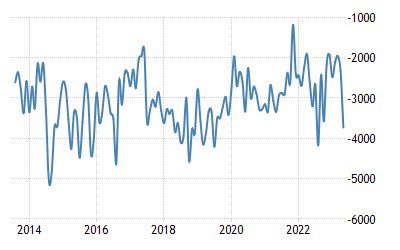
It is early but so far, no impact. Egypt trade balance:
It is early but so far, no impact. Egypt trade balance:
In addition to devaluing the cash and bond savings of Egyptians, it devalues their ongoing wages, which are mostly negotiated and denominated in Egyptian currency.
So unless someone got a 100% raise from 18 months ago (hardly anyone), they earn fewer USD-equivalents per hour.
So unless someone got a 100% raise from 18 months ago (hardly anyone), they earn fewer USD-equivalents per hour.
That’s one way that inflation tends to hurt the working/middle class in any country.
Inflation puts the challenge on the workers to negotiate higher wages just to keep up. And the higher the inflation, the harder than anchoring bias is to overcome.
Inflation puts the challenge on the workers to negotiate higher wages just to keep up. And the higher the inflation, the harder than anchoring bias is to overcome.
When inflation was 9% in the US a little while ago, workers basically got a pay cut unless they got a 9% raise.
But it’s easy for an employer to ask “why are you worth 9% more than last year?” But the employee is not; they are just trying to tread water on real wages.
But it’s easy for an employer to ask “why are you worth 9% more than last year?” But the employee is not; they are just trying to tread water on real wages.
Even 3% per year presents an issue.
A wage earner goes to employer and asks for a 5% raise.
“Why are you worth 5% more than last year?”
“I am not. I am worth 2% more due to experience, plus 3% inflation.”
People often have to switch jobs to get out of that anchoring bias.
A wage earner goes to employer and asks for a 5% raise.
“Why are you worth 5% more than last year?”
“I am not. I am worth 2% more due to experience, plus 3% inflation.”
People often have to switch jobs to get out of that anchoring bias.
And then of course CPI is a mix of scarce things (houses, meat, fuel, etc) and abundant things (software, electronics, grains, etc).
The price of scarce things structurally goes up faster than CPI.
So the inflation treadmill tends to be stacked against the wage earner.
The price of scarce things structurally goes up faster than CPI.
So the inflation treadmill tends to be stacked against the wage earner.
Official inflation in Egypt is 37% from a year ago, while the price of meat is up 93%.
Loading suggestions...