

#TheAyodhyaMovement
#TheForgottenHeroes
The #openmagazine came with the headline
“The Villain Nobody Knows” and the byline, “The Indian Civil Service officer who helped the Hindu Mahasabha lay claim to the Babri Masjid”.
The villain was an ICS officer of Kerala Cadre #KKKNair
#TheForgottenHeroes
The #openmagazine came with the headline
“The Villain Nobody Knows” and the byline, “The Indian Civil Service officer who helped the Hindu Mahasabha lay claim to the Babri Masjid”.
The villain was an ICS officer of Kerala Cadre #KKKNair

who played an unforgettable role in reinstating the fundamental right to worship of Hindus in the Rama Janmabhumi before Bharat became a constitutional republic.
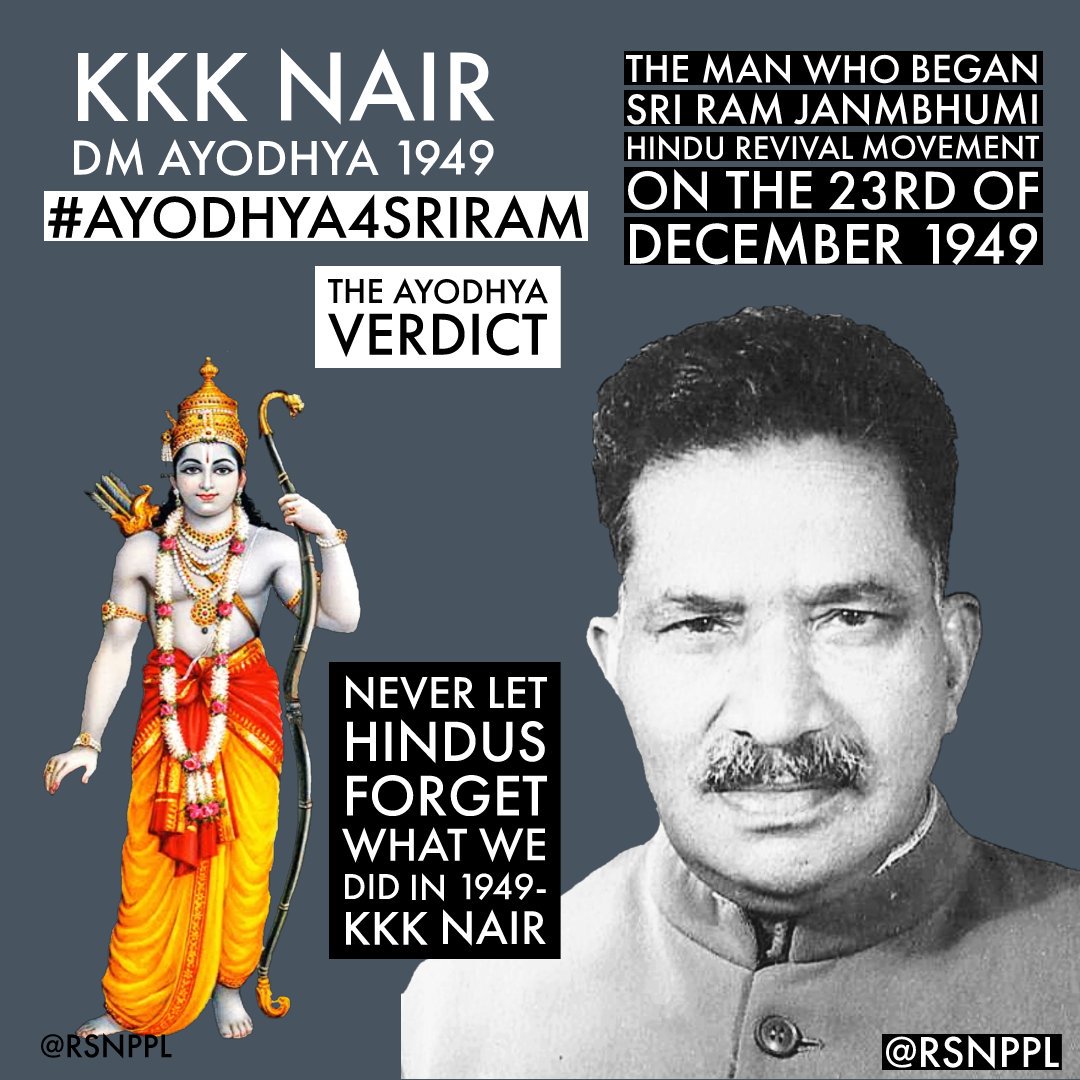
KK Nair or Kandangalathil Karunakaran Nair is a name deeply engraved in the history of the Ayodhya movement.
KK Nair or Kandangalathil Karunakaran Nair is a name deeply engraved in the history of the Ayodhya movement.
KKN was born on September 11, 1907, at Kuttanad, a small village in Alappuzha.
After completing his education in Kerala, he went to England for higher studies and won ICS at the age of 21. He joined as a civil servant in Uttar Pradesh in 1945 and became Deputy Commissioner-cum-
After completing his education in Kerala, he went to England for higher studies and won ICS at the age of 21. He joined as a civil servant in Uttar Pradesh in 1945 and became Deputy Commissioner-cum-
District Magistrate of Faizabad on June 1, 1949.
3 friends—Maharaja Pateshwari Prasad Singh, head of the princely state of Balrampur, Mahant Digvijai Nath, and KKK Nair. The three were united as much by their Hindu communal sentiments as their love for lawn tennis.
3 friends—Maharaja Pateshwari Prasad Singh, head of the princely state of Balrampur, Mahant Digvijai Nath, and KKK Nair. The three were united as much by their Hindu communal sentiments as their love for lawn tennis.
It was Tennis, which ensured that Nair, who had arrived in Gonda in August 1946, became a very good friend of the Maharaja.
The Maharaja organised a grand Yajna at Balrampur in early 1947. He invited, besides Mahant Digvijai Nath, many Hindu religious leaders, including
The Maharaja organised a grand Yajna at Balrampur in early 1947. He invited, besides Mahant Digvijai Nath, many Hindu religious leaders, including
Swami Karpatri, a sanyasi who belonged to the Dandis, one of the orders founded by Adi Shankaracharya & Nair was invited too.
The trio of Mahant Digvijai Nath, KKK Nair and Swami Karpatri met on the last day of the Yagna.
Sri Digvijai Nath—as per the views expressed by
The trio of Mahant Digvijai Nath, KKK Nair and Swami Karpatri met on the last day of the Yagna.
Sri Digvijai Nath—as per the views expressed by
Sri Vinayak Damodar Savarkar that the Hindu religious places which had been under occupation of foreigners must now be liberated—discussed the idea of capturing the Babri Masjid with Karpatriji and Nair.
Promising that he would get back to him after considering the proposal
Promising that he would get back to him after considering the proposal
seriously, Nair left for the district headquarters of Gonda. The next day, reaching the place of yajna at Balrampur, Nair went straight to Karpatriji and Mahant Digvijai Nath, who welcomed him and asked him to sit next to them. They began discussing the issue once again.
When Nair enquired about the detailed plan, the Mahant laid before him the strategy to get back Sri Ramjanmabhoomi in Ayodhya, apart from Kashi Vishwanath Temple in Varanasi and Sri Krishna janmabhoomi in Mathura.
Nair then promised Digvijai Nath that he would sacrifice
Nair then promised Digvijai Nath that he would sacrifice
everything in order to accomplish the task.’
Deputy Commissioner-cum-District Magistrate KKK Nair, had taken charge of Faizabad on 1 June 1949. Guru Datt Singh, the other district official involved in this exercise, was Nair’s fervent supporter.
He was the city magistrate of
Deputy Commissioner-cum-District Magistrate KKK Nair, had taken charge of Faizabad on 1 June 1949. Guru Datt Singh, the other district official involved in this exercise, was Nair’s fervent supporter.
He was the city magistrate of
Faizabad and acted as assistant to the deputy commissioner.
A Rajput, he considered himself ‘a man of God’ and believed that the ‘very existence of Hinduism’ and his ‘own existence’ were being threatened by the Hindus who dominated the Congress simply because this party had
A Rajput, he considered himself ‘a man of God’ and believed that the ‘very existence of Hinduism’ and his ‘own existence’ were being threatened by the Hindus who dominated the Congress simply because this party had
embarked upon a programme designed to secularise Bharat.
What happened next shows Nehru’s true colours of secularism..
On December 22, 1949, Uttar Pradesh Chief Minister Govind Vallabh Pant, at the behest of the then prime minister Jawaharlal Nehru, ordered to expel the
What happened next shows Nehru’s true colours of secularism..
On December 22, 1949, Uttar Pradesh Chief Minister Govind Vallabh Pant, at the behest of the then prime minister Jawaharlal Nehru, ordered to expel the
Hindus from the temple of Ram Lalla. But Faizabad District Collector KK Nair refused to implement the order, pointing out that the real stakeholders were performing Pooja there and the move would lead to riots and bloodshed.
(From PVN Rao's book 'Ayodhya"-PM Nehru ordered
(From PVN Rao's book 'Ayodhya"-PM Nehru ordered
DM KK Nair to remove Idols from Masjid. Nair wrote on file can't remove as it is Idols & none ready to remove it. Only certain Pujaris can do it by de-Idol & I found none to do it).
Following the incident, Govind Vallabh Pant suspended KK Nair from the service.
Following the incident, Govind Vallabh Pant suspended KK Nair from the service.
But Nair fought the Congress Government at court and managed to get an order in his favour.
After rejoining the service, he decided not to continue as an IAS officer as, by the time, he became an eyesore to Nehru.
After resigning from the service, he started practising as a
After rejoining the service, he decided not to continue as an IAS officer as, by the time, he became an eyesore to Nehru.
After resigning from the service, he started practising as a
lawyer in the Allahabad High Court. KK Nair upheld justice and made the way to the hearts of millions of people. People in and around Faizabad fondly called him ‘Nair Saheb’.
Taking the fight for Ram Mandir forward, KK Nair and his family joined the Jana Sangh.
Taking the fight for Ram Mandir forward, KK Nair and his family joined the Jana Sangh.
In 1952, his wife Sakunatala Nair contested on the Jana Sangh ticket and became a member of Uttar Pradesh assembly. Later, in 1962, both KK Nair and his wife became members of the 4th Lok Sabha, winning Bahraich and Kaiserganj constituencies respectively.
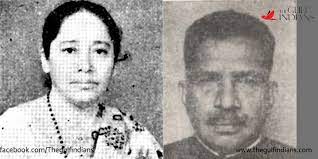
Interestingly, their driver was also elected as a member of the UP legislative assembly from Faizabad assembly constituency. The couple was later arrested and jailed during the Emergency for protesting against the dictatorial regime of Indira Gandhi.
On 7th September, 1977, K K Nair, one of the architects of Ram Mandir joined Ram’s Feet.
#JaiShreeRam
#Ayodhya
#VANDEMATARAM
#JaiShreeRam
#Ayodhya
#VANDEMATARAM
جاري تحميل الاقتراحات...