

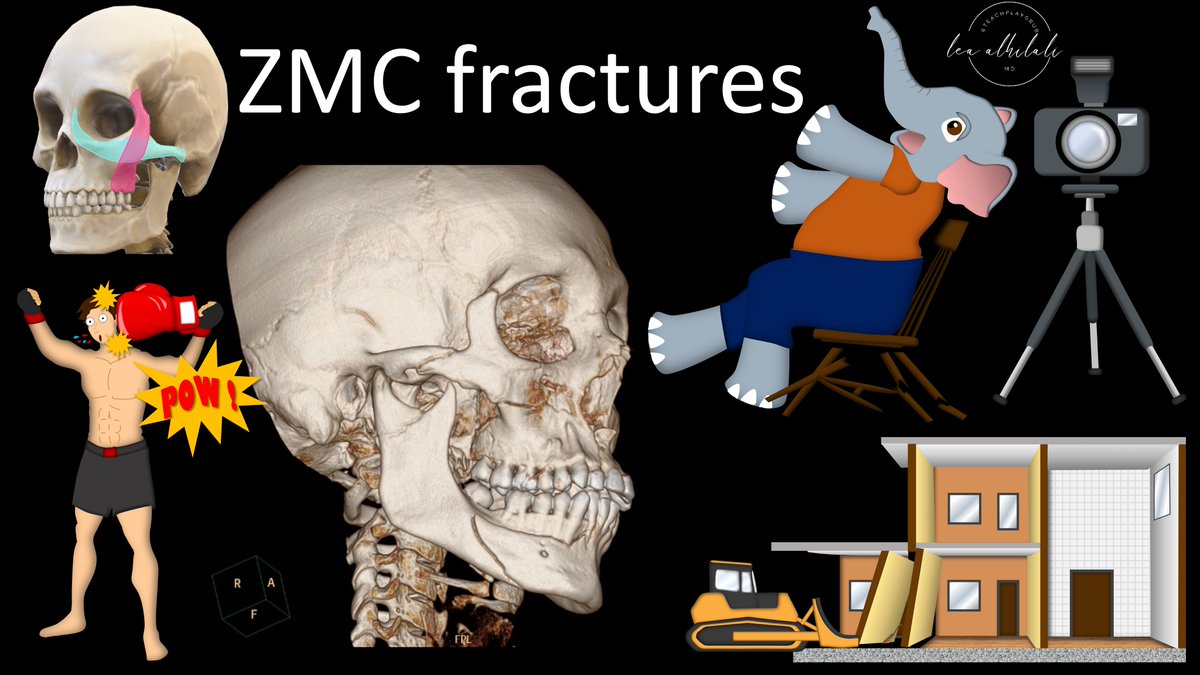
1/Facial fractures get a little cheeky!
If you are still calling those lateral facial fractures tri-pods you need to tri-again!
Here’s a #tweetorial to help you understand fractures of the zygomaticomaxillary complex or ZMC
#medtwitter #meded #FOAMed #radtwitter #radres
If you are still calling those lateral facial fractures tri-pods you need to tri-again!
Here’s a #tweetorial to help you understand fractures of the zygomaticomaxillary complex or ZMC
#medtwitter #meded #FOAMed #radtwitter #radres
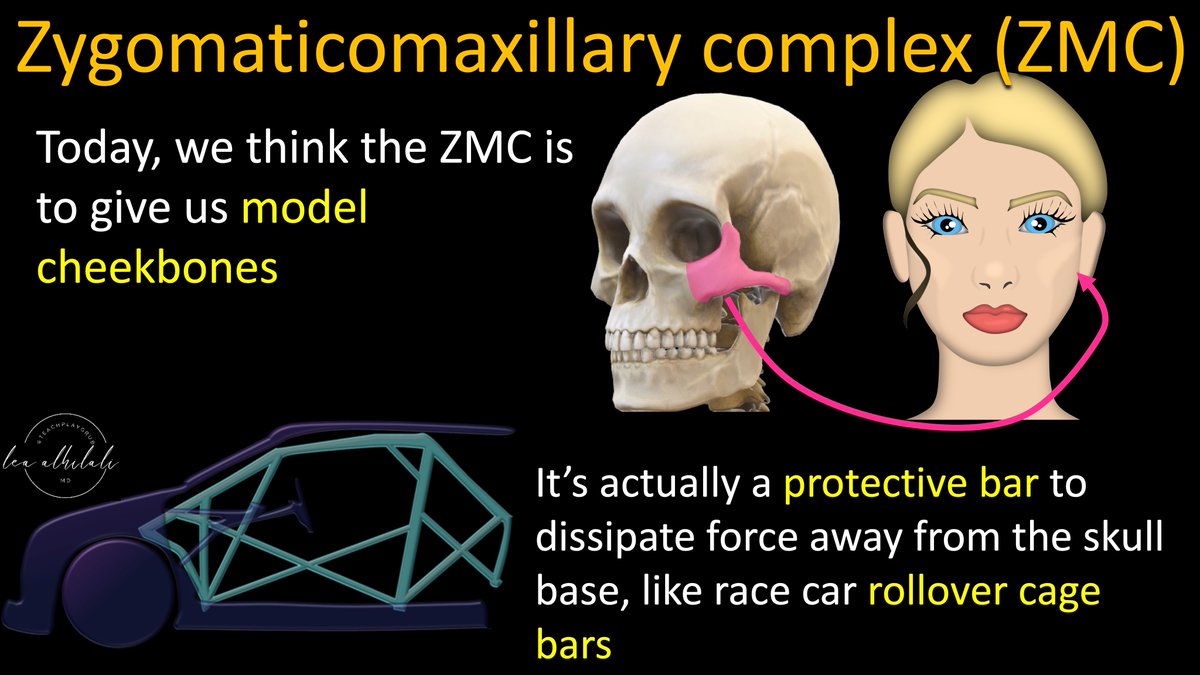
2/ZMC is the malar eminence (cheekbone) & its midface/skullbase attachments. Today we think its purpose is aesthetics (our model cheekbones)
But evolutionarily, it’s purpose is as a bar to dissipate force away from important skullbase structures—like race car rollover bars/cage
But evolutionarily, it’s purpose is as a bar to dissipate force away from important skullbase structures—like race car rollover bars/cage
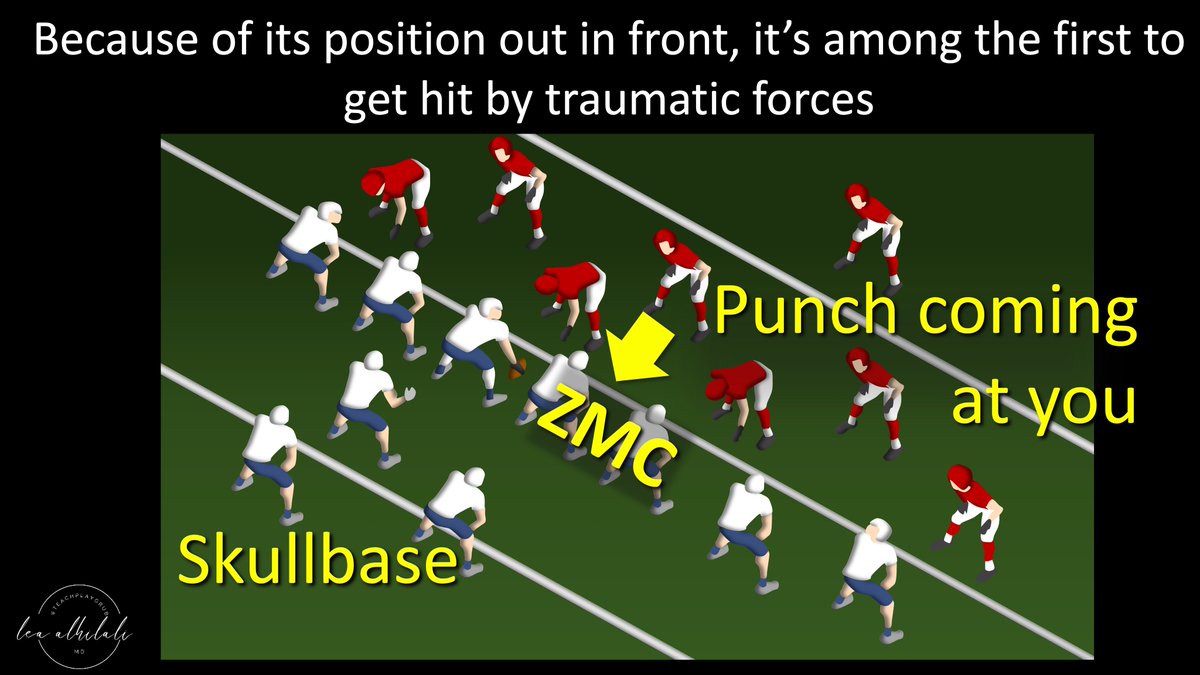
3/Bc our cheekbones stick out of our face, the ZMC is often the first line of defense protecting the skullbase from trauma—like the offensive line in football is first to get hit to protect the quarterback
In fact, ZMC fxs are the most common facial fxs other than nasal bone
In fact, ZMC fxs are the most common facial fxs other than nasal bone
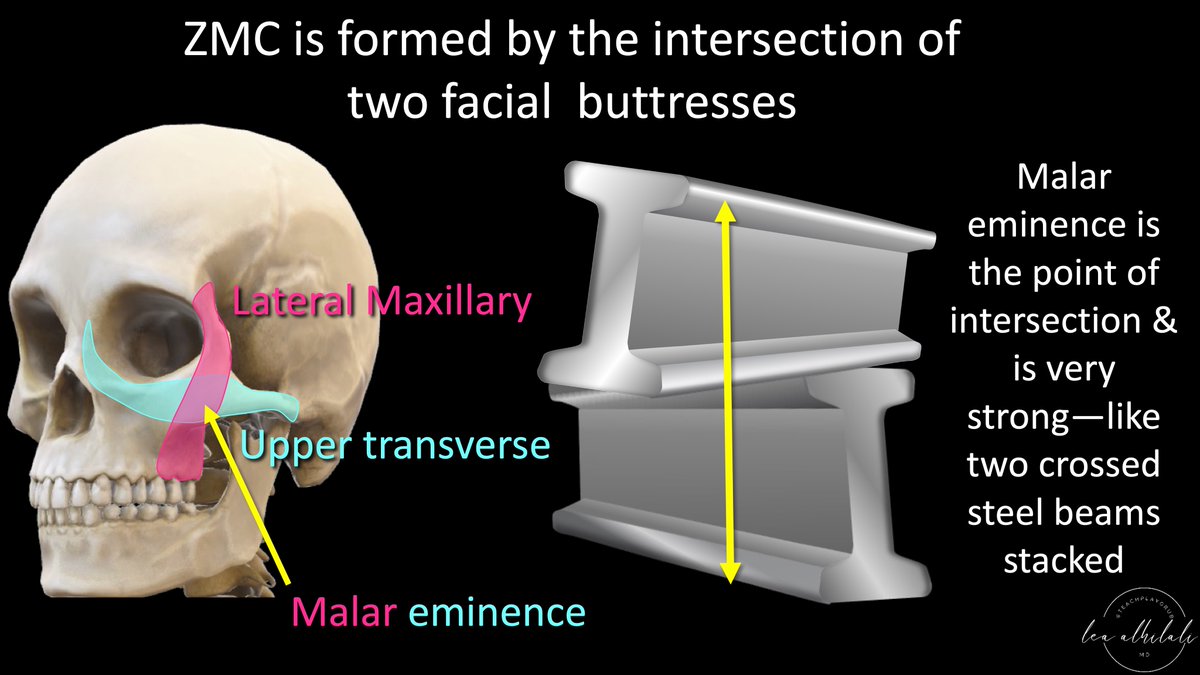
4/ZMC is formed by 2 intersecting facial buttresses. Buttresses are strong units that support our face—like a house frame
Malar eminence is at the intersection of the 2 buttresses—& since buttresses are very strong, their intersection is even stronger—like 2 stacked steel beams
Malar eminence is at the intersection of the 2 buttresses—& since buttresses are very strong, their intersection is even stronger—like 2 stacked steel beams
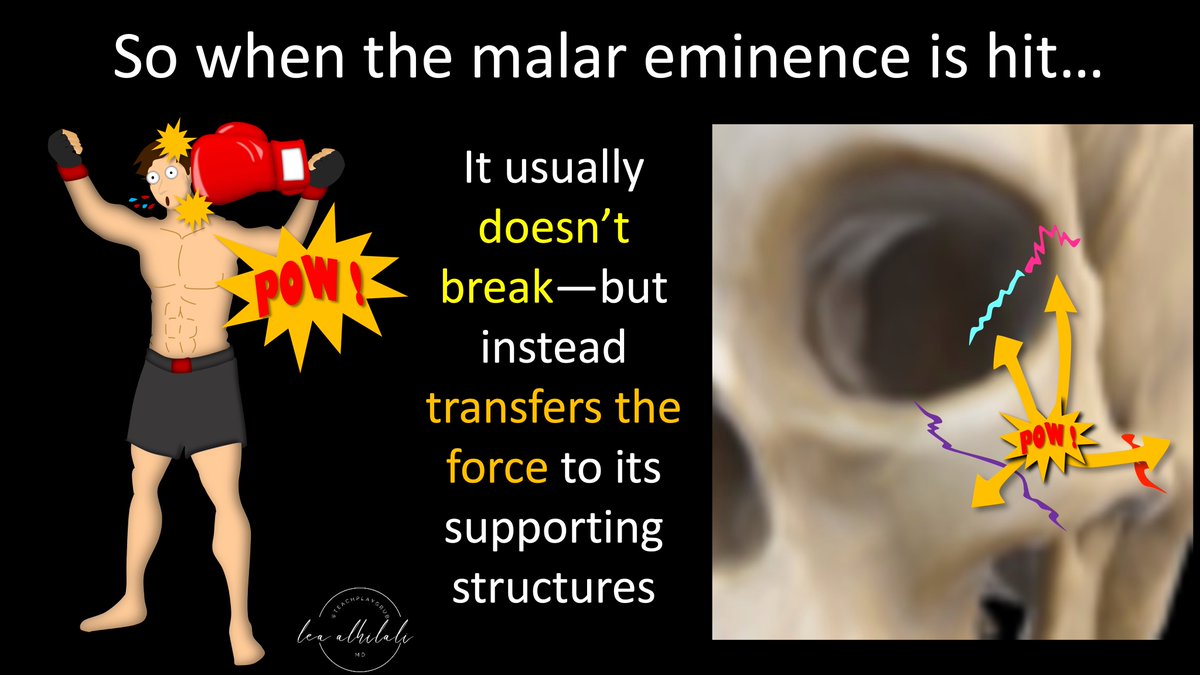
5/Bc the malar eminence is so strong, when it is hit—like in a good right hook--it doesn’t tend to fracture, but rather transfers the force to the supporting structures that attach it to the midface and skullbase
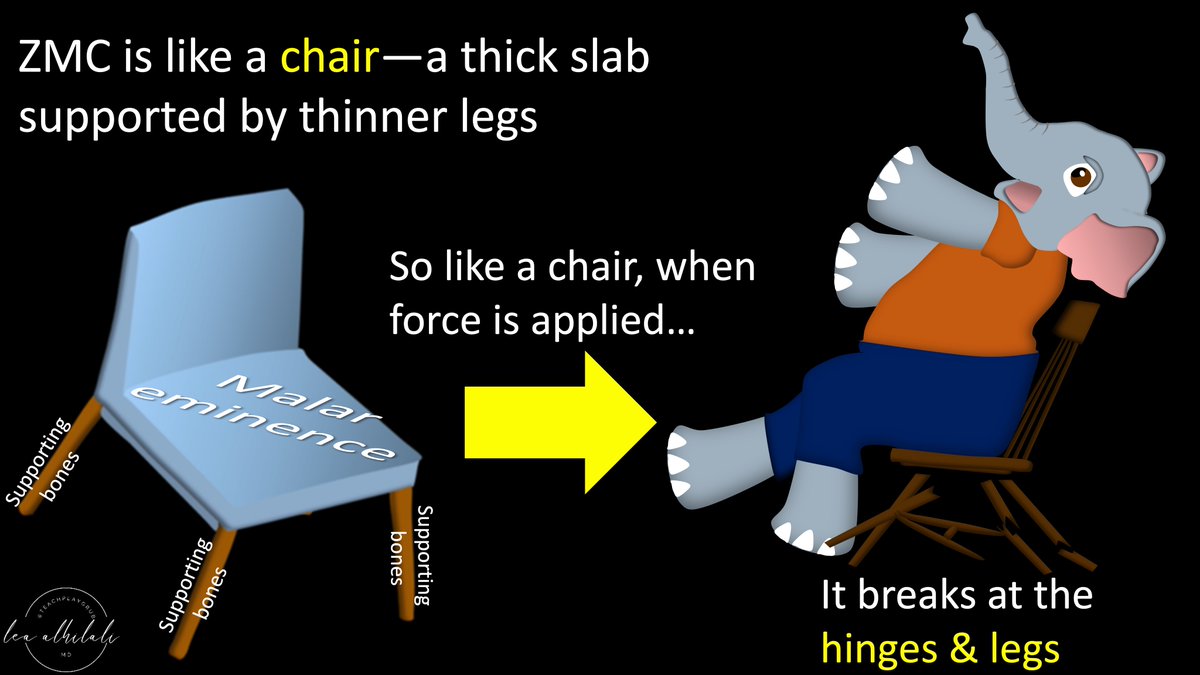
6/Think of the ZMC like a chair—there is the strong seat (malar eminence) & weaker legs (attachments).
So when force is applied to the malar eminence--like a chair--the seat does break, but rather the weaker legs/hinges are what crack.
So when force is applied to the malar eminence--like a chair--the seat does break, but rather the weaker legs/hinges are what crack.
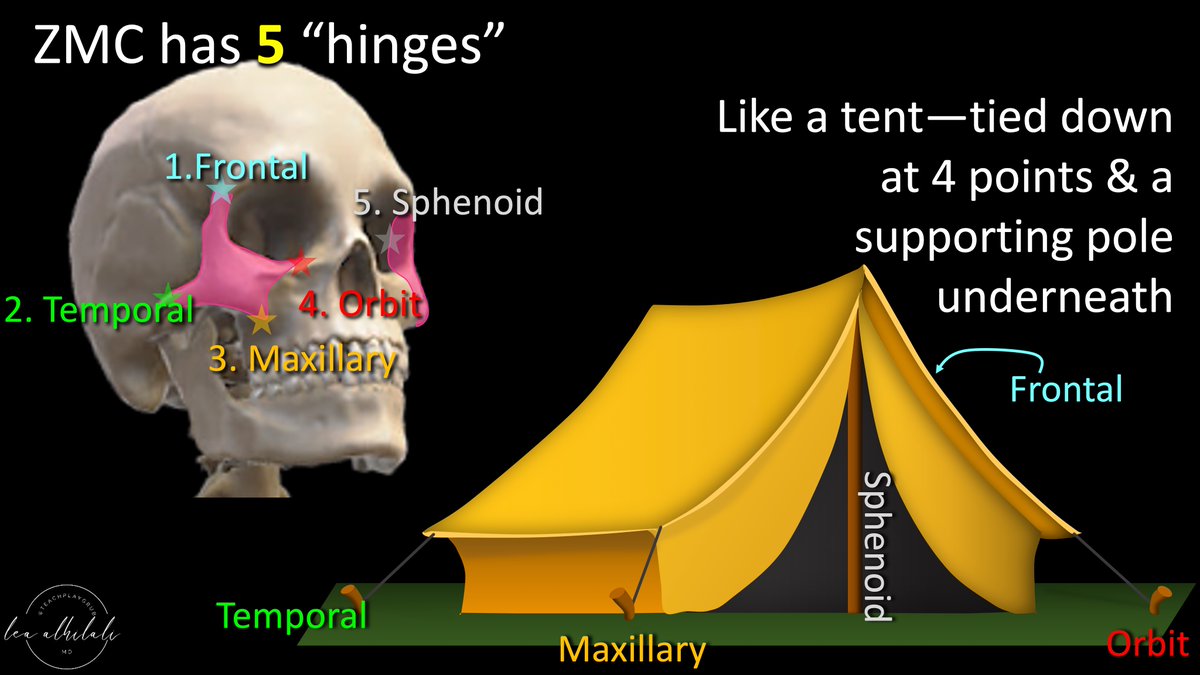
7/ZMC is a chair w/5 legs or hinges
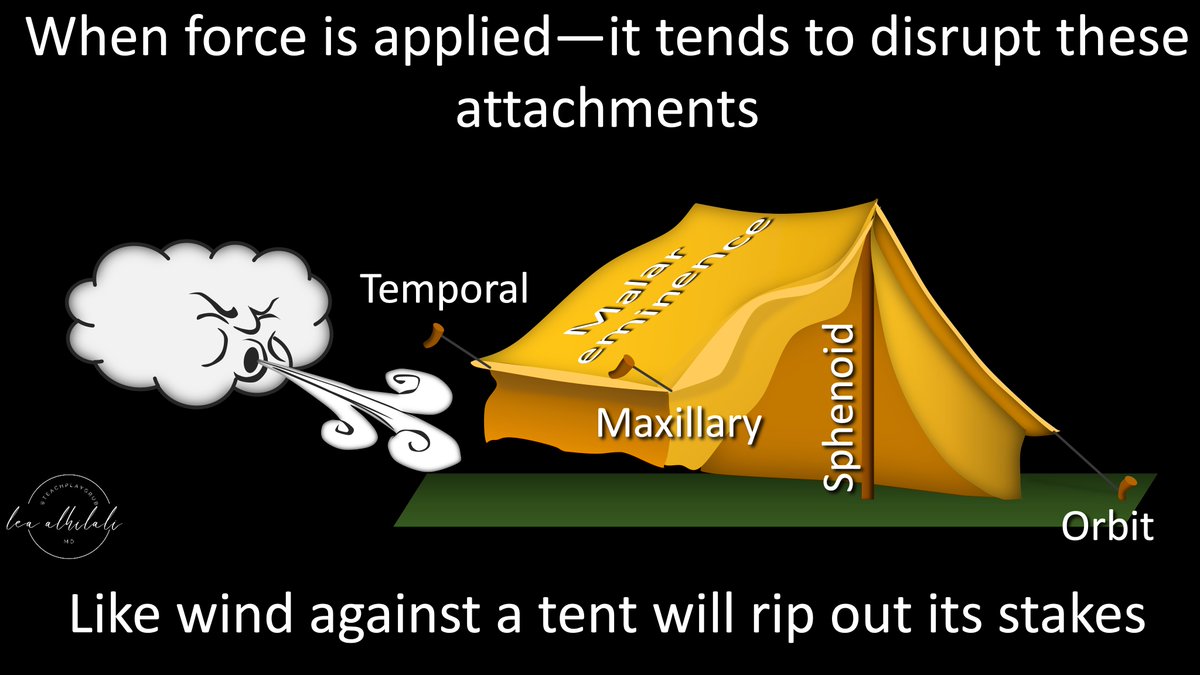
But chairs don’t usually have 5 legs, so think of it like a tent. There are 4 stakes at the periphery attaching it to the ground & one pole underneath
ZMC has 4 attachments to the midface & 1 attachment underneath to the skullbase (sphenoid)
But chairs don’t usually have 5 legs, so think of it like a tent. There are 4 stakes at the periphery attaching it to the ground & one pole underneath
ZMC has 4 attachments to the midface & 1 attachment underneath to the skullbase (sphenoid)
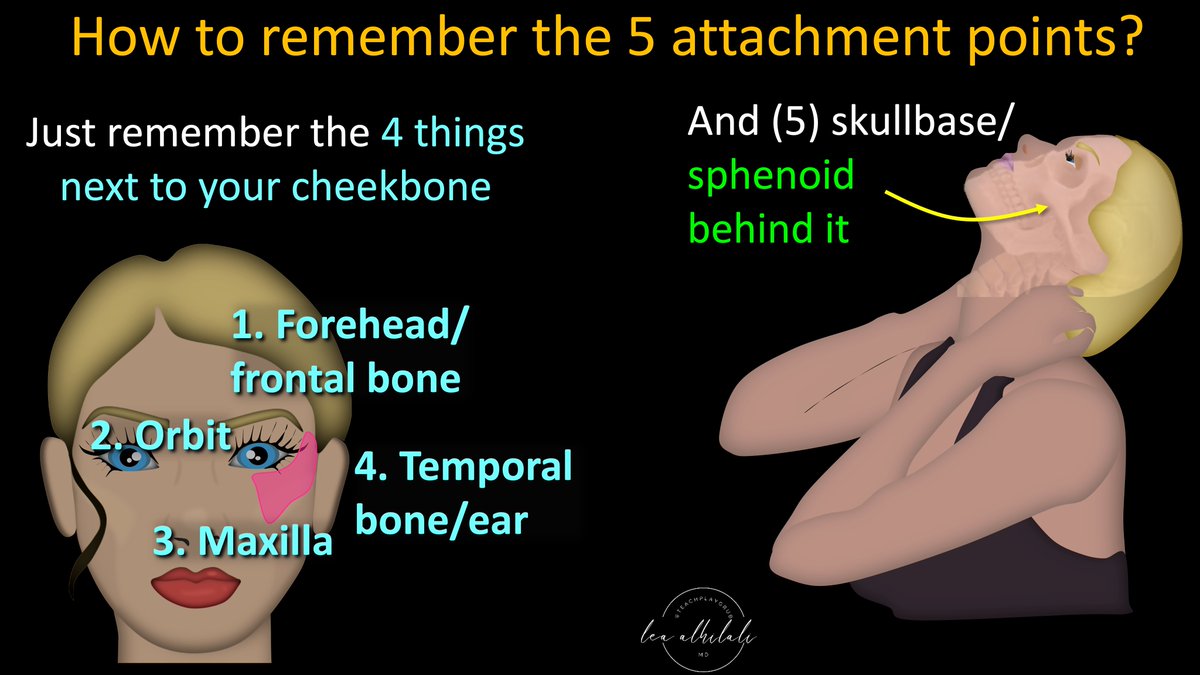
8/How to remember these 5 attachment points?
Just think of the structures that surround your cheekbone forehead (frontozygomatic), orbit (infraorbital), maxilla (zygomaticomaxillary), & ear (zygomaticotemporal).
Underneath it all is the skullbase/sphenoid (zygomaticosphenoid)
Just think of the structures that surround your cheekbone forehead (frontozygomatic), orbit (infraorbital), maxilla (zygomaticomaxillary), & ear (zygomaticotemporal).
Underneath it all is the skullbase/sphenoid (zygomaticosphenoid)
9/Like a tent attached by stakes & supported by a pole, forces like tend to rip the stakes out, detaching the tent from the ground.
Similarly, forces to the ZMC tend to detach the malar eminence from its attachment points by fracturing these connections
Similarly, forces to the ZMC tend to detach the malar eminence from its attachment points by fracturing these connections
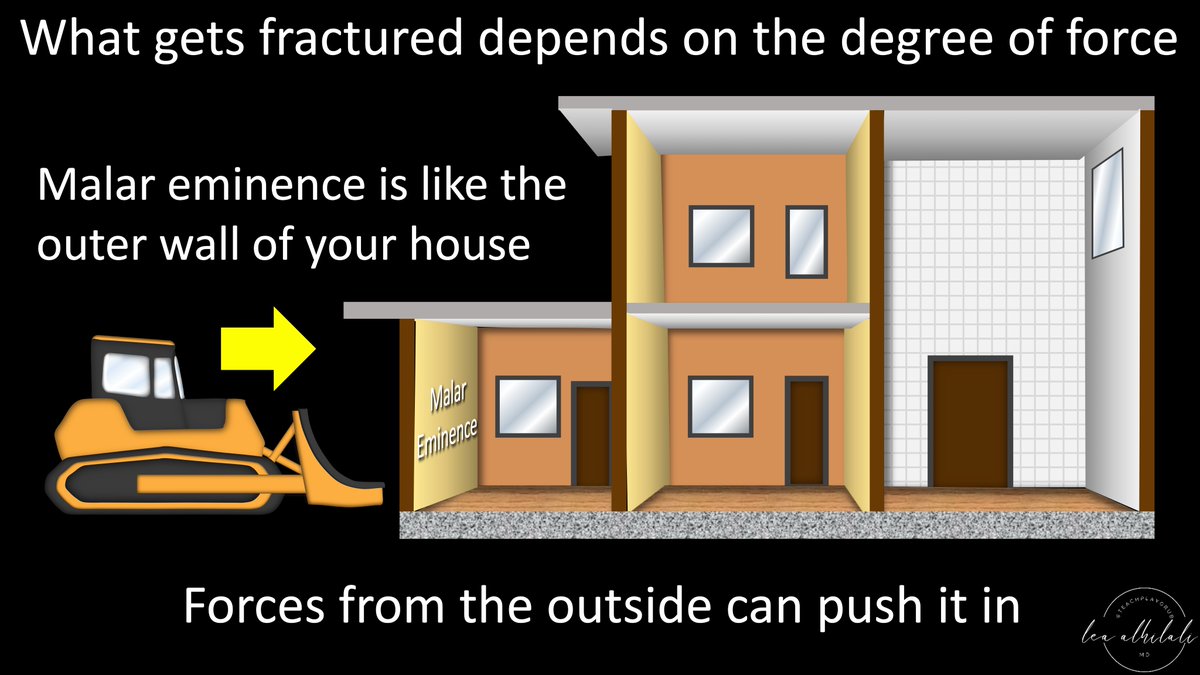
10/What gets fractured depends on the amount of force applied.
Think of the malar eminence like the strong outer wall of your house.
When a force like bulldozer is applied, it will push the wall into the house, detaching it from its attachments to the rest of the house
Think of the malar eminence like the strong outer wall of your house.
When a force like bulldozer is applied, it will push the wall into the house, detaching it from its attachments to the rest of the house
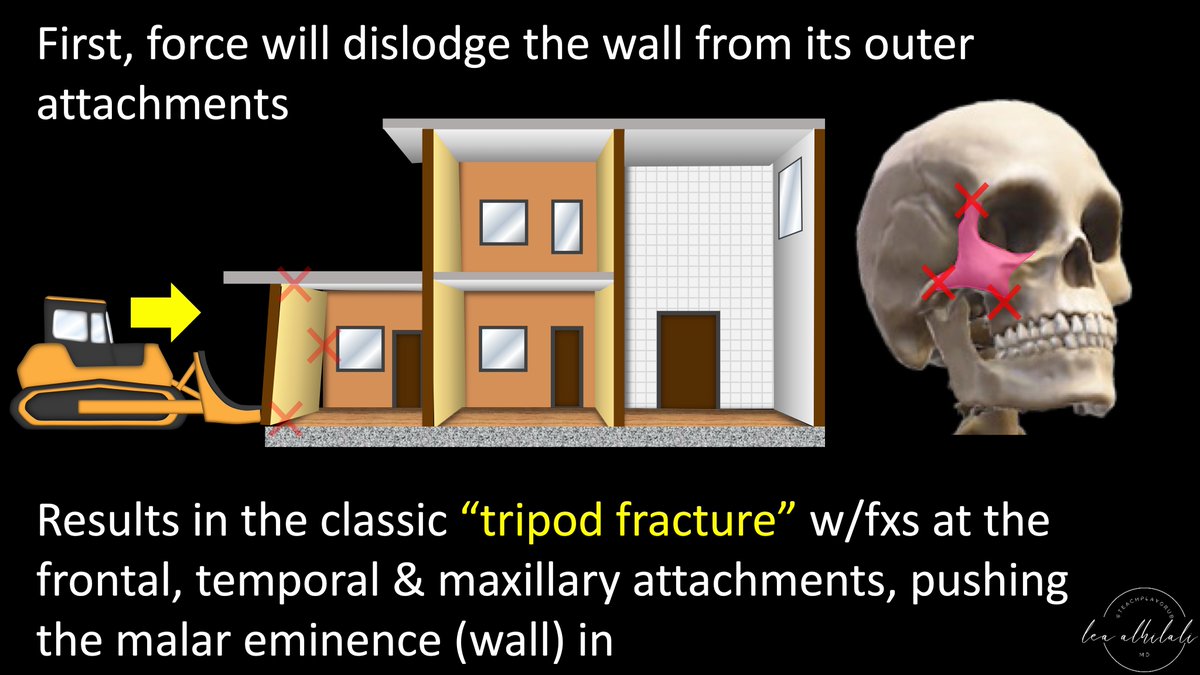
11/If the force is small, the wall will detach from just 1 attachment like the floor or roof. But typically, the force pushes the wall all the way in—full detachment.
This is the typical tripod fx—where main attachments to the midface are fractured & malar eminence is pushed in
This is the typical tripod fx—where main attachments to the midface are fractured & malar eminence is pushed in
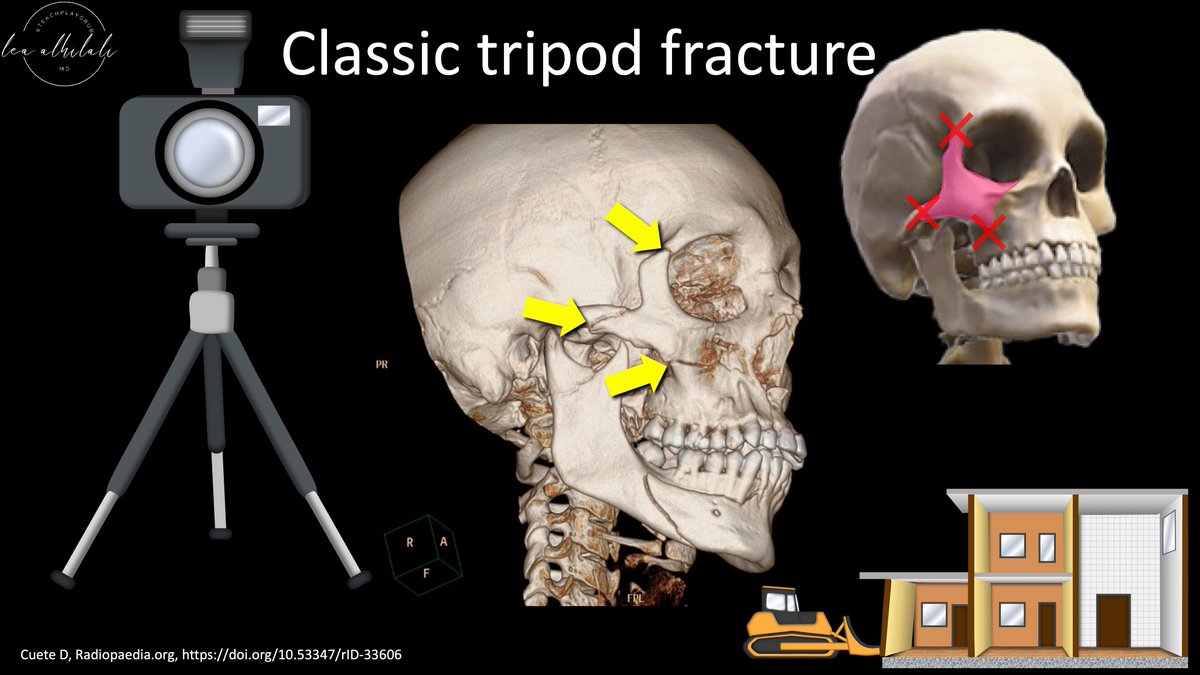
12/Here is an example of a tripod fracture. The three main attachment points (think of roof, floor, walls) are fractures, but the malar eminence is intact
13/If the force continues pushing the wall in, eventually, the wall will push on the floor so that the floor eventually buckles.
Same w/ZMC fxs. Continued force will cause the attachment at the orbital rim to fracture—resulting in an orbital floor fracture
Same w/ZMC fxs. Continued force will cause the attachment at the orbital rim to fracture—resulting in an orbital floor fracture
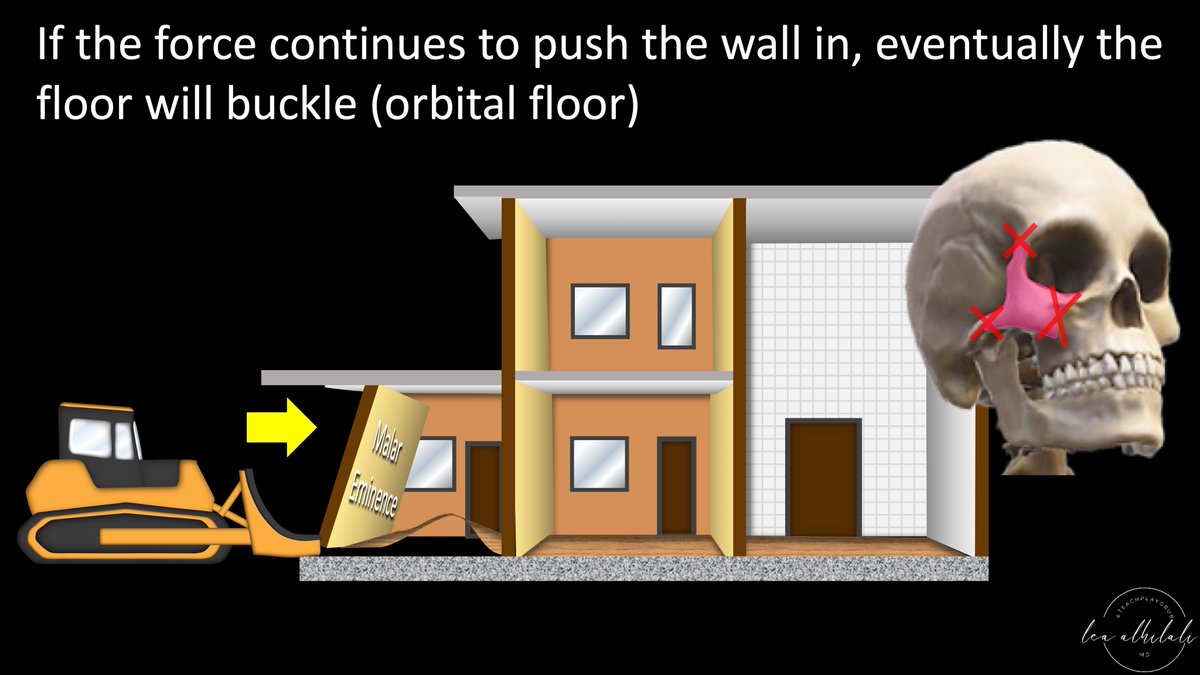
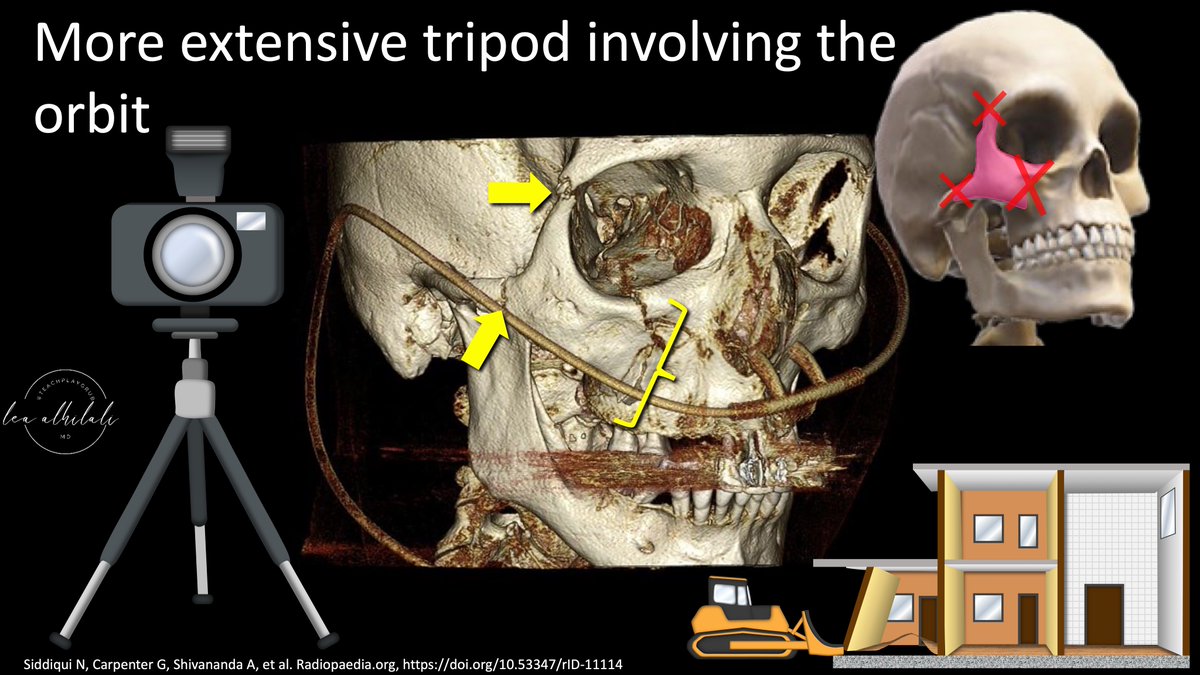
14/There is debate as to whether to call this fx a tetrapod or extended tripod fx. However, it is typically considered a more extensive tripod—where the malar eminence is detached like a typical tripod & but also pushed in enough that it buckles the orbital floor.
15/If the force continues pushing the wall in, eventually it will run into the deeper inner structures of the house & crush those.
For ZMC, deeper attachment, the deeper structure (the tent pole) is the sphenoid attachment.
For ZMC, deeper attachment, the deeper structure (the tent pole) is the sphenoid attachment.
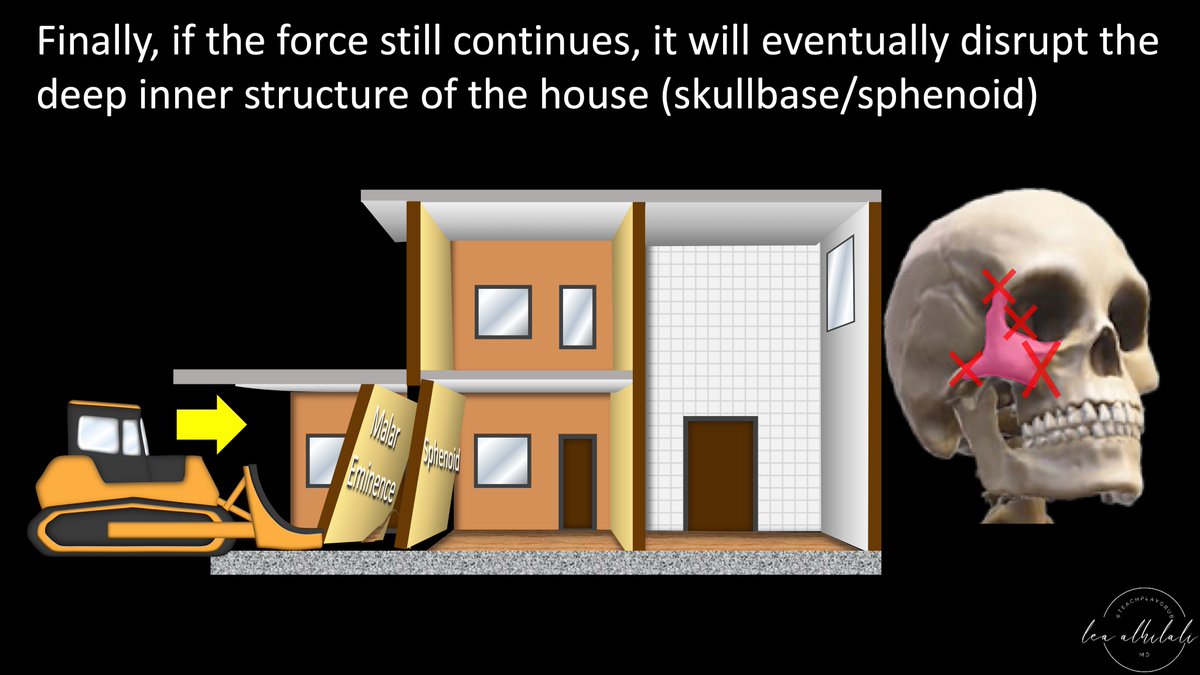
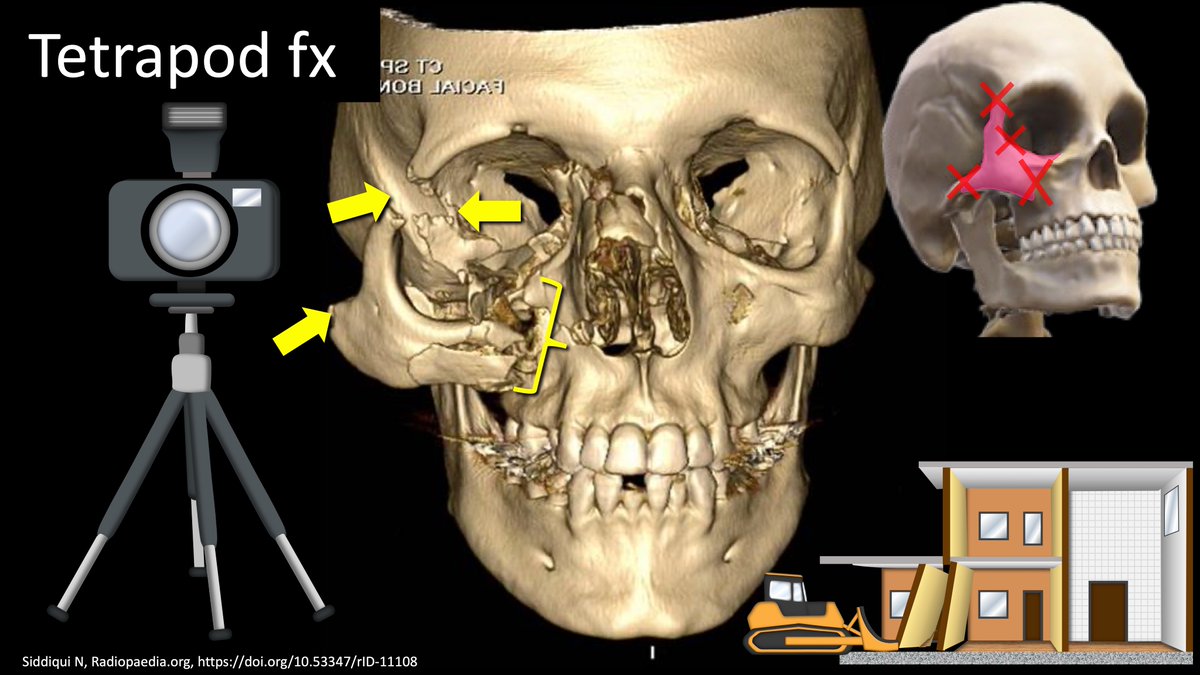
16/This is called a tetrapod fx, although some call it a pentapod fracture, if the orbital attachment is considered separate
The ZMC or outer wall has not only been detached, it’s been pushed in enough to fracture the inner structures of the skullbase, the sphenoid attachment
The ZMC or outer wall has not only been detached, it’s been pushed in enough to fracture the inner structures of the skullbase, the sphenoid attachment
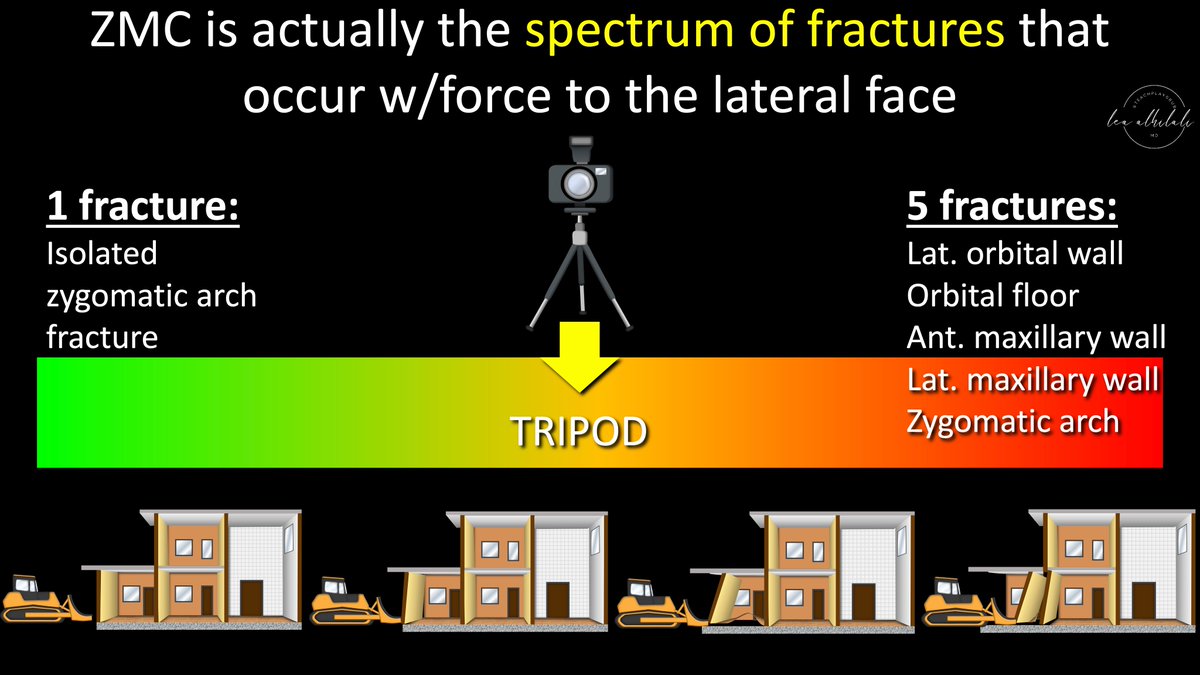
17/So ZMC fxs are actually a spectrum of fxs that occur when force is applied to the lateral face or cheekbone
They can span from a single zygomatic arch fx to up to 5 different fxs
The “tripod” fx is in the middle, w/3 fxs. But calling it a tripod doesn’t capture this spectrum
They can span from a single zygomatic arch fx to up to 5 different fxs
The “tripod” fx is in the middle, w/3 fxs. But calling it a tripod doesn’t capture this spectrum
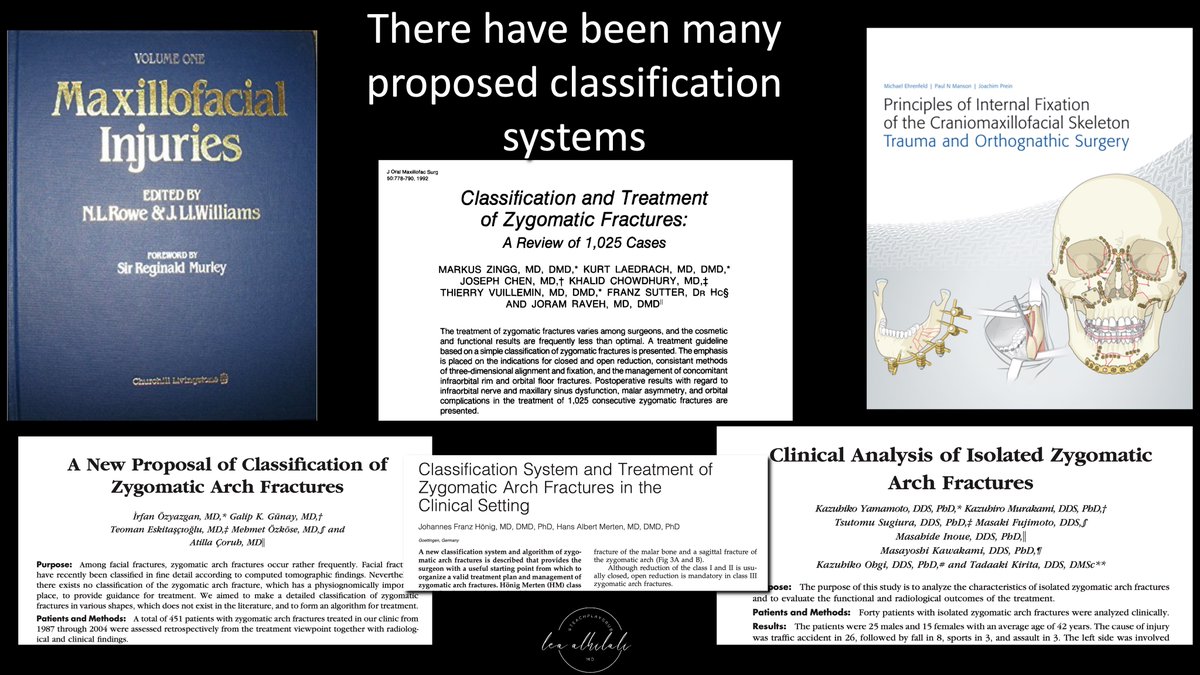
18/Numerous classification systems have proposed for ZMC fxs, some related to degree of force, others to need for internal fixation after reduction.
But most agree that these need to be treated on an individual basis, considering the other facial fxs that may accompany them
But most agree that these need to be treated on an individual basis, considering the other facial fxs that may accompany them
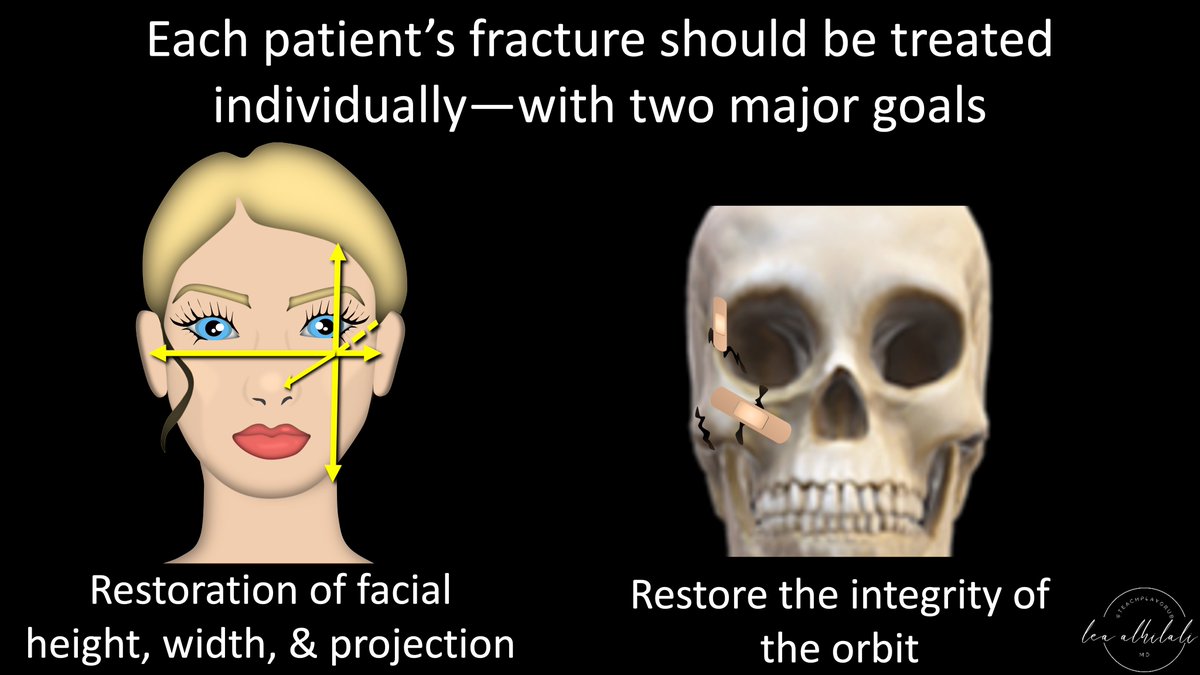
19/Treatment of ZMC fxs has 2 main goals: to restore facial height, width & projection (give back your model cheekbones) & restore orbital integrity to help preserve extraocular movement
Mandibular impingement is another consideration, but we’ll focus on the main two
Mandibular impingement is another consideration, but we’ll focus on the main two
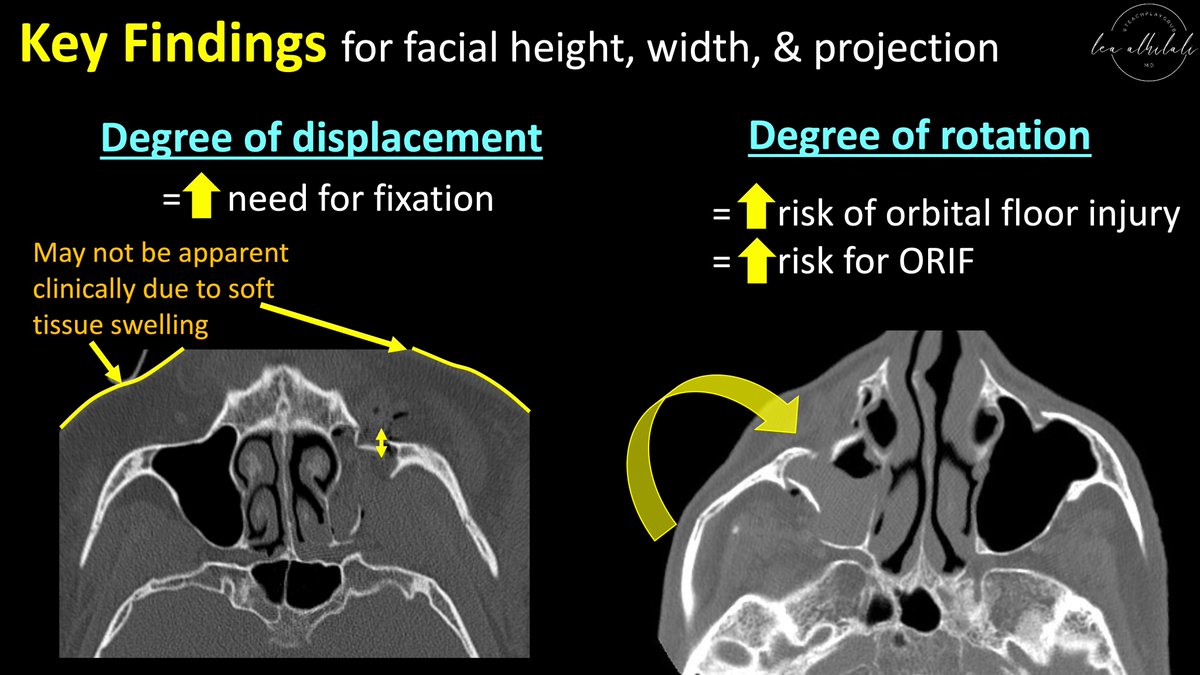
20/For restoring facial structure, the two important imaging findings are:
Displacement (displaced fractures need reduction)
Rotation (rotated fractures are more likely to have orbital fxs & need fixation)
These findings may not be visible clinically from soft tissue swelling
Displacement (displaced fractures need reduction)
Rotation (rotated fractures are more likely to have orbital fxs & need fixation)
These findings may not be visible clinically from soft tissue swelling
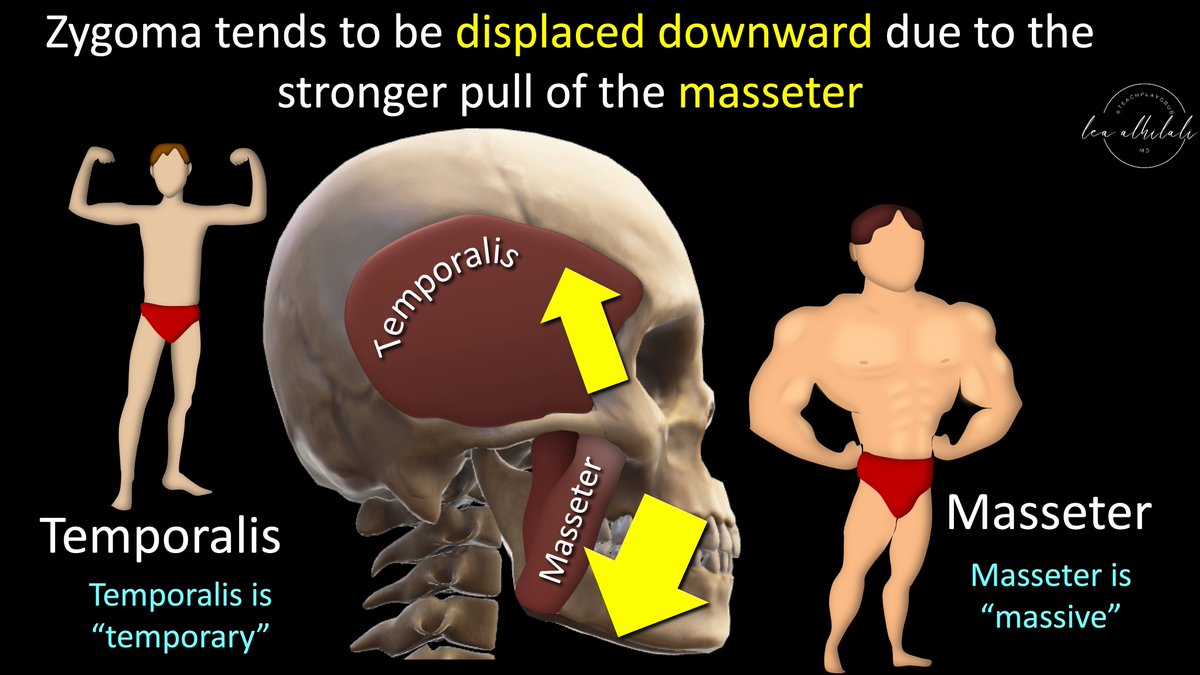
21/Almost all ZMC fractures in which the malar eminence is detached are displaced bc the downward pull of the masseter muscle is greater than the upward pull of the temporalis—so fxs are pulled down.
Remember massive is greater than temporary, so masseter wins!
Remember massive is greater than temporary, so masseter wins!
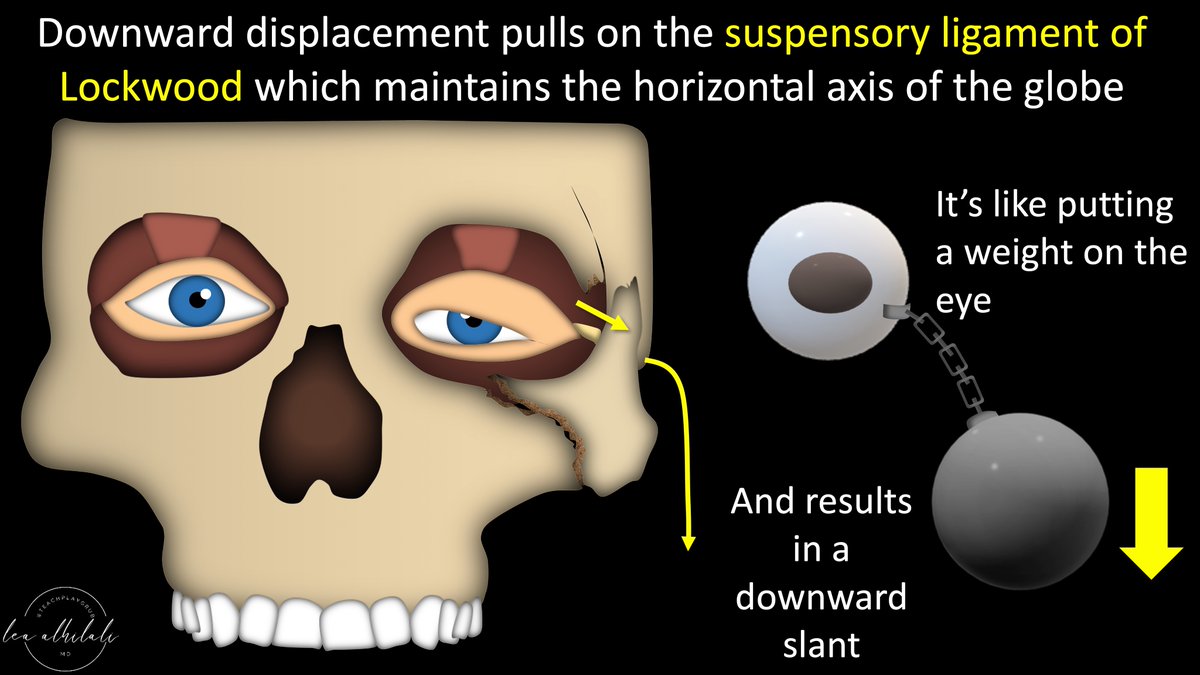
22/This downward displacement affects the orbit—bc the ligament responsible for maintaining the horizontal position of the globe inserts onto the zygoma. So when the zygoma goes down, it goes down with it, resulting in a downward slant to the globe
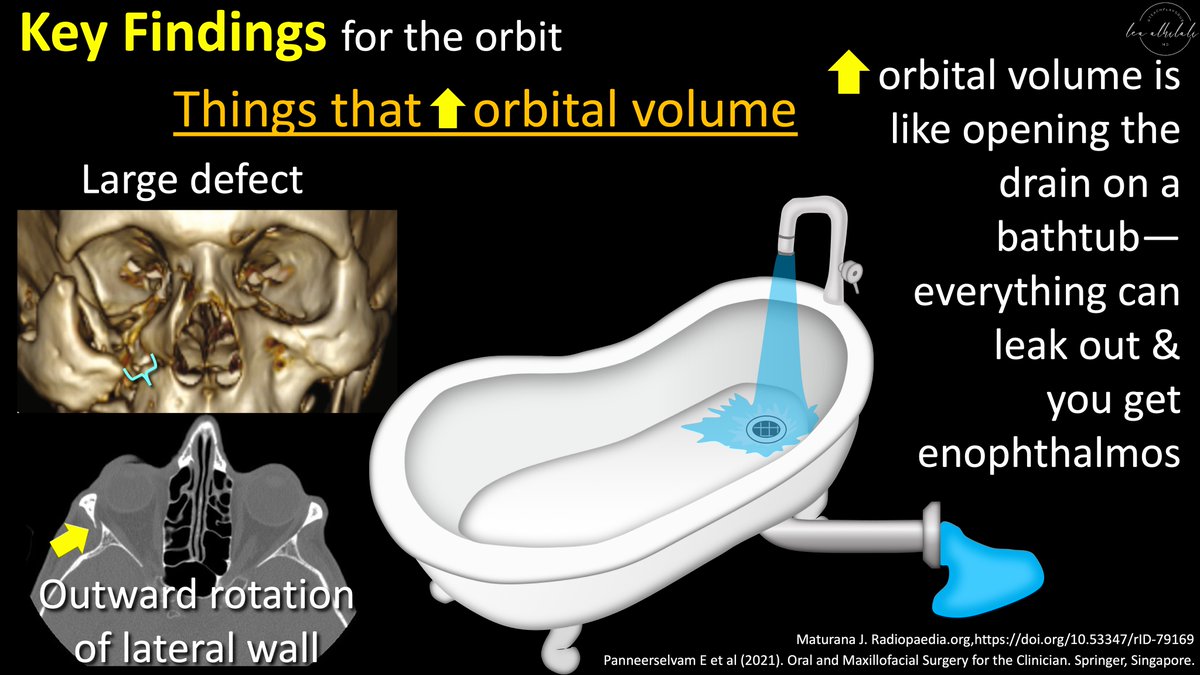
23/For orbital integrity—mention anything that may increase orbital volume—like large orbital fxs or lateral wall outward rotation
These increase the need for orbital reconstruction bc increasing orbital volume is like opening a drain, things can sink out & cause enophthalmos
These increase the need for orbital reconstruction bc increasing orbital volume is like opening a drain, things can sink out & cause enophthalmos
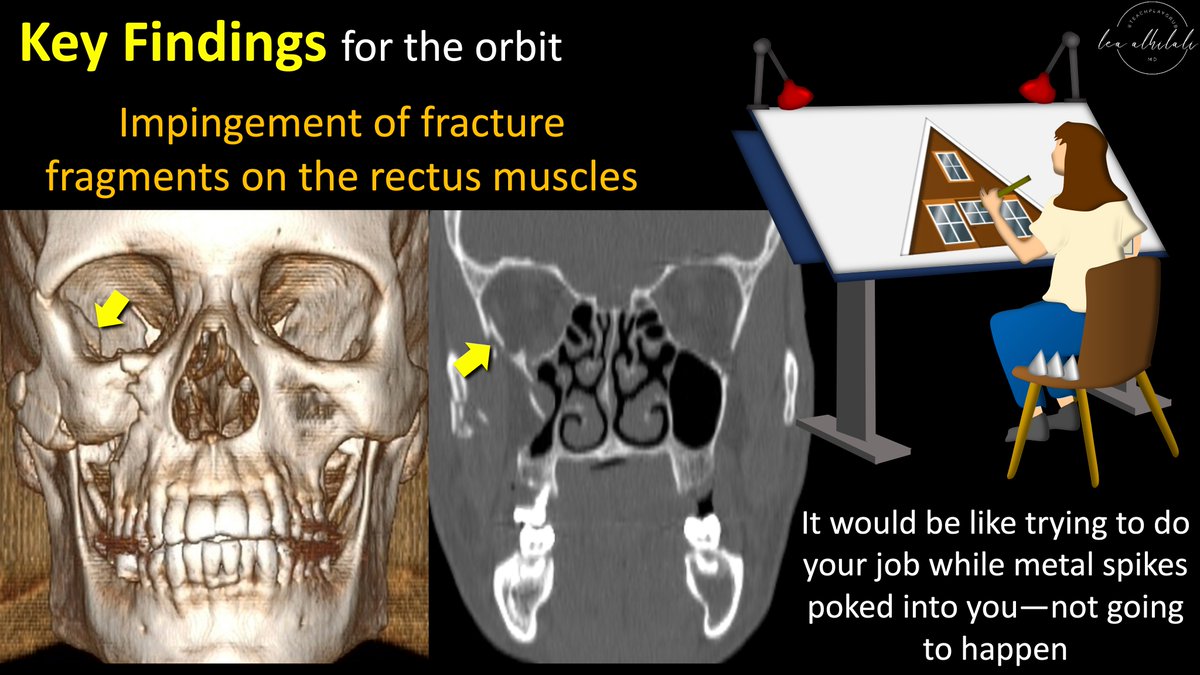
24/Also mention any fracture fragments that may impinge on orbital structures, such as the extraocular muscles or orbital apex.
Having sharp fracture fragments impinging on orbital structures is like trying to do your work sitting on spikes—you can’t do your job!
Having sharp fracture fragments impinging on orbital structures is like trying to do your work sitting on spikes—you can’t do your job!
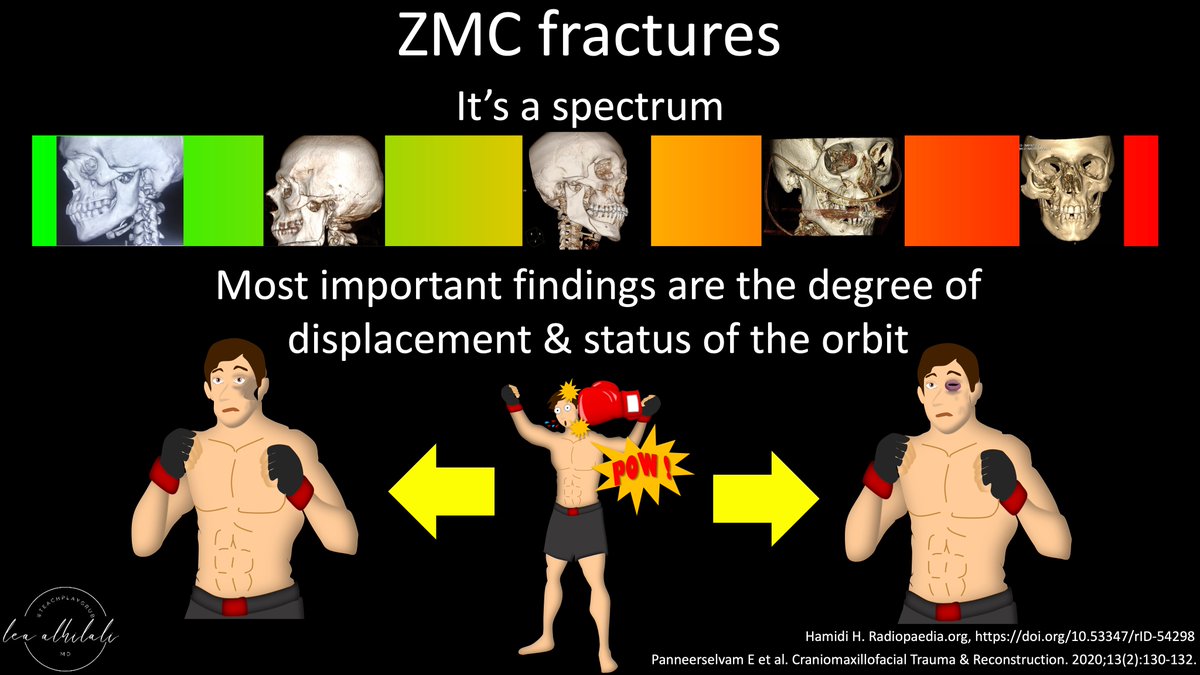
25/ZMC fxs are a spectrum. Call them ZMC to full capture the mechanism & all related fxs
And remember—key findings are displacement/rotation & orbital integrity
So when it comes to calling them tripods, don’t just turn the other cheek—remember they’re part of the ZMC spectrum!
And remember—key findings are displacement/rotation & orbital integrity
So when it comes to calling them tripods, don’t just turn the other cheek—remember they’re part of the ZMC spectrum!
Loading suggestions...