

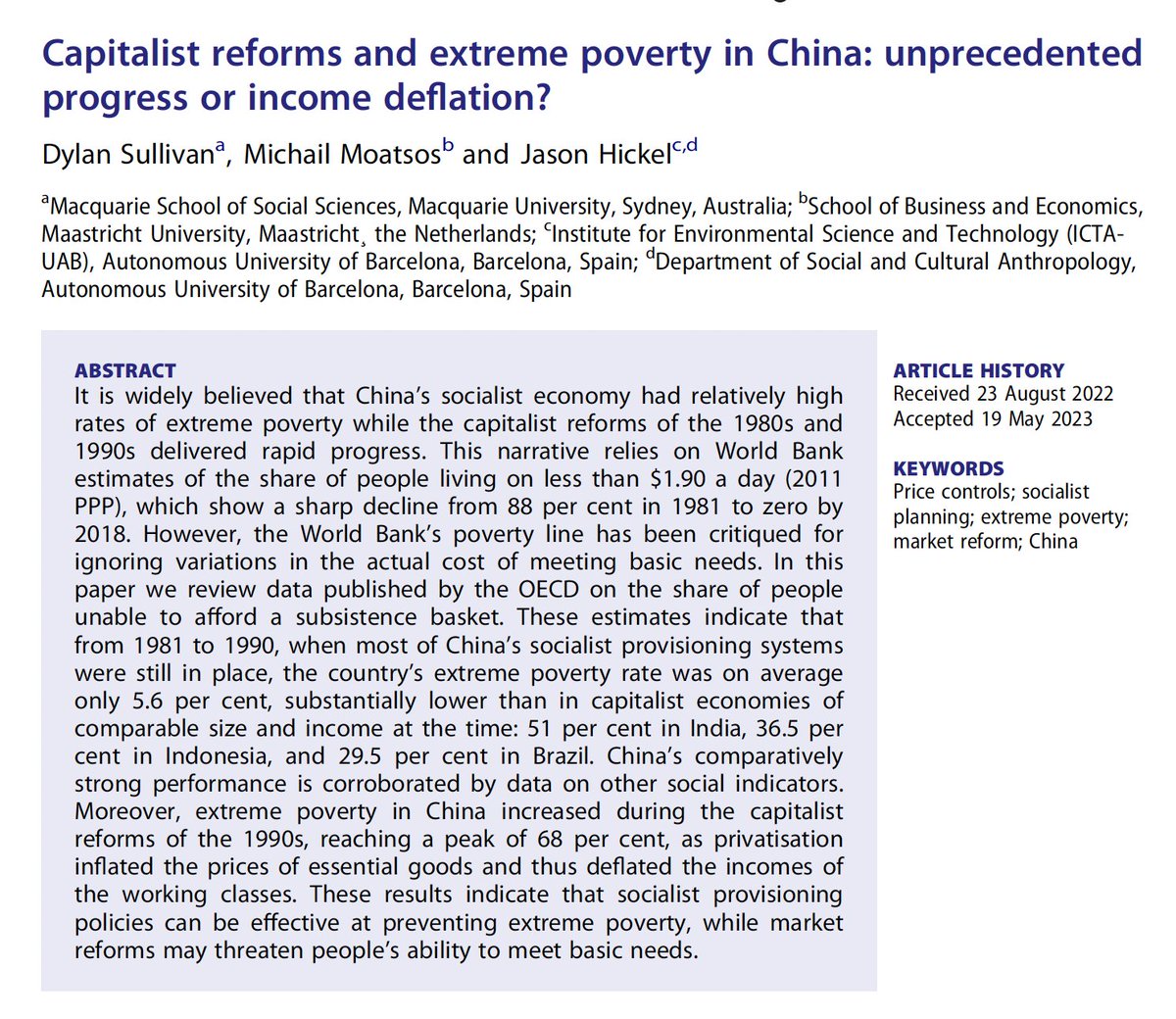
I'm excited to announce this new paper with Dylan Sullivan and Michail Moatsos. We explore the effect of capitalist reforms on extreme poverty in China. It's a surprising and fascinating story, with important implications for policy. 🧵 tandfonline.com

The dominant narrative holds that socialist China had high rates of extreme poverty, and the capitalist reforms of the 1990s brought rapid progress (as in this graph). This narrative is based on the World Bank method of measuring PPP-income against the $1.90 threshold.
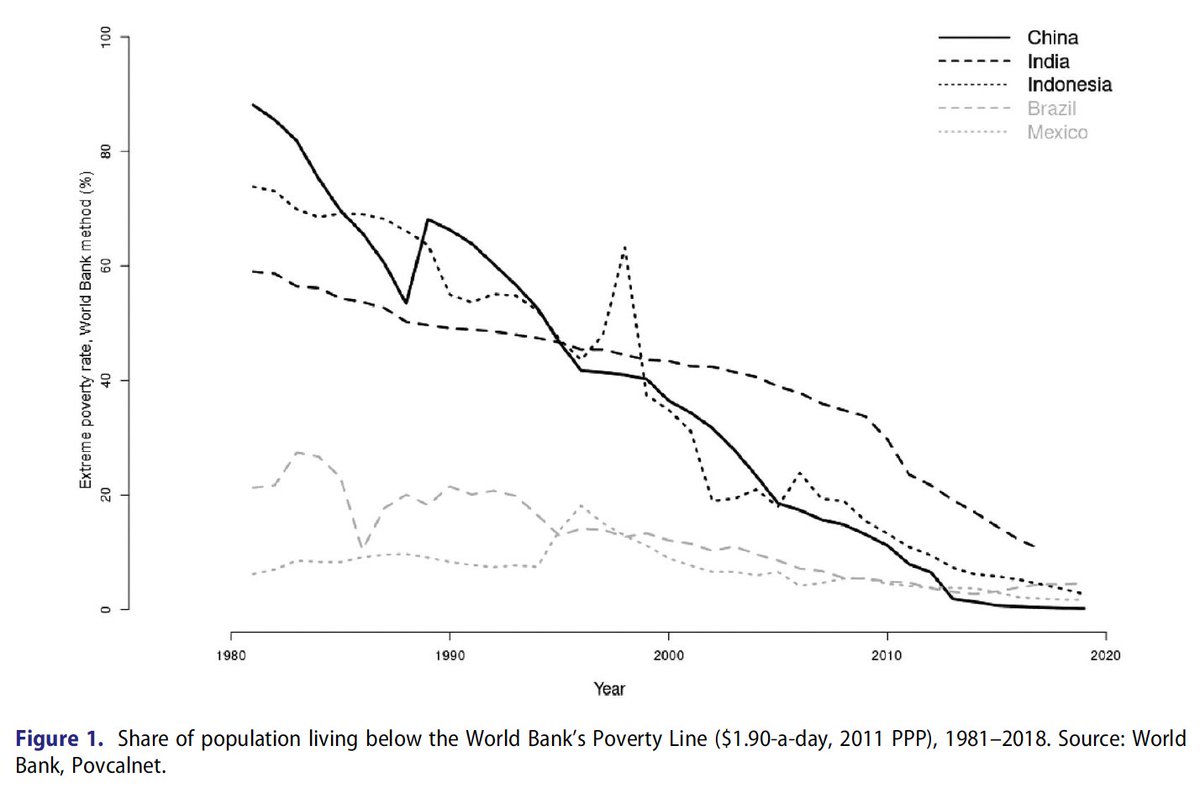
But there's a problem. For more than a decade the World Bank's method has been criticised for ignoring variations in the cost of basic needs (food, clothing, fuel, shelter). Basically, the WB poverty data does not tell us whether people can actually access necessary goods.
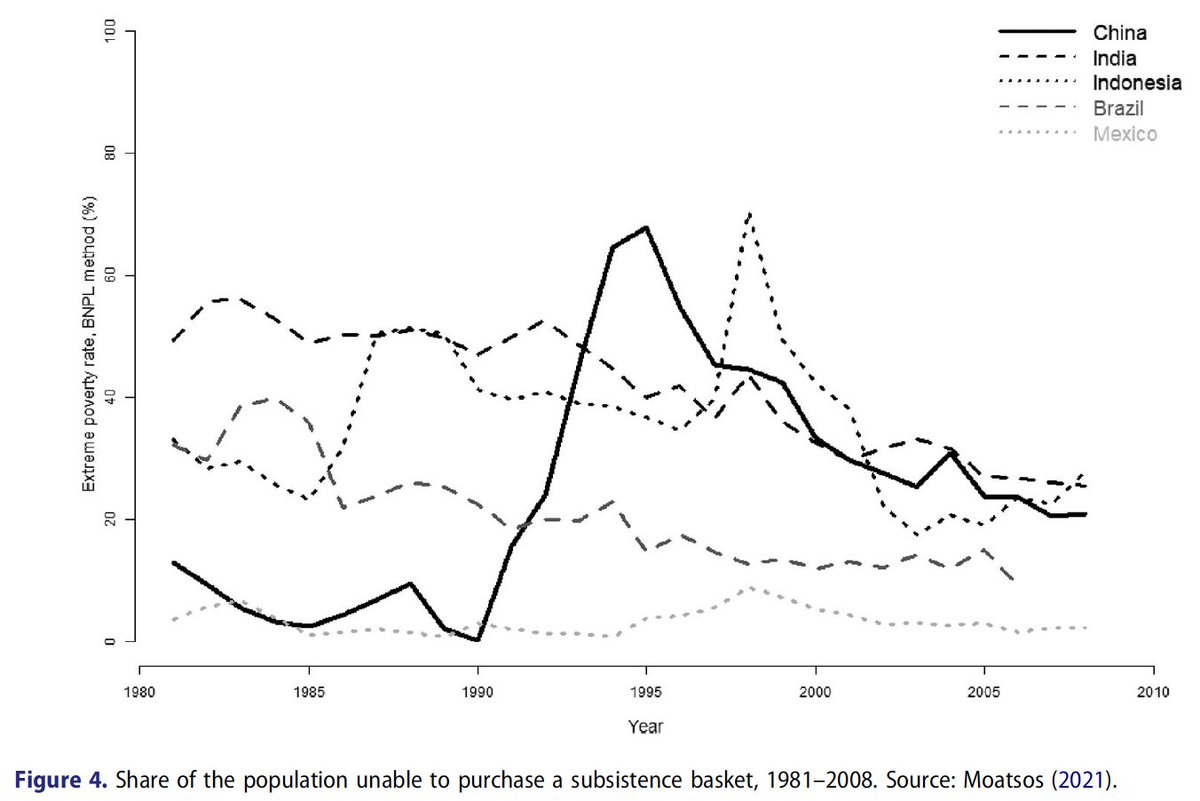
In recent years, scholars have developed a more empirically robust approach, which measures people's income against the cost of basic needs. The OECD published data from 1981-2008 (they have other years too, but not based on direct data; see footnote 2).
What does it show?
What does it show?
We see extreme poverty in China was relatively low in the 1980s, when most of China's socialist provisioning systems were still in place. China outperformed capitalist countries of similar size and income (India and Indonesia), and many middle-income countries too (like Brazil).
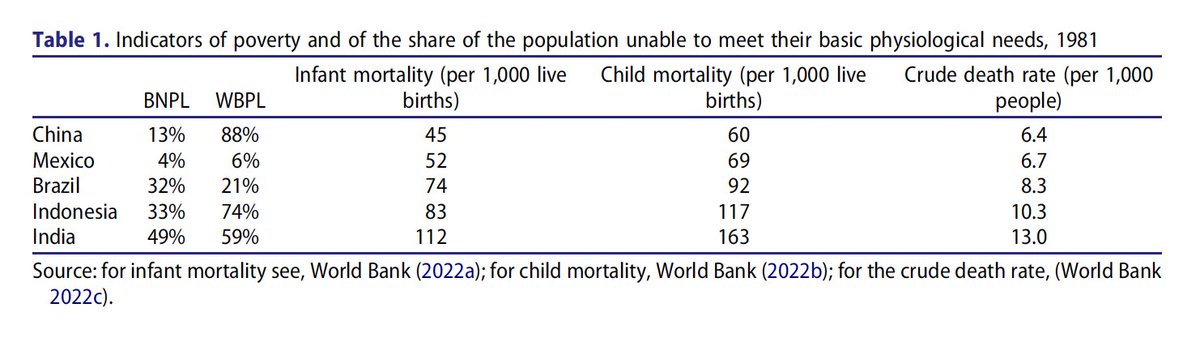
This story is supported by data on key social indicators. We checked 14 indicators. In most cases, China outperformed the other countries. Table 1 shows performance on various mortality rates (see the paper for all the other indicators).
Then what happened? The capitalist reforms of the 1990s caused poverty to rise substantially, as China's public provisioning systems were dismantled. Privatization inflated the prices of essential goods and thus deflated the incomes of the working classes. The graph again:
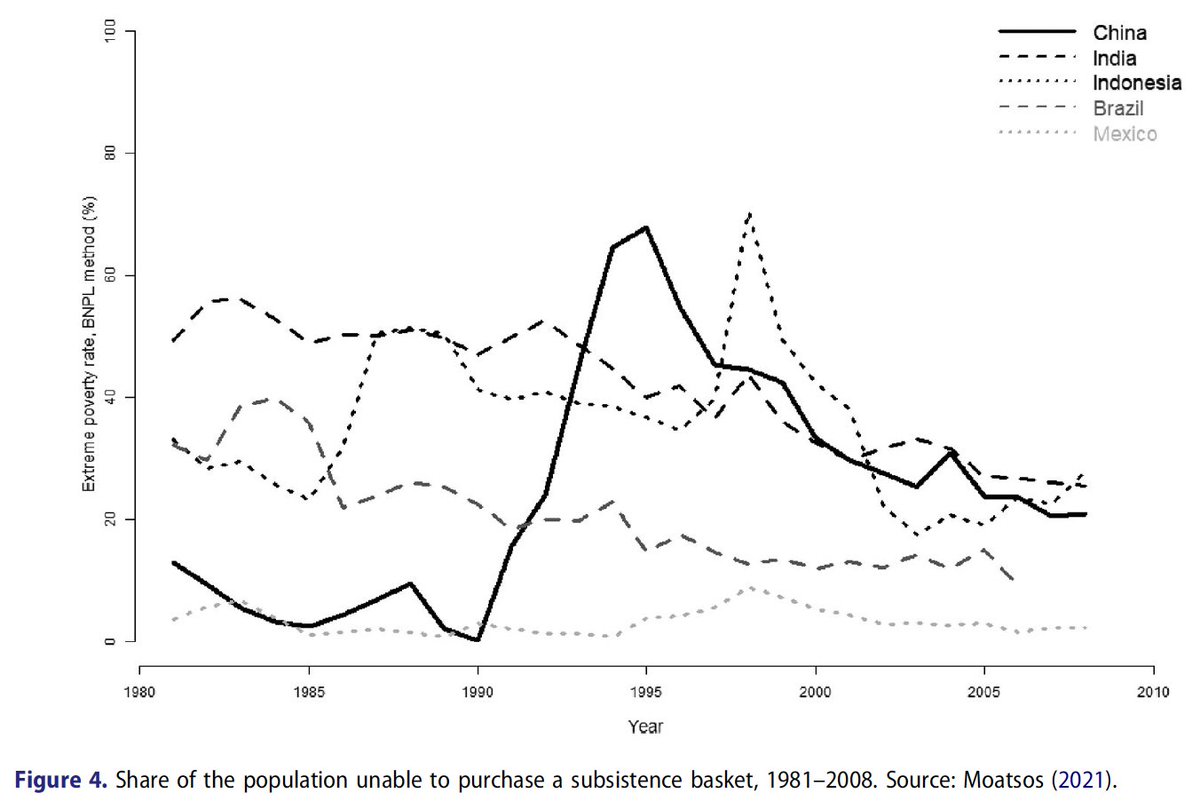
Not only China. Market liberalization (quite often imposed through WB/IMF structural adjustment programmes) caused extreme poverty to worsen in many other countries during this period too.
Thankfully, China has gradually recovered from this crisis. Real data only goes to 2008, but Moatsos credibly indicates the poverty rate was down to 5% by 2018, as the labour movement gains strength and as Xi's anti-poverty programmes deliver progress.
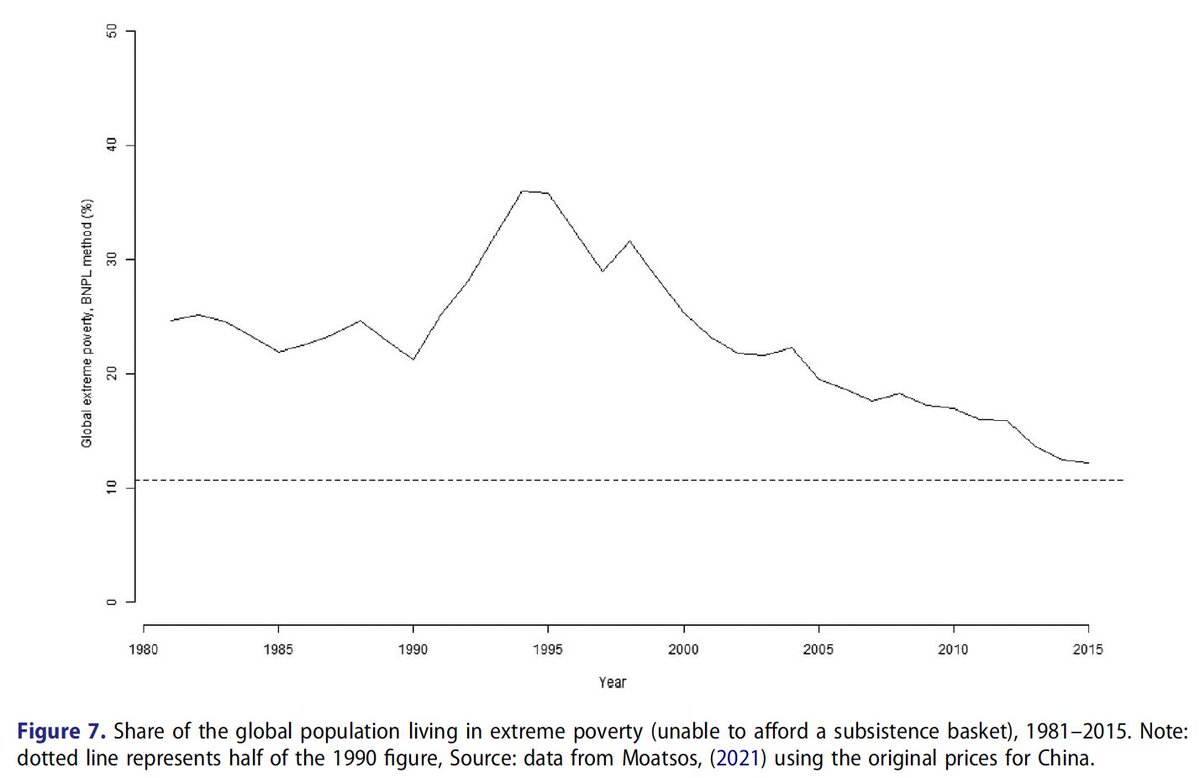
So what does the needs-based metric say about global poverty? While poverty rates declined after the end of colonialism, they increased during the neoliberal period. Progress has resumed since ~2004.
But the MDG target (cut the poverty rate in half by 2015) was missed (just).
But the MDG target (cut the poverty rate in half by 2015) was missed (just).
What can we learn from all this? Well, public provisioning systems (and price controls) can be *very* effective at preventing poverty and improving social outcomes. Especially in developing countries. This enabled China to outperform much richer nations.
But note that the poverty line here is focused on basic needs. Clearly China of the 1980s needed to increase industrial production to deliver higher-order living standards! We argue this could have been done without the capitalist reforms, thus preventing quite a lot of misery.
There's much more to this paper and I hope it will answer all the questions that may arise. See also our discussion of limitations. It's open-access and available here: tandfonline.com
Loading suggestions...