
1. Hindus have deep confusion about the role of Shastras in Hindu Dharma. There is a great resistance towards accept Hindu Shastra as being central to Hindu life, philosophy, worldview, and our civilization as a whole.
2. One of the important reasons for this confusion & negative attitude is utter ignorance and inability to properly understand and appreciate Shastra as Shabda-Pramana i.e. one of the authentic source of valid knowledge.
3. By Hindu Shastra, I am only referring to Dharma & Upasana, and Moksha Shastras which would include all core texts of Hindu Dharma, namely Veda (including Upanishads), Smritis, Itihasa-Puranas, Agama, and Tantras.
4. There is a wonderful verse in #Manusmriti which gives a good perspective to understand Shastra as Pramana. It basically explains about when a person undertake actions, how exactly this comes to happen, what mental activities precedes one's actual performance of action.
5. Manu 2.3 says:
सङ्कल्पमूलः कामो वै यज्ञाः सङ्कल्पसम्भवाः । व्रतानि यमधर्माश्च सर्वे सङ्कल्पजाः स्मृताः ॥
Desire (Kama) has its root in Thought (Sankalpa); Sacrifices proceed from Thought; Vows and Restraints—all these have been described as originating in Thought.
सङ्कल्पमूलः कामो वै यज्ञाः सङ्कल्पसम्भवाः । व्रतानि यमधर्माश्च सर्वे सङ्कल्पजाः स्मृताः ॥
Desire (Kama) has its root in Thought (Sankalpa); Sacrifices proceed from Thought; Vows and Restraints—all these have been described as originating in Thought.
6. Medhatithi in his commentary enumerates how actual performance of action is impelled by three mental activities: a. Sankalpa (Thought/Idea about Karma-Karmaphala relationship) b. Kama (Longing/desire to attain the phala) c. Nishchaya (Mental resolve to act to attain phala)
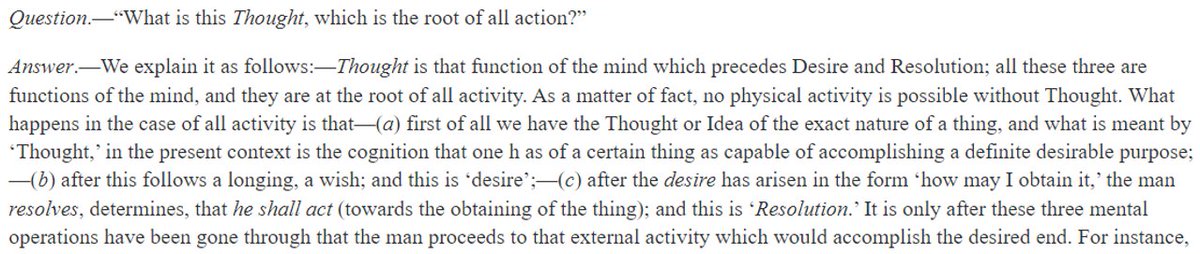
7. It may be asked, how does Shastra come into the picture in this at all? When it is said that Shastra is a Pramana, what it means is that it is a source of knowledge which reveals the goal and the method to attain that goal.
8. In the case of Dharmashastra, the goal or phala is attainment of Punya, Sukha, Svarga, Chittashuddhi. The means are Karmas that have to be performed and avoided which the Shastras respectively enjoin through Vidhi and prohibited through nishedha.
9. In the case of Upasana Shastras, it reveals the Upasana methods and their respective end results which could be Devata Siddhi, Salokya mukti, etc.
Mokshashastra reveals the ultimate goal of life and the path to attain the same.
Mokshashastra reveals the ultimate goal of life and the path to attain the same.
10. In other words, the function of the Shastras is to facilitate in the Sankalpa or the proper understanding of the desired goals and the means to attain those goals.
11. Shastras reveals knowledge about objects such as Sukha, Svarga, Moksha, etc. which non-empirical and hence cannot be gained from other Pramanas like direct perception, inference, etc.
Therefore, Shastras are irreplaceable and immutable, and hence, core of Hindu civilization.
Therefore, Shastras are irreplaceable and immutable, and hence, core of Hindu civilization.
Loading suggestions...