

If you're preparing for the USMLE, here are ways you can get the most out of reviewing an NBME practice assessment...
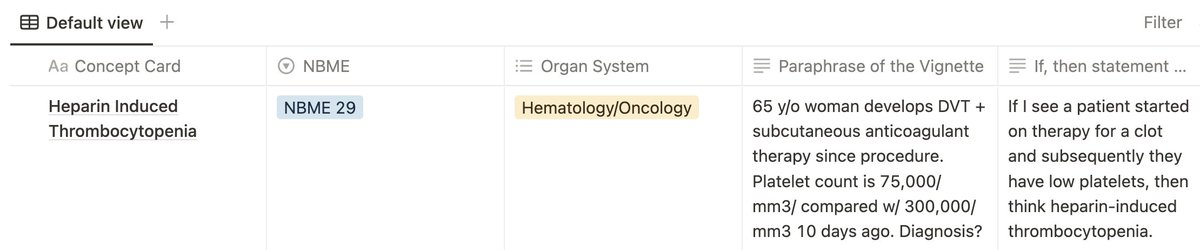
To optimally review your incorrects, create a table with the following columns:
1. NBME #
2. Topic tested
3. Organ System
4. Subdomain OR Clerkship
5. Paraphrase
6. If then statement...
7. Question Style
8. Test Taking Psychology
Let's define each header...
1. NBME #
2. Topic tested
3. Organ System
4. Subdomain OR Clerkship
5. Paraphrase
6. If then statement...
7. Question Style
8. Test Taking Psychology
Let's define each header...
1. NBME # (form)
This will help you visually track your weak content areas across each of your progress assessments.
Step 1: NBME # 25-30, UWSA 1, UWSA 2, Free 120
Step 2: NBME 9-13, UWSA 1, UWSA 2, Free 120
This will help you visually track your weak content areas across each of your progress assessments.
Step 1: NBME # 25-30, UWSA 1, UWSA 2, Free 120
Step 2: NBME 9-13, UWSA 1, UWSA 2, Free 120
2. Topic tested
Understanding the focal point of the assessment is important to define.
Step 1 - what basic science concept is being tested (leveraging where this concept is in First Aid will be helpful)
Step 2 - what diagnosis is being assessed? management of which dx?
Understanding the focal point of the assessment is important to define.
Step 1 - what basic science concept is being tested (leveraging where this concept is in First Aid will be helpful)
Step 2 - what diagnosis is being assessed? management of which dx?
3. Organ System
Categorizing the organ system helps create a neural network in your brain to characterize the symptoms & organize the dx so you can make good ddx.
If you see 2 or more systems involved or its a genetic syndrome, then the cell should be tagged 'multi-system'
Categorizing the organ system helps create a neural network in your brain to characterize the symptoms & organize the dx so you can make good ddx.
If you see 2 or more systems involved or its a genetic syndrome, then the cell should be tagged 'multi-system'
4. Subdomain OR Clerkship
Step 1 Subdomains: Embryology, Anatomy, Physiology, Pathology, Pharmacology, Biochem, Immuno, Microbio
Step 2 CK Clerkships: OB, Peds, FM, Psych, IM, Neuro, Surgery, EM
This will help you identify weak areas esp if you link it to organ system!
Step 1 Subdomains: Embryology, Anatomy, Physiology, Pathology, Pharmacology, Biochem, Immuno, Microbio
Step 2 CK Clerkships: OB, Peds, FM, Psych, IM, Neuro, Surgery, EM
This will help you identify weak areas esp if you link it to organ system!
5. Paraphrase
Create a mental representation of the q:
CC + symptoms + PE + labs/imaging
Ex: 7 yo + jaundice + scleral icterus + low hapto
Preserve the stem of the question in your paraphrase...
Create a mental representation of the q:
CC + symptoms + PE + labs/imaging
Ex: 7 yo + jaundice + scleral icterus + low hapto
Preserve the stem of the question in your paraphrase...
Stem preservation is the idea internalizing the last line/stem of the question after the paraphrase.
This is what specific assessment point the NBME wants you to know based on the vignette.
Ex: 7 yo + jaundice + scleral icterus + low hapto.
🌱 What is the likely diagnosis?
This is what specific assessment point the NBME wants you to know based on the vignette.
Ex: 7 yo + jaundice + scleral icterus + low hapto.
🌱 What is the likely diagnosis?
Create an if...then statement involves creating a cognitive loop to help you recognize the concept in the future.
Ex: If I see low haptoglobin, then think intravascular hemolysis.
The if/then statement will be created after you read the NBME explanation.
Ex: If I see low haptoglobin, then think intravascular hemolysis.
The if/then statement will be created after you read the NBME explanation.
7. Question style
This is an advanced test-taking column but very helpful.
It helps you figure out what types of question do you struggle with...
Research based, ⬆/⬇️, ethics, calculation, etc.
Once isolated, creating a strategy/approach to the question type is key.
This is an advanced test-taking column but very helpful.
It helps you figure out what types of question do you struggle with...
Research based, ⬆/⬇️, ethics, calculation, etc.
Once isolated, creating a strategy/approach to the question type is key.
8. Test Taking Psychology
Understanding 'why' you missed it is so essential:
Content?
Changed the answer?
Ran out of time?
Figure out the psychological patterns so you can visualize & strategize for your next assessments.
Understanding 'why' you missed it is so essential:
Content?
Changed the answer?
Ran out of time?
Figure out the psychological patterns so you can visualize & strategize for your next assessments.
This definitely can take some time, however reviewing NBMEs thoroughly can be so helpful in:
1. ⬆️ Confidence.
2. Having a guide to review 3 days prior to the real exam.
3. Isolating where you need to focus content review.
1. ⬆️ Confidence.
2. Having a guide to review 3 days prior to the real exam.
3. Isolating where you need to focus content review.
Review your tables by:
1. Creating vignette based flashcards
2. Going into Rx/AMBOSS and doing focused questions on topics you missed
3. Or simply reviewing the 'if...then statements'/vignettes in a table format.
1. Creating vignette based flashcards
2. Going into Rx/AMBOSS and doing focused questions on topics you missed
3. Or simply reviewing the 'if...then statements'/vignettes in a table format.
Loading suggestions...