

1/N
Ancient Indians were the first to invent numerical methods to find cube roots. In this thread I am going to trace the development of these methods & show how it it spread to Europe via works of Arabic & Persian mathematicians
Ancient Indians were the first to invent numerical methods to find cube roots. In this thread I am going to trace the development of these methods & show how it it spread to Europe via works of Arabic & Persian mathematicians
2/N
The first mention of a numerical method to compute cube root of a number is found in the mathematical treatise Āryabhatīyam (आर्यभटीयम्) of Āryabhata (आर्यभट)
The first mention of a numerical method to compute cube root of a number is found in the mathematical treatise Āryabhatīyam (आर्यभटीयम्) of Āryabhata (आर्यभट)
3/N
Āryabhata (499 CE) from India was one of the greatest mathematicians and astronomers that the world has witnessed till date. He is also referred to as Āryabhata - I to differentiate from the mathematician Āryabhata -II from a later period.
Āryabhata (499 CE) from India was one of the greatest mathematicians and astronomers that the world has witnessed till date. He is also referred to as Āryabhata - I to differentiate from the mathematician Āryabhata -II from a later period.
4/N
A significant amount of modern algebra, spherical trigonometry, geometry, kinematics & astronomy can be traced back to the works published by Aryabhata in his groundbreaking work Āryabhatīyam.
A significant amount of modern algebra, spherical trigonometry, geometry, kinematics & astronomy can be traced back to the works published by Aryabhata in his groundbreaking work Āryabhatīyam.
5/N
Bhaskara-I, another ancient Indian mathematician commented: “Āryabhata is the genius who explored the depths of the ocean of ultimate knowledge of mathematics, kinematics and spherics, and handed over the three sciences to the world."
Bhaskara-I, another ancient Indian mathematician commented: “Āryabhata is the genius who explored the depths of the ocean of ultimate knowledge of mathematics, kinematics and spherics, and handed over the three sciences to the world."
6/N
The specific numerical recipe for finding the cube root of a number is given in Āryabhatīyam verse 2.5
The specific numerical recipe for finding the cube root of a number is given in Āryabhatīyam verse 2.5

7/N
Before I explain the Āryabhata’s cube root extraction method, I need to first introduce some contextual information that’s necessary to understand the method
Before I explain the Āryabhata’s cube root extraction method, I need to first introduce some contextual information that’s necessary to understand the method
8/N
Ancient Indians observed that if a number has n digits, the number of digits in the cube of the number will be x, where (3n - 2) <= x <= 3n
Ancient Indians observed that if a number has n digits, the number of digits in the cube of the number will be x, where (3n - 2) <= x <= 3n
9/N
With that approach, Āryabhata prescribes to group the number of digits starting from the unit’s place of the given number whose cube root is to be found into three
With that approach, Āryabhata prescribes to group the number of digits starting from the unit’s place of the given number whose cube root is to be found into three
10/N
The groups of the three notational places are called
* Ghana (G)
* Prathama-Aghana (A1)
* Dvitiya-Aghana (A2)
The groups of the three notational places are called
* Ghana (G)
* Prathama-Aghana (A1)
* Dvitiya-Aghana (A2)
11/N
An example of such notational places is shown for the number 97336
An example of such notational places is shown for the number 97336

12/N
Now, let’s see the description of the numerical recipe as described by Āryabhata
Now, let’s see the description of the numerical recipe as described by Āryabhata

13/N
Let’s apply Āryabhata’s recipe to find the cube root of 97336
Let’s apply Āryabhata’s recipe to find the cube root of 97336

14/N
Here is another non-trivial example to find the cube root of 3048625. In this case, we have to pay special attention in step 2 so that the remaining steps are feasible to do.
Here is another non-trivial example to find the cube root of 3048625. In this case, we have to pay special attention in step 2 so that the remaining steps are feasible to do.

15/N
The method that Āryabhata introduced was followed, elaborated and commented on by subsequent Indian mathematicians
The method that Āryabhata introduced was followed, elaborated and commented on by subsequent Indian mathematicians
16/N
Brahmagupta (no later than 598 CE) in his Brāhmasphuṭasiddhānta (12.7) repeats the method as described by Aryabhata
Brahmagupta (no later than 598 CE) in his Brāhmasphuṭasiddhānta (12.7) repeats the method as described by Aryabhata

17/N
Translation of the above verse from Brahmasphutasiddhanta is given below
Translation of the above verse from Brahmasphutasiddhanta is given below

18/N
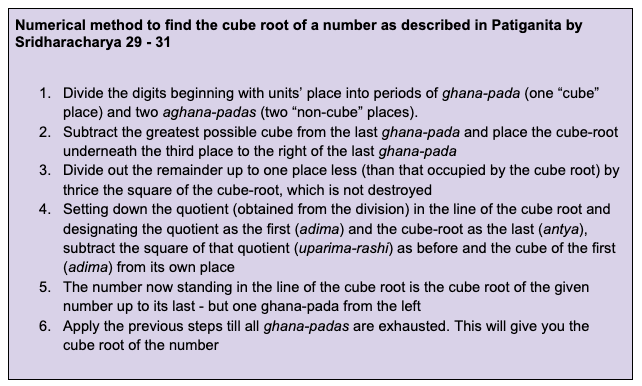
Sridhara Acharya (no later than 870 CE) improved on the method for finding cube-root proposed by Āryabhata - I. He provides an elaborated mechanism in his seminal text Patiganita (verses 29 - 31)
Sridhara Acharya (no later than 870 CE) improved on the method for finding cube-root proposed by Āryabhata - I. He provides an elaborated mechanism in his seminal text Patiganita (verses 29 - 31)
19/N
Here is a break-down of the method to extract cube-root as proposed by Sridharacharya
Here is a break-down of the method to extract cube-root as proposed by Sridharacharya
20/N
The earliest known work in Arabic that treats the extraction of cube roots was written by Abu'l-Hasan al-Uqlidisi in Damascus around 952 CE
The earliest known work in Arabic that treats the extraction of cube roots was written by Abu'l-Hasan al-Uqlidisi in Damascus around 952 CE
21/N
Al-Uqlidisi ("the Euclidean") was an Arab mathematician whose Kitab al-Fusul Fi Al-Hisab al-Hindi (“The Book of Chapters on Hindu Arithmetic”) is the earliest known Arabic work discussing the positional use of the Hindu numerals & methods
Al-Uqlidisi ("the Euclidean") was an Arab mathematician whose Kitab al-Fusul Fi Al-Hisab al-Hindi (“The Book of Chapters on Hindu Arithmetic”) is the earliest known Arabic work discussing the positional use of the Hindu numerals & methods
22/N
As the name of the book suggests Al-Uqlidisi used all the material on mathematics from the available Hindu / Indian seminal work including work by Aryabhata
As the name of the book suggests Al-Uqlidisi used all the material on mathematics from the available Hindu / Indian seminal work including work by Aryabhata
23/N
Another Arabic book that translated Aryabhata’s method for cube root finding is “Kitab fi usul hisab al-hind” by Persian mathematician Kushyar ibn Labban in 11th Century. The literal translation of the name of the book is “Principles of Hindu Reckoning”
Another Arabic book that translated Aryabhata’s method for cube root finding is “Kitab fi usul hisab al-hind” by Persian mathematician Kushyar ibn Labban in 11th Century. The literal translation of the name of the book is “Principles of Hindu Reckoning”
24/N
Europe first got a taste of the Hindu system of cube root mechanism from Leonardo of Pisa who learnt it from the Arabs. In his Liber Abaci (1202 CE), Leonardo describes the root finding method from Āryabhatīyam pretty much verbatim
Europe first got a taste of the Hindu system of cube root mechanism from Leonardo of Pisa who learnt it from the Arabs. In his Liber Abaci (1202 CE), Leonardo describes the root finding method from Āryabhatīyam pretty much verbatim
25/N
So the Indian/Hindu method of cube root finding was adopted by the Arabs, who then transmitted to the European world.
So the Indian/Hindu method of cube root finding was adopted by the Arabs, who then transmitted to the European world.
26/N
Europeans learned about the Indian cube root extraction numerical methods through the writings of mathematicians like Leonardo of Pisa (1202 CE), Johannes de Sacrobosco (1195 - 1256 CE), Alexander de Villedieu (1175-1240 CE), and Petrus de Dacia (1235–1289 CE)
Europeans learned about the Indian cube root extraction numerical methods through the writings of mathematicians like Leonardo of Pisa (1202 CE), Johannes de Sacrobosco (1195 - 1256 CE), Alexander de Villedieu (1175-1240 CE), and Petrus de Dacia (1235–1289 CE)
27/N
By the 15th century, Sacrobosco’s work on arithmetics became the basis for most important mathematical textbooks in Europe. It became the foundation for later modern textbooks and in the process made Hindu cube root extraction methods widely available
By the 15th century, Sacrobosco’s work on arithmetics became the basis for most important mathematical textbooks in Europe. It became the foundation for later modern textbooks and in the process made Hindu cube root extraction methods widely available
28/N
Root-finding methods today are essential ingredients of modern mathematics and have a wide range of applications in fields such as fluid dynamics, medical imaging & artificial intelligence.
Root-finding methods today are essential ingredients of modern mathematics and have a wide range of applications in fields such as fluid dynamics, medical imaging & artificial intelligence.
29/N
Ancient Indian mathematicians like Aryabhata, Brahmagupta & Sridhara provided the rigorous mathematical foundation on top of which today’s root finding mechanisms are built.
Ancient Indian mathematicians like Aryabhata, Brahmagupta & Sridhara provided the rigorous mathematical foundation on top of which today’s root finding mechanisms are built.
30/N
References
References
Loading suggestions...