

One crypto sector is estimated to reach $16 Trillion by 2030:
Real World Assets.
This will be the CATALYST for mainstream Crypto adoption.
Here's your 2023 guide to RWAs (and the top protocols):
Real World Assets.
This will be the CATALYST for mainstream Crypto adoption.
Here's your 2023 guide to RWAs (and the top protocols):

Catalysts
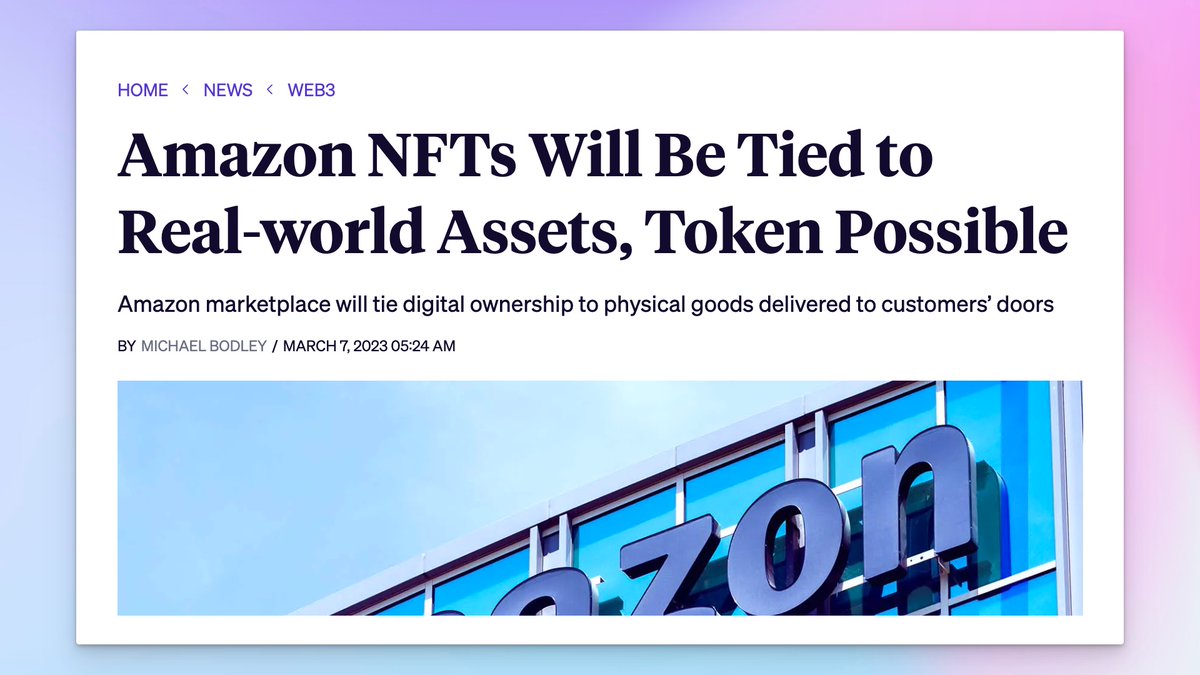
• Amazon's new NFTs are rumored to be tied to RWAs
• Goldman Sachs launched GS Dap to tokenize traditional assets.
• Monetary Authority of Singapore is testing asset tokenization via Project Guardian
• Siemens issues a €60m bond on Polygon
Guys, it's happening
• Amazon's new NFTs are rumored to be tied to RWAs
• Goldman Sachs launched GS Dap to tokenize traditional assets.
• Monetary Authority of Singapore is testing asset tokenization via Project Guardian
• Siemens issues a €60m bond on Polygon
Guys, it's happening
The Problems /w DeFi
Crypto's market cap has reached $1.2 trillion, but some still question its usefulness.
Critics view it as financial wizardry, speculative games, and high-risk PVP casino.
However, Circle's CEO sees tokenization as inevitable.
Crypto's market cap has reached $1.2 trillion, but some still question its usefulness.
Critics view it as financial wizardry, speculative games, and high-risk PVP casino.
However, Circle's CEO sees tokenization as inevitable.
Inconsistent Yields
DeFi yields are great during bull markets but tank in bear markets due to lower activity.
(T-bills are 4.75% risk-free!)
Imagine getting stable yields in DeFi without being affected by crypto's volatility.
Sexy.
That's where Real World Assets come in.
DeFi yields are great during bull markets but tank in bear markets due to lower activity.
(T-bills are 4.75% risk-free!)
Imagine getting stable yields in DeFi without being affected by crypto's volatility.
Sexy.
That's where Real World Assets come in.


What are RWAs?
Real World Assets (RWAs) are physical assets that can be tokenized and represented on-chain.
An example is fiat-backed stablecoins: $1 is held in a bank and then tokenized on a blockchain.
It has DeFi superpowers once it's on the chain.
Real World Assets (RWAs) are physical assets that can be tokenized and represented on-chain.
An example is fiat-backed stablecoins: $1 is held in a bank and then tokenized on a blockchain.
It has DeFi superpowers once it's on the chain.
Any Asset Can be Tokenized
Some Examples:
• Precious metals
• Carbon Credits
• Commodities
• Real estate
• Equities
• Cars
The traditional finance systems has >$600T worth of assets. Imagine if we tokenize these assets and bring their yield on chain.
Some Examples:
• Precious metals
• Carbon Credits
• Commodities
• Real estate
• Equities
• Cars
The traditional finance systems has >$600T worth of assets. Imagine if we tokenize these assets and bring their yield on chain.
The Benefits of RWAs
• Save money - cut out the middlemen & rent seekers.
• Smaller investments - can't buy a whole property? Buy a small piece with a token.
• Loan Access - it's tough for emerging-market businesses to get funds, but RWAs can help
• Save money - cut out the middlemen & rent seekers.
• Smaller investments - can't buy a whole property? Buy a small piece with a token.
• Loan Access - it's tough for emerging-market businesses to get funds, but RWAs can help

Additional Benefits
• Can enhance liquidation in traditionally illiquid assets like real estate, fine art, & private equity.
• Transparency - you can see the economic value and history of ownership.
RWAs are the bridge between Crypto and TradFi world.
• Can enhance liquidation in traditionally illiquid assets like real estate, fine art, & private equity.
• Transparency - you can see the economic value and history of ownership.
RWAs are the bridge between Crypto and TradFi world.
The Top RWA Protocols
RWAs are ALREADY here.
So which protocols are the market leaders?
I'll focus on popular ones. They tend to involve undercollateralized lending in various sectors.
Then, I'll mention some others that caught my eye.
RWAs are ALREADY here.
So which protocols are the market leaders?
I'll focus on popular ones. They tend to involve undercollateralized lending in various sectors.
Then, I'll mention some others that caught my eye.

GoldFinch
GoldFinch provides undercollateralized loans to companies in emerging markets such as Africa, SE Asia, & LATAM.
Their business isn't reliant on the crypto markets and makes consistent revenue.
As of now, they have over $100M in active loans.
GoldFinch provides undercollateralized loans to companies in emerging markets such as Africa, SE Asia, & LATAM.
Their business isn't reliant on the crypto markets and makes consistent revenue.
As of now, they have over $100M in active loans.

Centrifuge
Using their dApp, Tinlake, companies can mint NFTs representing real-world assets.
These NFTs can be used as collateral to take out loans.
Defi protocols & institutions can lend crypto by using these NFTs as collateral.
They have originated over $300M.
Using their dApp, Tinlake, companies can mint NFTs representing real-world assets.
These NFTs can be used as collateral to take out loans.
Defi protocols & institutions can lend crypto by using these NFTs as collateral.
They have originated over $300M.

TrueFi
Uncollateralized Lending Marketplace
They've originated $1.7b in loans and have paid out $40m in interest to protocol participants.
Founded by the same team as the TrueUSD stablecoin.
Uncollateralized Lending Marketplace
They've originated $1.7b in loans and have paid out $40m in interest to protocol participants.
Founded by the same team as the TrueUSD stablecoin.

Maple Finance
Uncollateralized Lending focused on institutional lenders and corporate borrowers.
Basically, you can lend your assets to institutional traders.
Uncollateralized Lending focused on institutional lenders and corporate borrowers.
Basically, you can lend your assets to institutional traders.

Bad Debt
One risk with undercollateralized lending is bad debt & defaults (aka bums).
A few happened after FTX's collapse.
1) Auros owed $18m. They've paid back 55%, and restructured the rest
2) Orthogonal Trading are deadbeats and still owe $31m
One risk with undercollateralized lending is bad debt & defaults (aka bums).
A few happened after FTX's collapse.
1) Auros owed $18m. They've paid back 55%, and restructured the rest
2) Orthogonal Trading are deadbeats and still owe $31m
Maple 2.0
Maple Finance learned from this and upgraded to Maple 2.0.
• Lenders can withdraw anytime (vs. 30-day lock-up)
• Pool delegates can declare early defaults
• They want to diversify into more real-world lending such as treasury & insurance.
Maple Finance learned from this and upgraded to Maple 2.0.
• Lenders can withdraw anytime (vs. 30-day lock-up)
• Pool delegates can declare early defaults
• They want to diversify into more real-world lending such as treasury & insurance.

Swarm Markets
Tokenizing traditional financial assets.
They've brought TSLA, AAPL, & U.S. treasury bills on-chain via Polygon.
Benefit? Trade tokens 24/7, even when the Traditional markets are closed.
Plus, it's legit and follows German regulations.
Tokenizing traditional financial assets.
They've brought TSLA, AAPL, & U.S. treasury bills on-chain via Polygon.
Benefit? Trade tokens 24/7, even when the Traditional markets are closed.
Plus, it's legit and follows German regulations.

Ondo Finance
Institutional-grade finance on Chain. BlackRock manages the funds.
Your USDC can give you access to yields to:
• U.S. Treasuries
• Short Term Bonds
• High-Yield Income via corporate bonds.
You can further lend/borrow stables via Flux Finance
Institutional-grade finance on Chain. BlackRock manages the funds.
Your USDC can give you access to yields to:
• U.S. Treasuries
• Short Term Bonds
• High-Yield Income via corporate bonds.
You can further lend/borrow stables via Flux Finance

RealT
RealT allows you to buy fractional and tokenized ownership in real estate in the U.S.
The problems it solves:
• Fractional - you can own real estate starting at ~$50
• Liquidity - Digital tokens mean liquidity increases
They built a marketplace off of Aave.
RealT allows you to buy fractional and tokenized ownership in real estate in the U.S.
The problems it solves:
• Fractional - you can own real estate starting at ~$50
• Liquidity - Digital tokens mean liquidity increases
They built a marketplace off of Aave.

MakerDAO
The OG DeFi protocol behind the $DAI stablecoin.
MakerDAO started getting into real-world assets to diversify the collateral types that back its stablecoin, DAI.
• There are ~$680m in RWAs
• The RWAs currently contribute 58% of their revenue.
The OG DeFi protocol behind the $DAI stablecoin.
MakerDAO started getting into real-world assets to diversify the collateral types that back its stablecoin, DAI.
• There are ~$680m in RWAs
• The RWAs currently contribute 58% of their revenue.


MakerDao is Limiting RWAs to become more Decentralized.
"Decentralization means limiting our attack surface to physical threats, specifically our RWA collateral as a percentage of the total portfolio. In the Endgame Plan, I put this limit at 25%,” - Rune, MakerDao's founder
"Decentralization means limiting our attack surface to physical threats, specifically our RWA collateral as a percentage of the total portfolio. In the Endgame Plan, I put this limit at 25%,” - Rune, MakerDao's founder
Other Interesting RWA Protocols to Watch For:
• Realio - EVM compatible, L1 blockchain for RWAs
• Clearpool - uncollateralized liquidity to institutions
• HomeCoin - Stablecoin backed by U.S. homes
• Agrotoken / LandX- tokenizing agriculture
• Realio - EVM compatible, L1 blockchain for RWAs
• Clearpool - uncollateralized liquidity to institutions
• HomeCoin - Stablecoin backed by U.S. homes
• Agrotoken / LandX- tokenizing agriculture
RWA Protocols
• Mattereum - verifies that RWAs are legit + have legal contracts
• Helois ReFi - fund solar projects
• Consol Freight - Shipping freight invoices
• Toucan Protocol - Carbon credit market
• Mattereum - verifies that RWAs are legit + have legal contracts
• Helois ReFi - fund solar projects
• Consol Freight - Shipping freight invoices
• Toucan Protocol - Carbon credit market
Challenges with RWA Adoption
Despite RWA's potential, MANY challenges exist:
• Not Decentralized. Uncollateralized loans rely on centralized parties for underwriting and determining credit.
• Heavy reliance on USDC - most RWA protocols use USDC, which is centralized.
Despite RWA's potential, MANY challenges exist:
• Not Decentralized. Uncollateralized loans rely on centralized parties for underwriting and determining credit.
• Heavy reliance on USDC - most RWA protocols use USDC, which is centralized.
• Time-Consuming - Tokenizing physical assets involves legal, technical, and operational challenges.
• Hacks - It's a risk with anything on-chain
• Assets can be seized.
MakerDao's EndGame plan notes this.
• Hacks - It's a risk with anything on-chain
• Assets can be seized.
MakerDao's EndGame plan notes this.

• Limited regulatory frameworks for crypto & RWAs.
• Americans face restrictions due to securities/investor laws + KYC / AML procedures.
• Bad Debt - Crypto collateral can be liquidated fast. RWAs can't.
• Americans face restrictions due to securities/investor laws + KYC / AML procedures.
• Bad Debt - Crypto collateral can be liquidated fast. RWAs can't.
Slowly At First, And Then All At Once
RWA innovation lags behind DeFi since you can't just fork code & start printing.
The feedback loop is slower (regulations), and everything's still an experiment.
It takes time to build infrastructure and make sure everything's compliant.
RWA innovation lags behind DeFi since you can't just fork code & start printing.
The feedback loop is slower (regulations), and everything's still an experiment.
It takes time to build infrastructure and make sure everything's compliant.
I Have 0 RWA Exposure
I'm optimistic about RWAs, but the risk-reward ratio isn't there yet for me.
Regulation risks & an overreliance on USDC.
It doesn't make sense for me to take on those risks for ~8% APR, esp with undercollateralized lending.
I'm optimistic about RWAs, but the risk-reward ratio isn't there yet for me.
Regulation risks & an overreliance on USDC.
It doesn't make sense for me to take on those risks for ~8% APR, esp with undercollateralized lending.
Long Term Bullish
1) Adoption is happening.
2) It solves problems with TradFi & brings more stable Yields to DeFi
3) All narratives need a SIMPLE story to take off.
This can capture a new audience into DeFi who have been skeptical of "real use" cases.
1) Adoption is happening.
2) It solves problems with TradFi & brings more stable Yields to DeFi
3) All narratives need a SIMPLE story to take off.
This can capture a new audience into DeFi who have been skeptical of "real use" cases.
Narrative / Timing / Product Fit
Some may wonder, "Why are you writing a thread on RWA and not investing?"
1. I think of long-term theses
2. Stay updated on trends
3. Wait for the right timing / protocols before getting exposure.
So I'm sharing my personal research with you.
Some may wonder, "Why are you writing a thread on RWA and not investing?"
1. I think of long-term theses
2. Stay updated on trends
3. Wait for the right timing / protocols before getting exposure.
So I'm sharing my personal research with you.
Further Resources
Check out Binance's detailed RWA report that inspired this thread.
It's a great read if you want to dive deeper.
RWA Thought Leaders:
• @tokenomacs (wrote the Binance report)
• @ChainLinkGod
• @DefiIgnas
• @rwa_xyz
Check out Binance's detailed RWA report that inspired this thread.
It's a great read if you want to dive deeper.
RWA Thought Leaders:
• @tokenomacs (wrote the Binance report)
• @ChainLinkGod
• @DefiIgnas
• @rwa_xyz
And if you enjoyed this thread, then:
1) Give me a follow → @thedefiedge
2) Retweet the 1st tweet linked below if you think your audience would find this valuable. (I think they would)
1) Give me a follow → @thedefiedge
2) Retweet the 1st tweet linked below if you think your audience would find this valuable. (I think they would)
جاري تحميل الاقتراحات...