

Peter Lynch's 25 Golden Investment Rules:

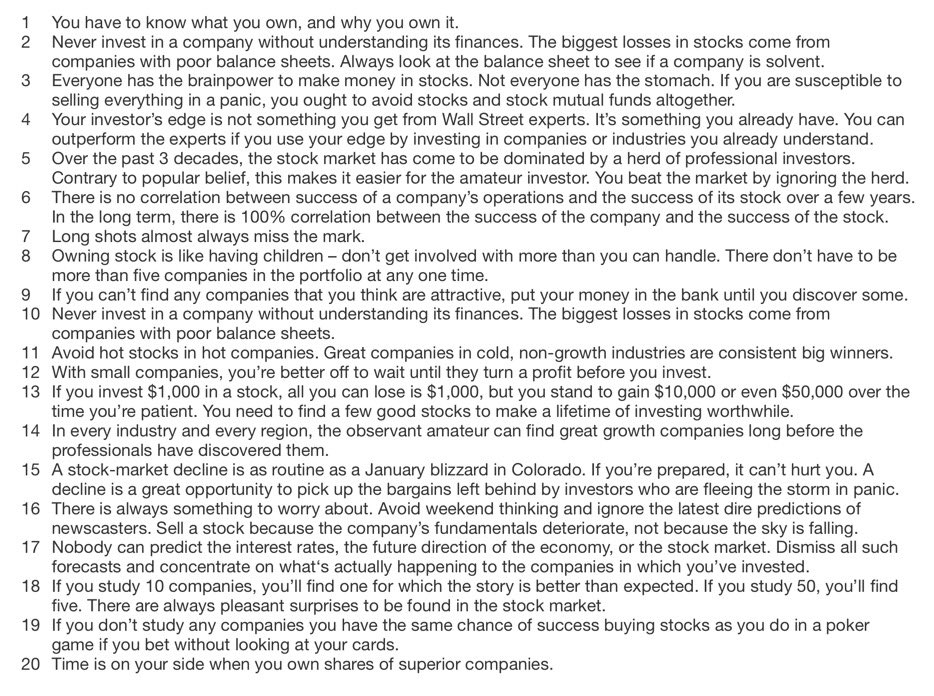
Rule 1: Investing is fun and exciting, but dangerous if you don't do any work.
Rule 2: Your investor's edge is not something you get from Wall Street experts. It's something you already have.
Rule 2: Your investor's edge is not something you get from Wall Street experts. It's something you already have.
Rule 3: Over the past decades, stocks have been dominated by a herd of professional investors. This makes it easier for the amateur investor. You can beat the market by ignoring the herd.
Rule 4: Behind every stock is a company. Find out what it's doing.
Rule 4: Behind every stock is a company. Find out what it's doing.
Rule 5: In the short term, there is no correlation between the success of a company's operations and its stock price. In the long term, there is a 100% correlation between the success of the company and its stock price.
Rule 6: You have to know what you own, and why you own it.
Rule 6: You have to know what you own, and why you own it.
Rule 7: Long shots almost always miss the mark.
Rule 8: Owning stocks is like having children — don't get involved with more than you can handle.
Rule 8: Owning stocks is like having children — don't get involved with more than you can handle.
Rule 9: If you can't find any companies that you think are attractive, put your money in the bank until you discover some.
Rule 10: Never invest in a company without understanding its finances. The biggest losses in stocks come from companies with poor balance sheets.
Rule 10: Never invest in a company without understanding its finances. The biggest losses in stocks come from companies with poor balance sheets.
Rule 11: Avoid hot stocks in hot industries. Great companies in cold, non-
growth industries are consistent big winners.
Rule 12: With small companies, you are better off to wait until they are profitable before you invest.
growth industries are consistent big winners.
Rule 12: With small companies, you are better off to wait until they are profitable before you invest.
Rule 13: If you want to invest in a troubled industry, buy the
companies with staying power and wait for the industry to show signs of revival.
Rule 14: If you invest $1000 in a stock, all you can lose is $1000, but you stand to gain $50,000 over time if you are patient.
companies with staying power and wait for the industry to show signs of revival.
Rule 14: If you invest $1000 in a stock, all you can lose is $1000, but you stand to gain $50,000 over time if you are patient.
Rule 15: In every industry and every region of the country, the observant
amateur can find great growth companies long before the professionals did.
Rule 16: A stock market decline is as routine as a January blizzard in Colorado. If you are prepared, it can't hurt you.
amateur can find great growth companies long before the professionals did.
Rule 16: A stock market decline is as routine as a January blizzard in Colorado. If you are prepared, it can't hurt you.
Rule 17: Everyone has the brainpower to make money in stocks. Not everyone has the stomach.
Rule 18: There is always something to worry about. Avoid weekend thinking and ignore the latest dire predictions of the newscasters.
Rule 18: There is always something to worry about. Avoid weekend thinking and ignore the latest dire predictions of the newscasters.
Rule 19: Nobody can predict interest rates or the future direction of the
economy. Dismiss all such forecasts and concentrate on what matters.
Rule 20: If you study 10 companies, you will find 1 for which the story is better than expected. If you study 50, you'll find 5.
economy. Dismiss all such forecasts and concentrate on what matters.
Rule 20: If you study 10 companies, you will find 1 for which the story is better than expected. If you study 50, you'll find 5.
Rule 21: If you don't study any companies, you have the same success buying stocks as you do in a poker game if you bet without looking at your cards.
Rule 22: Time is on your side when you own shares of superior companies.
Rule 22: Time is on your side when you own shares of superior companies.
Rule 23: If you have the stomach for stocks, but neither the time nor the
inclination to do the homework, invest in index funds.
Rule 24: Invest a bit of your money in faster-growing economies by investing some portion of your assets in overseas stocks with a good record.
inclination to do the homework, invest in index funds.
Rule 24: Invest a bit of your money in faster-growing economies by investing some portion of your assets in overseas stocks with a good record.
Rule 25: In the long run, a portfolio of well-chosen stocks will always outperform a portfolio of bonds or a money-market account.
If you liked this, you'll love our website.
▪️ Each Tuesday we share 5 investment insights
▪️ Each Thursday we publish a deeper investment article
Learn more about Peter Lynch here:
qualitycompounding.substack.com
▪️ Each Tuesday we share 5 investment insights
▪️ Each Thursday we publish a deeper investment article
Learn more about Peter Lynch here:
qualitycompounding.substack.com

Here is a great overview:
Loading suggestions...