

It is very important to understand the difference between let, const, and var in ES6.
Take a look:
Take a look:

1. let
— “let” is used to declare a block-scoped variable. It means that the variable declared with “let” can only be accessed within the block in which it was declared.
— “let” is used to declare a block-scoped variable. It means that the variable declared with “let” can only be accessed within the block in which it was declared.
In this example, “x” is declared twice, first in the “test()” function and then within the “if” block. The two variables are completely separate from each other because they have different scopes. This is because “let” is block-scoped.

2. const
— “const” is also used to declare a block-scoped variable, but with the difference that its value cannot be reassigned once it is initialized.
— “const” is also used to declare a block-scoped variable, but with the difference that its value cannot be reassigned once it is initialized.
In this example, we try to reassign the value of “x” to “3”, which will result in an error because “const” variables cannot be reassigned.

3. var
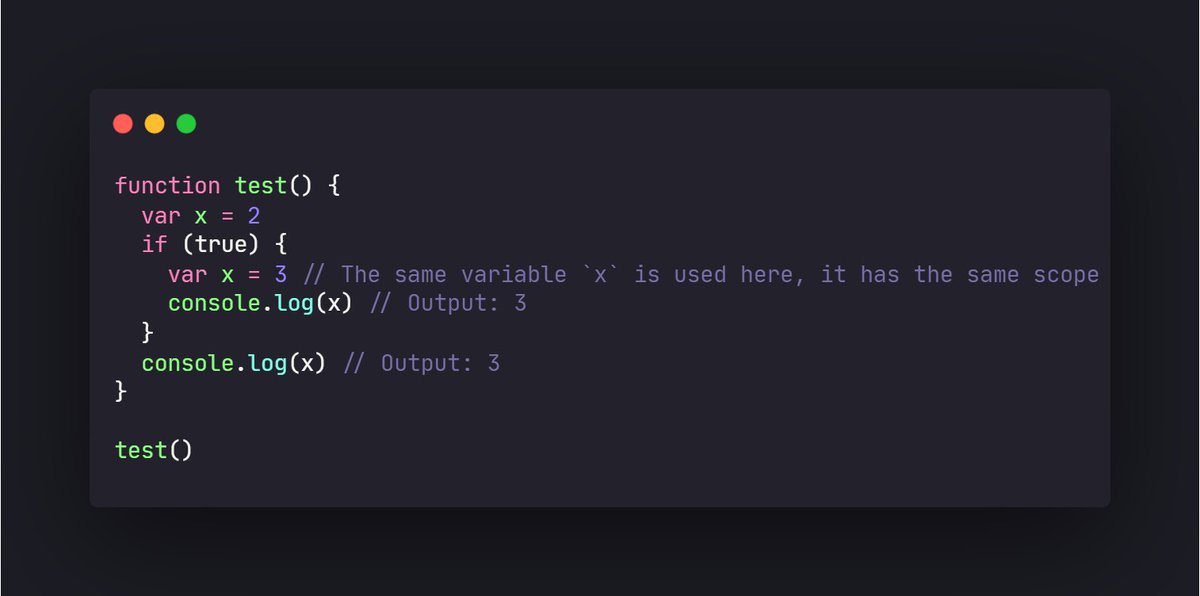
— “var” is used to declare a variable with function-level scoping. It means that the variable declared with “var” can be accessed within the function in which it was declared, or even outside the function if it is declared globally.
— “var” is used to declare a variable with function-level scoping. It means that the variable declared with “var” can be accessed within the function in which it was declared, or even outside the function if it is declared globally.
In this example, “x” is declared twice, first in the “test()” function and then within the “if” block.
The second declaration of “x” using “var” is not creating a new variable with a new scope, bt rather modifying the original variable, which is accessible outside the “if” block.
The second declaration of “x” using “var” is not creating a new variable with a new scope, bt rather modifying the original variable, which is accessible outside the “if” block.
Recommendation 💡
Overall, my recommendation to use “let” and “const” instead of “var”, especially in modern JavaScript, because “let” and “const” provide block-scoping, which is more predictable and less error-prone.
Overall, my recommendation to use “let” and “const” instead of “var”, especially in modern JavaScript, because “let” and “const” provide block-scoping, which is more predictable and less error-prone.
You can get my free JavaScript e-book that has 100+ free resources.
🔗 haiderkh1.gumroad.com
🔗 haiderkh1.gumroad.com
That's a wrap!
If you enjoyed this thread:
1. Follow me @slow_developer for more of these
2. RT the tweet below to share this thread with your audience
If you enjoyed this thread:
1. Follow me @slow_developer for more of these
2. RT the tweet below to share this thread with your audience
Loading suggestions...