

Spread Operators in JavaScript.
The Beginner's Guide.
Thread:
The Beginner's Guide.
Thread:
If you’re new to JavaScript or used Arrays and Objects in JavaScript extensively, then you might have come across `...` (spread operator).
The spread operator is also extensively used for updating state objects in React.
The spread operator is also extensively used for updating state objects in React.
In this thread, we’ll take a closer look at the spread operator and how it can be used to make your code more efficient and flexible. So, let’s get started!
☞ What is the Spread Operator?
The spread operator (...) is a shorthand that allows you to spread the contents of an array or object into a new array or object.
The spread operator (...) is a shorthand that allows you to spread the contents of an array or object into a new array or object.
This means that instead of having to write a loop or iterate over the elements of an array, you can simply use the spread operator to spread the elements into a new array.
For example, consider the following code:

In this example, the spread operator is used to spread the elements of array1 into a new array called array2.
The result is a new array that is identical to the original array.
The result is a new array that is identical to the original array.
☞ Spread Operator in Arrays
The spread operator can be used in a variety of ways when working with arrays.
One of the most common use cases is to spread the elements of one array into a new array. For example:
The spread operator can be used in a variety of ways when working with arrays.
One of the most common use cases is to spread the elements of one array into a new array. For example:

In this example, the spread operator is used to spread the elements of array1 and array2 into a new array called array3.
The result is a new array that contains all the elements of both array1 and array2.
The result is a new array that contains all the elements of both array1 and array2.
☞ Spread Operator in Function Arguments
Another use case for the spread operator in arrays is to spread the elements of an array into a function call. For example:
Another use case for the spread operator in arrays is to spread the elements of an array into a function call. For example:
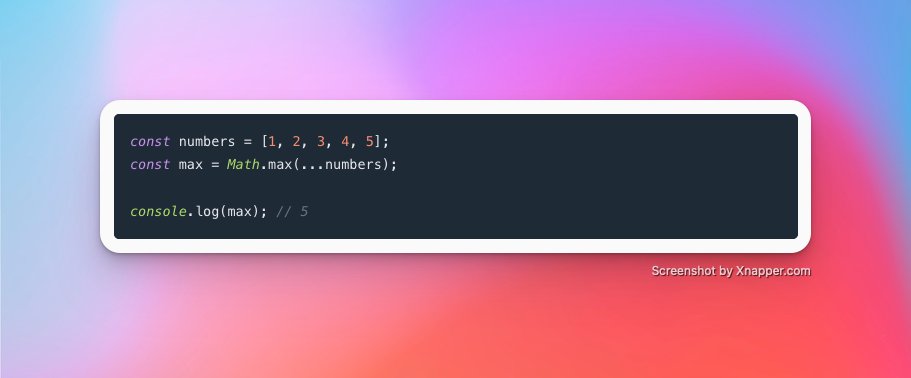
In this example, the spread operator is used to spread the elements of the numbers array into a call to the Math.max function.
The result is the maximum value in the array.
The result is the maximum value in the array.
☞ Spread Operator in Objects
The spread operator can also be used when working with objects. For example:
The spread operator can also be used when working with objects. For example:
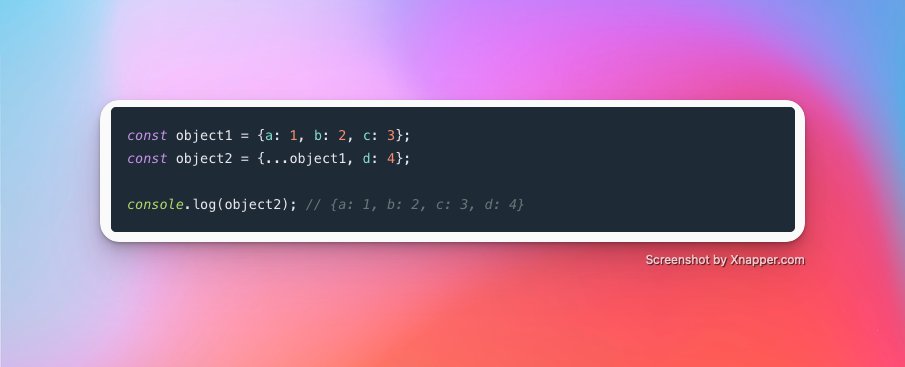
In this example, the spread operator is used to spread the properties of object1 into a new object called object2.
The result is a new object that contains all the properties of object1 plus an additional property called d.
The result is a new object that contains all the properties of object1 plus an additional property called d.
Another use case for the spread operator in objects is to merge two or more objects into a single object.
For example:
For example:

In this example, the spread operator is used to merge the properties of object1 and object2 into a new object called object3.
The result is a new object that contains all the properties of both object1 and object2.
The result is a new object that contains all the properties of both object1 and object2.
☞ Conclusion
The spread operator is a powerful operator that can be used in a variety of ways when working with arrays and objects in JavaScript.
The spread operator is a powerful operator that can be used in a variety of ways when working with arrays and objects in JavaScript.
That's a wrap!
If you enjoyed this thread:
1. Follow us @codedamncom for more of these.
2. Retweet the first tweet above to share with your friends.
If you enjoyed this thread:
1. Follow us @codedamncom for more of these.
2. Retweet the first tweet above to share with your friends.
Loading suggestions...