

Given Jevons paradox if half of the energy is required for an operation due to efficiencies people will tend to more than double their activity.
IE by shifting to sustainable energy you would unlock a lot more economic activity
IE by shifting to sustainable energy you would unlock a lot more economic activity
Ratio to batteries required to renewables seems off to me. Perhaps this accommodates a substantial cost decline in batteries relative to renewables
For reference our open source bitcoin miner model suggests a ~par ratio (MWh vs MW renewable)
github.com
github.com
An aside, in 2007 I spent a year and a half working on global energy and carbon dioxide.
It still lives half-hidden on the internet if you want to amuse yourselves: internetfileserver.phillip.com.sg
(Please ignore the nuclear forecast which got totally upended by the Fukushima tsunami)
It still lives half-hidden on the internet if you want to amuse yourselves: internetfileserver.phillip.com.sg
(Please ignore the nuclear forecast which got totally upended by the Fukushima tsunami)
This is an important point wrt to commodities.
Given a price-signal, production will respond, and reserves will grow.
Given a price-signal, production will respond, and reserves will grow.
Tesla's design-engineering integration parallels Apple's approach and is critically important during technology transitions
The world wants a cybercar
Interesting to think about where apple draws the boundary vis a vis its supply and manufacturing partners
Wonder if a car that puzzle pieces together could potentially allow for different form factors derived from the same manufacturing process
Suspect that people won’t believe Tesla’s assertions that it can manufacture it for half the cost until Tesla actually reveals the design of the vehicle.
As with LFP batteries, these more efficient power trains will entail some performance compromises.
Reduction in silicon carbide in particular embeds some power constraint
No need for a robotaxi to go 0-60 in 2 seconds 🤣
Reduction in silicon carbide in particular embeds some power constraint
No need for a robotaxi to go 0-60 in 2 seconds 🤣
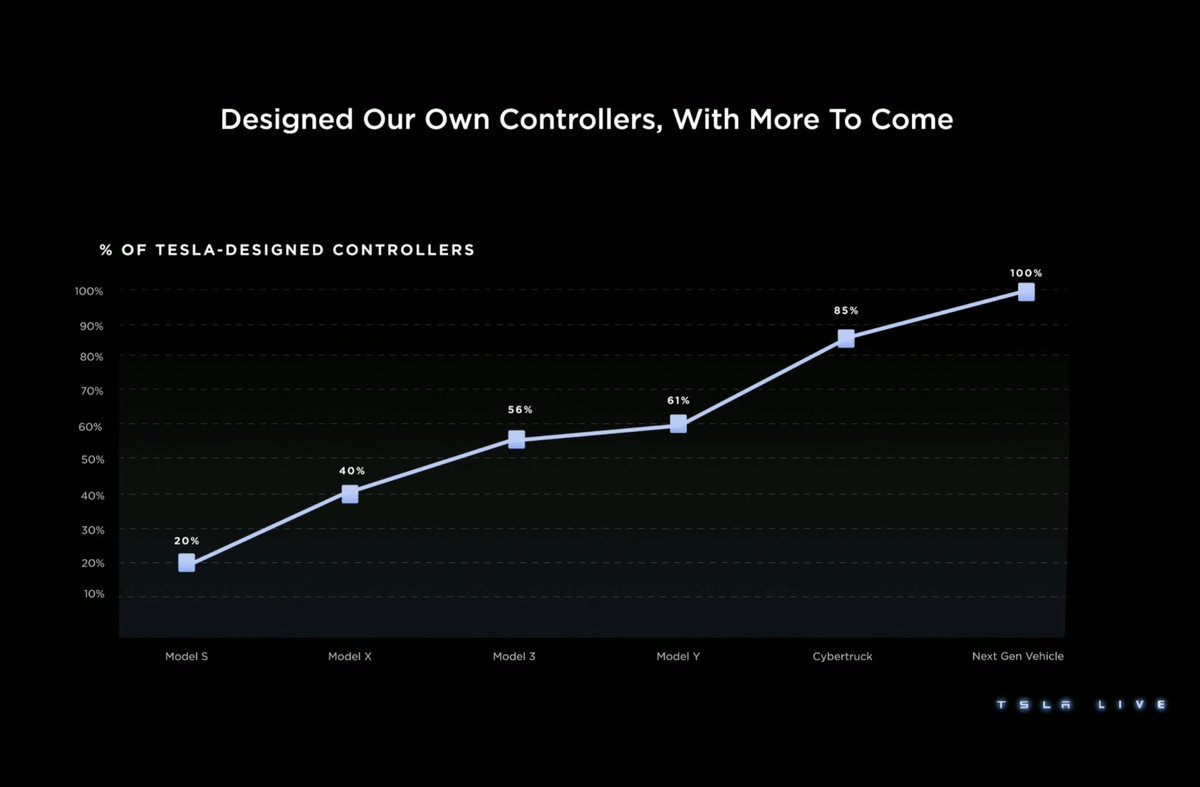
On in-housing control design, it’s not just a supply-chain redundancy thing.
As AI software gets more capable, being able to software-control every system in the vehicle becomes more critical.
As AI software gets more capable, being able to software-control every system in the vehicle becomes more critical.
123 million miles driven per day across the fleet is a lot.
Tesla has a massive advantage in data capture potential, and software validation.
Tesla has a massive advantage in data capture potential, and software validation.
Thinking about the $1,000 drivetrain.
Throw in 70kWh of batteries at $70 per kWh and you get the entire powertrain at $6k
Within traditional ICE, powertrain will occupy ~25% of total cost of the vehicle.
Use the same ratio and you can get to a ~$24k vehicle
Throw in 70kWh of batteries at $70 per kWh and you get the entire powertrain at $6k
Within traditional ICE, powertrain will occupy ~25% of total cost of the vehicle.
Use the same ratio and you can get to a ~$24k vehicle
(Plenty or reason to believe—in EV—that drivetrain share of total costs will actually increase, so total cost to build could be lower)
Tesla’s mention of reinforcement learning with regards to full-self-driving is a first (I think)
Notable that the chatGPT capability advance was enabled by reinforcement learning with human feedback
That Tesla has customer’s in the loop at scale positions them uniquely
Notable that the chatGPT capability advance was enabled by reinforcement learning with human feedback
That Tesla has customer’s in the loop at scale positions them uniquely
Loading suggestions...