

I noticed that the American discourse tends to hugely exaggerate the role of ethnolinguistic factor as the driving force of state/nation-formation. Which is kinda ironic, considering how the US emerged in the first place
And since American internal debates largely shape the global discourse, these Wilsonian lenses become the default way to look at the state/nation formation all around the world
I would say that contemporary American way to look at the state/nation formation is a blend of Wilsonian inertia and externalisation of modern American identity politics. A projection of internal American political games to the outer world
A widespread assumption that ethnolinguistics differences are the main (if not the sole) force behind the nation formation seems to be overstretched. In many (most?) cases it may be the other way around
Exception: Identity -> Institutions
The rule: Institutions -> Identity
Exception: Identity -> Institutions
The rule: Institutions -> Identity
If you look at many (most?) *successful* independence movements around the world, you will notice that they tend to first create some kind of working institutions and then work out their identity. Which may be very eclectic and hastily developed. Still, works perfectly
On the other hand, plenty of unsuccessful movements can have much more "real", historically rooted identity, much sounder (historically or ethnolinguistically speaking) arguments in favour of independence. Still, it doesn't work out. Because it doesn't really matter
It's more typical for a nation first to achieve strong autonomy/independence motivated by reasons that have nothing to do with ethnolinguistics. And then try to work out some kind of common identity to explain what we are even all about
Almost any explanation would work, really
Almost any explanation would work, really
Consider Taiwan. It's not that the Taiwanese realised their deep ethnolinguistic differences with the mainland and then independence agenda started growing more popular. It's that Taiwan first became de facto independent for reasons that had nothing to do with ethnolinguistics...
Taiwanese effective independence triggered a normal process of nation formation. First your paths with the mainland diverge, *then* you start constructing a different identity. If it is not different enough, you must make it more different
Taiwanese nation building was not triggered by the indigenous revolt or the local Hans realising their differences from the mainland. It was triggered by the takeover of Taiwan by an interest group that had irreconcilable differences with the interest group in Beijing. That's it
Identity is overrated. Institutions shape identity, way more often than the other way around
Arguments are overrated. It doesn't matter if you have a "sound argument" as long as your institutions work. Working institutions prove the argument had been correct in the first place
Arguments are overrated. It doesn't matter if you have a "sound argument" as long as your institutions work. Working institutions prove the argument had been correct in the first place
What is hugely underrated though is the earthly interest and the interest groups. This may easily turn out as *the* main blind spot of modern public discourse which tends to focus on the agenda (= rhetorics) and ignore the reality of interest groups
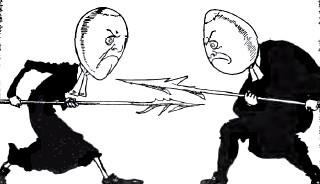
Analysing political conflicts as solely the conflicts of agendas may be reductionist. Interest groups exist and fight each other irrespectively of any agenda. Big enders do not fight the Little enders solely for how to break the egg. They also fight for who is the boss
Consider Stalin. In the early 20ths, the Party was swarmed by schism between the Lefts and the Rights. To put it simply, lefts wanted to build the planned economy and launch industrialisation (robbing the village for it). The rights wanted to allow for the elements of the market
The most popular and brilliant of the Communist leaders, Leon Trotsky leaded the left wing. So Stalin sided with the rightists. He criticised Trotsky from the rightist positions, standing for the freedom of individual farming, more market-oriented economy, more economic freedom
Once Stalin crushed first his arch-rival and then his former comrades in the anti-Trotskyist fight, he concentrated the supreme power in the USSR. Once he did it, he almost immediately switched to the Leftist, Trotskyist economic agenda. Planned economy and industrialisation
Stalin sided with the rightists against the leftists only to execute what the leftists had proposed once he took power. Many were shocked. Trotskyists were bitching that Stalin "stole their program"
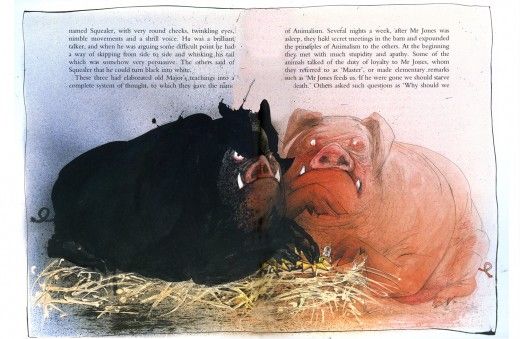
(See Napoleon vs Snowball conflict in the Animal Farm. It's highly accurate)
(See Napoleon vs Snowball conflict in the Animal Farm. It's highly accurate)

Analysing Stalin vs Trotsky conflict in terms of "agenda" is reductionist. Stalin sided with rightists to defeat the leftists and then executed the leftist program once he took over. Because the fight wasn't about "rightism" or "leftism". It was all about who is the boss
The end
The end
Loading suggestions...