

1/ Do #DeFi protocols really need a token to work? 🧵
2/ Yesterday I asked CT to 'name a #DeFi protocol that wouldn't work without a token.'
Answers are eye-opening.
Ranging from 'all of them' to 'could prove there is none'.
So... is there any?
Answers are eye-opening.
Ranging from 'all of them' to 'could prove there is none'.
So... is there any?
3/ I'd argue that the majority of projects launch a token out of financial necessity.
Token sale is a preferred and the easiest way to raise funds.
Without a necessary funding there wouldn't be that many projects in the first place.
Token sale is a preferred and the easiest way to raise funds.
Without a necessary funding there wouldn't be that many projects in the first place.
4/ Secondly, token serves a role for bootstrapping liquidity.
Without liquidity mining, Sushiswap wouldn't have been able to attract any TVL/users since it didn't add any additional value to Uniswap's V2.
I wonder if Uniswap launched $UNI because of Sushi threat? 🧐
Without liquidity mining, Sushiswap wouldn't have been able to attract any TVL/users since it didn't add any additional value to Uniswap's V2.
I wonder if Uniswap launched $UNI because of Sushi threat? 🧐
5/ Token is also used as a community building tool.
But building a community around the token and NOT around the protocol itself is a short-term strategy.
Your community will abandon you when the price plummets.
But building a community around the token and NOT around the protocol itself is a short-term strategy.
Your community will abandon you when the price plummets.
6/ Some #DeFi protocols integrate their tokens into the core functioning mechanism:
• $SNX, $GNS, $AMP, $RUNE facilitate liquidity creation & transfer
• $USDD, $USDN, $UST, $FRAX are backed by native tokens
• $OHM bonding for liquidity
• $SNX, $GNS, $AMP, $RUNE facilitate liquidity creation & transfer
• $USDD, $USDN, $UST, $FRAX are backed by native tokens
• $OHM bonding for liquidity
7/ Yet many protocols could technically function without a token:
• DEXes, derivative exchanges, DEX aggregators
• Lending protocols
• Yield aggregators
• Collateralized stablecoins
• Wallets
Their core business models don't depend on the token.
• DEXes, derivative exchanges, DEX aggregators
• Lending protocols
• Yield aggregators
• Collateralized stablecoins
• Wallets
Their core business models don't depend on the token.
8/ Token for (some) of these protocols is a risk management tool!
$MKR is a backstop for insolvency: holders take risk of dilution to cover undercapitalized debt.
Perpetual DEXes use the token to build up insurance fund in case of failed liquidations.
multicoin.capital
$MKR is a backstop for insolvency: holders take risk of dilution to cover undercapitalized debt.
Perpetual DEXes use the token to build up insurance fund in case of failed liquidations.
multicoin.capital
9/This risk management extends to the protocol ownership.
Would you use Aave or Compound if one entity controlled a key to all assets and protocol parameters?
Protocols can use multi-sig to prevent it, but a governance token scales multi-sig to millions of people.
Would you use Aave or Compound if one entity controlled a key to all assets and protocol parameters?
Protocols can use multi-sig to prevent it, but a governance token scales multi-sig to millions of people.
10/ Unfortunately, not all protocols reached this level of governance decentralization.
But decentralization is a spectrum and 'a token is an option on future utility.'
So while a token serves as a fundraising tool at first, the utility is can be added later on.
But decentralization is a spectrum and 'a token is an option on future utility.'
So while a token serves as a fundraising tool at first, the utility is can be added later on.
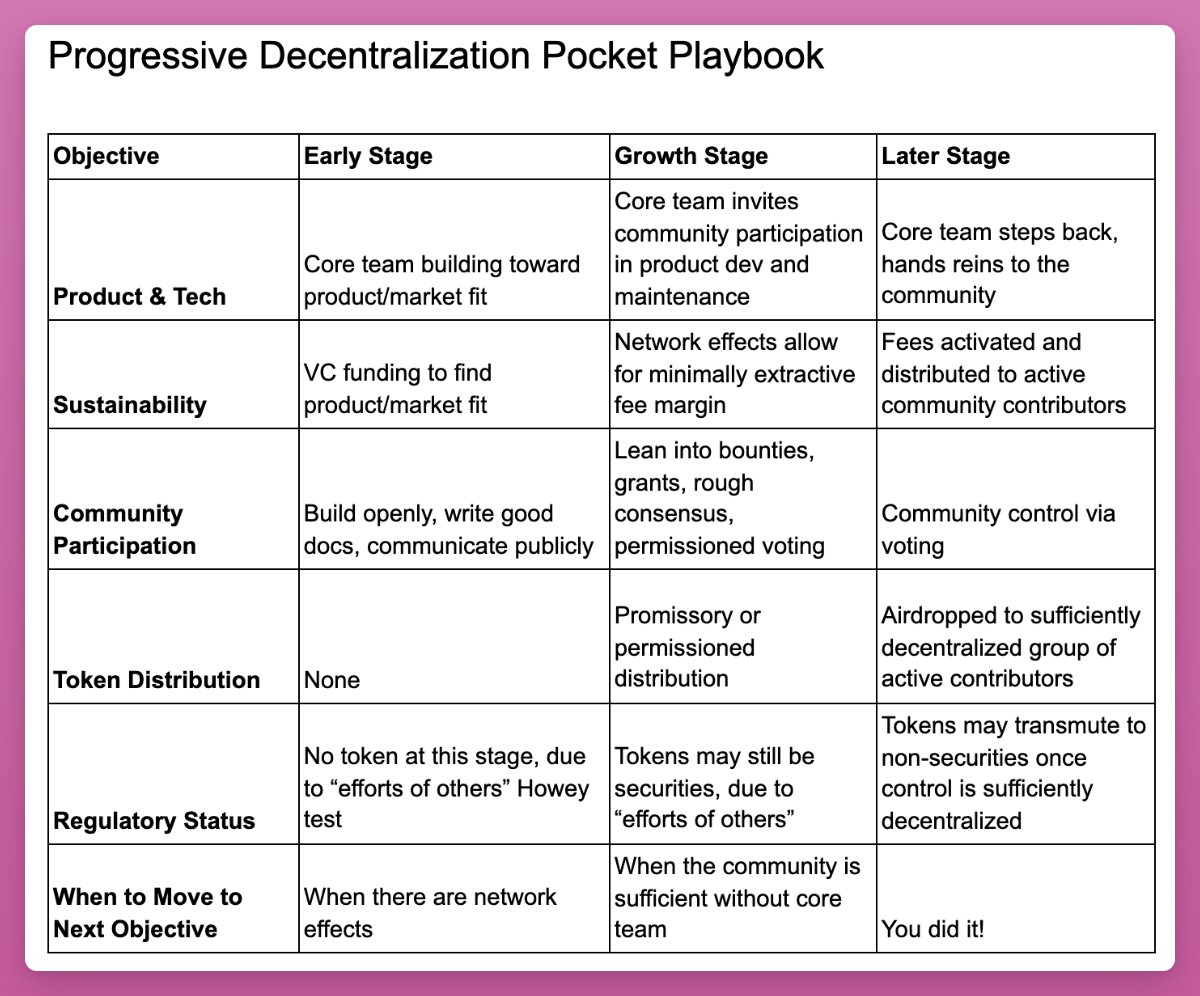
11/ It coincides with the a16z's vision of Progressive Decentralization as the protocol matures.
When a product market fit is established, control and risk management is granted to the community via a token.
Increasing MC also provides a stronger guarantee against bad actors.
When a product market fit is established, control and risk management is granted to the community via a token.
Increasing MC also provides a stronger guarantee against bad actors.
12/ On the final note, $UNI seems to be a controversial one.
• $UNI doesn't manage any risk, and contracts are immutable so no parameters to change
• Revenue sharing is value-destructive for LPs @multicoincap
But $UNI is the largest $DeFi token by market cap.
• $UNI doesn't manage any risk, and contracts are immutable so no parameters to change
• Revenue sharing is value-destructive for LPs @multicoincap
But $UNI is the largest $DeFi token by market cap.
13/ IMO $UNI's value comes from:
• Option for future utility
• Governance to influence other protocols
Uniswap DAO voted to launch on zkSync, potentially giving zkSync a leadership position in zk-Rollup race.
That's power.
• Option for future utility
• Governance to influence other protocols
Uniswap DAO voted to launch on zkSync, potentially giving zkSync a leadership position in zk-Rollup race.
That's power.
14/ Overall, many protocols exist thanks to the token: from fundraising to liquidity attraction.
They facilitate community building and redistribute revenue.
But at the end, ensuring security of the protocol and governance gives the ultimate reason for a token to exist.
They facilitate community building and redistribute revenue.
But at the end, ensuring security of the protocol and governance gives the ultimate reason for a token to exist.
15/ Did I miss something important? Please let me know 👐
Follow me @DefiIgnas for more.
Like/Retweet the first tweet below if you can:
Follow me @DefiIgnas for more.
Like/Retweet the first tweet below if you can:
Loading suggestions...