

Over the past 8 years, I’ve admitted >5,000 patients.
I use the same strategy every time to:
• Stay organized
• Be Efficient
• Be complete
Admissions can be overwhelming.
Stop stressing, steal my 4 tips below ⤵️
I use the same strategy every time to:
• Stay organized
• Be Efficient
• Be complete
Admissions can be overwhelming.
Stop stressing, steal my 4 tips below ⤵️
Do you struggle with:
• Remembering a patient's PMH and problems?
• Worrying you're forgetting orders?
• Admissions taking > 1 hr?
If you already have a system that works for you, stick with it.
If you’re learning, this is what has worked for me for 8 years⤵️
• Remembering a patient's PMH and problems?
• Worrying you're forgetting orders?
• Admissions taking > 1 hr?
If you already have a system that works for you, stick with it.
If you’re learning, this is what has worked for me for 8 years⤵️
Tip #1 / Write it down
You MUST stay organized.
You need one place to jot notes through the admission while:
• dissecting the chart
• talking to ER doc
• interviewing the patient
• walking to and from patient room
• placing orders
• writing your note
My simple trick?
You MUST stay organized.
You need one place to jot notes through the admission while:
• dissecting the chart
• talking to ER doc
• interviewing the patient
• walking to and from patient room
• placing orders
• writing your note
My simple trick?
Pen and paper.
If you try to remember it all?
You WILL forget things.
Keeping notes on computer/phone?
I found several problems with this:
If you try to remember it all?
You WILL forget things.
Keeping notes on computer/phone?
I found several problems with this:
1️⃣ Computer wasn't available in the patient's room or walking to/from.
2️⃣ Logging into a computer in the patient's room was inefficient.
3️⃣ I couldn't format my notes easily in my phone.
4️⃣ Negative perception of being "on the computer / phone" with the patient.
2️⃣ Logging into a computer in the patient's room was inefficient.
3️⃣ I couldn't format my notes easily in my phone.
4️⃣ Negative perception of being "on the computer / phone" with the patient.
5️⃣ Frequent "screen switching" on computer
No matter where I go / EHR I use, my process is the same.
Pen and paper are always with you.
This keeps you organized with all of your info in one place.
Why is this important?
No matter where I go / EHR I use, my process is the same.
Pen and paper are always with you.
This keeps you organized with all of your info in one place.
Why is this important?
Tip #2 / Keep a list of orders
Ideas for orders come at all times but you may not be in a position to place them at that moment.
So you need a reminder when you ARE placing orders.
That's why tip #1 is so important.
Whether to work-up a differential or "maintenance"...
Ideas for orders come at all times but you may not be in a position to place them at that moment.
So you need a reminder when you ARE placing orders.
That's why tip #1 is so important.
Whether to work-up a differential or "maintenance"...
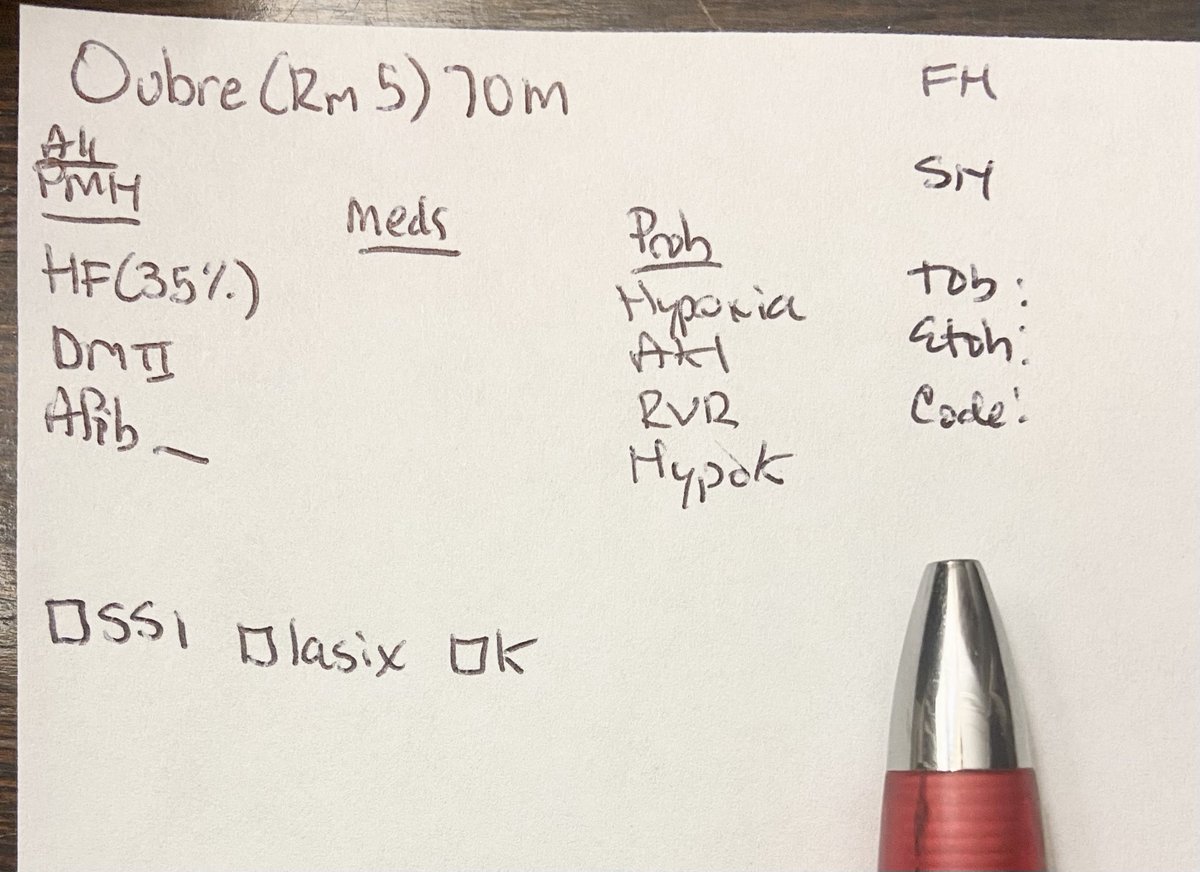
Ex: When I see "diabetes", I immediately draw a 🔲 and write "SSI" as a note to my future self to order insulin (if needed).
This helps you avoid jumping to and from order placing which
• prevents context switching
• improves efficiency
This helps you avoid jumping to and from order placing which
• prevents context switching
• improves efficiency
Tip #3 / Explore the chart for high level info first.
You have limited time, you don't need to explore every small detail.
1️⃣ Read ER note / talk to the ER doctor.
Why did they come?
This will give context and focus for chart history.
Later, you can dig into the details.
You have limited time, you don't need to explore every small detail.
1️⃣ Read ER note / talk to the ER doctor.
Why did they come?
This will give context and focus for chart history.
Later, you can dig into the details.
2️⃣ Find last H&P / discharge summary and/or PCP note.
This will
• help you capture medical history and
• expose recent issues which may have lead to current presentation
3️⃣ Glance for an echo.
You do not want to discover they have heart failure the hard way.
This will
• help you capture medical history and
• expose recent issues which may have lead to current presentation
3️⃣ Glance for an echo.
You do not want to discover they have heart failure the hard way.
4️⃣ With PMH as context, scan the medication list for medications you NEED to confirm for admission
AND look for medications which seem absent.
EX: Anticoagulation for Afib, DAPT for CAD, insulin dosing
AND look for medications which seem absent.
EX: Anticoagulation for Afib, DAPT for CAD, insulin dosing
Tip #4 / Keep a list of PMH and active problems.
Just like orders, keep a running list as you discover them.
(This has important CDI implications...but I won't get into that)
Check this while putting in orders and writing your note.
It becomes a massive check list.
Just like orders, keep a running list as you discover them.
(This has important CDI implications...but I won't get into that)
Check this while putting in orders and writing your note.
It becomes a massive check list.
This may sound complex and time consuming, but it saves you time and becomes muscle memory.
Below is an example of a quick template I might make as I'm initially reviewing the chart
Below is an example of a quick template I might make as I'm initially reviewing the chart
In summary, to stay organized, be efficient and complete:
1️⃣ Write things down with pen and paper
2️⃣ Keep a list of orders
3️⃣ Explore the chart for high level info first
4️⃣ Keep a list of PMH and active problems
1️⃣ Write things down with pen and paper
2️⃣ Keep a list of orders
3️⃣ Explore the chart for high level info first
4️⃣ Keep a list of PMH and active problems
That's a wrap!
If you enjoyed this thread:
1. Follow me @Dr_Oubre for more of these
2. RT the tweet below to share this thread with your audience
If you enjoyed this thread:
1. Follow me @Dr_Oubre for more of these
2. RT the tweet below to share this thread with your audience
Loading suggestions...