

1/N
This is a thread on finding positive integer (x, y) pairs of solutions for second order indeterminate equations of the form Nx^2 + k = y^2 where N is a non-square positive number.
This is a thread on finding positive integer (x, y) pairs of solutions for second order indeterminate equations of the form Nx^2 + k = y^2 where N is a non-square positive number.
2/N
Solution to this category of equations was invented by ancient Indian mathematicians by at least 628 CE, approximately 1000 years before the mathematicians in Europe started thinking about it.
Solution to this category of equations was invented by ancient Indian mathematicians by at least 628 CE, approximately 1000 years before the mathematicians in Europe started thinking about it.
3/N
This equation is commonly known today as ‘Pell’s equation’, named after the English scholar John Pell (1611 CE –1685 CE). But interestingly John Pell has nothing to do with the equation.
This equation is commonly known today as ‘Pell’s equation’, named after the English scholar John Pell (1611 CE –1685 CE). But interestingly John Pell has nothing to do with the equation.
4/N
Leonhard Euler, the famous Swiss mathematician mistakenly attributed to Pell a solution that had in fact been found by another English mathematician, William Brouncker (1620 CE –1684 CE), in response to a challenge by Fermat
Leonhard Euler, the famous Swiss mathematician mistakenly attributed to Pell a solution that had in fact been found by another English mathematician, William Brouncker (1620 CE –1684 CE), in response to a challenge by Fermat
5/N
Ancient India has a history of pioneering solutions for indeterminate equations. Aryabhata in his treatise Aryabhaṭiya describes a recipe (called Kuttaka) for solutions of the linear indeterminate equation ay − bx = c with integer coefficients a, b, c.
Ancient India has a history of pioneering solutions for indeterminate equations. Aryabhata in his treatise Aryabhaṭiya describes a recipe (called Kuttaka) for solutions of the linear indeterminate equation ay − bx = c with integer coefficients a, b, c.
6/N
I have provided a detailed analysis earlier showing how linear indeterminate equations can be solved by the Kuttaka method in one of my previous threads. I will provide a reference to my description of Kuttaka at the end of this thread.
I have provided a detailed analysis earlier showing how linear indeterminate equations can be solved by the Kuttaka method in one of my previous threads. I will provide a reference to my description of Kuttaka at the end of this thread.
7/N
In the chapter Kuṭṭakādhyāyaḥ of Brāhma-sphuṭa-siddhānta (628 CE), Brahmagupta, a brilliant Hindu Indian astronomer & mathematician takes up the much harder problem of finding positive integer solutions to the quadratic indeterminate equation Nx^2 + k = y^2
In the chapter Kuṭṭakādhyāyaḥ of Brāhma-sphuṭa-siddhānta (628 CE), Brahmagupta, a brilliant Hindu Indian astronomer & mathematician takes up the much harder problem of finding positive integer solutions to the quadratic indeterminate equation Nx^2 + k = y^2
8/N
Equations of the form Nx^2 + k = y^2 were called varga-prakṛti (square-nature) in ancient India, a fitting name as the problem involves finding a square x^2 whose product with a given non-square N would again become a square y^2 after adding a small integer k.
Equations of the form Nx^2 + k = y^2 were called varga-prakṛti (square-nature) in ancient India, a fitting name as the problem involves finding a square x^2 whose product with a given non-square N would again become a square y^2 after adding a small integer k.
9/N
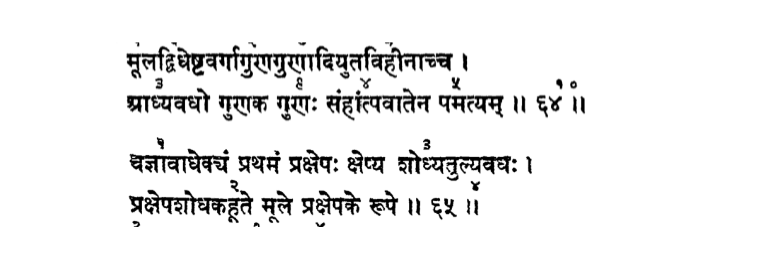
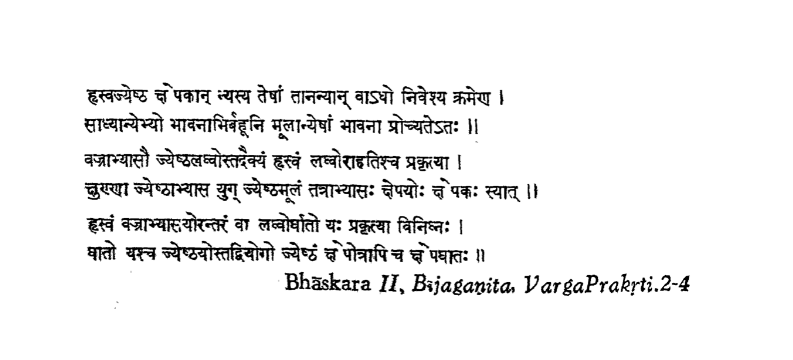
Attached is the verse from the chapter Kuṭṭakādhyāyaḥ of Brāhma-sphuṭa-siddhānta, written by Brahmagupta (no later than 628 CE) which explains the mathematical identity used to solve the equations of the form Nx^2 + k = y^2
Attached is the verse from the chapter Kuṭṭakādhyāyaḥ of Brāhma-sphuṭa-siddhānta, written by Brahmagupta (no later than 628 CE) which explains the mathematical identity used to solve the equations of the form Nx^2 + k = y^2
10/N
Brahmagupta uses the terms Gunaka, Adya, Antya & Kshepa for the terms N, x, y & k respectively to analyze the equation Nx^2 + k = y^2 & corresponding identities
Brahmagupta uses the terms Gunaka, Adya, Antya & Kshepa for the terms N, x, y & k respectively to analyze the equation Nx^2 + k = y^2 & corresponding identities
11/N
Below I am providing a textural description of the solution for second order indeterminate equation as explained by Brahmagupta in Brāhma-sphuṭa-siddhānta
Below I am providing a textural description of the solution for second order indeterminate equation as explained by Brahmagupta in Brāhma-sphuṭa-siddhānta

12/N
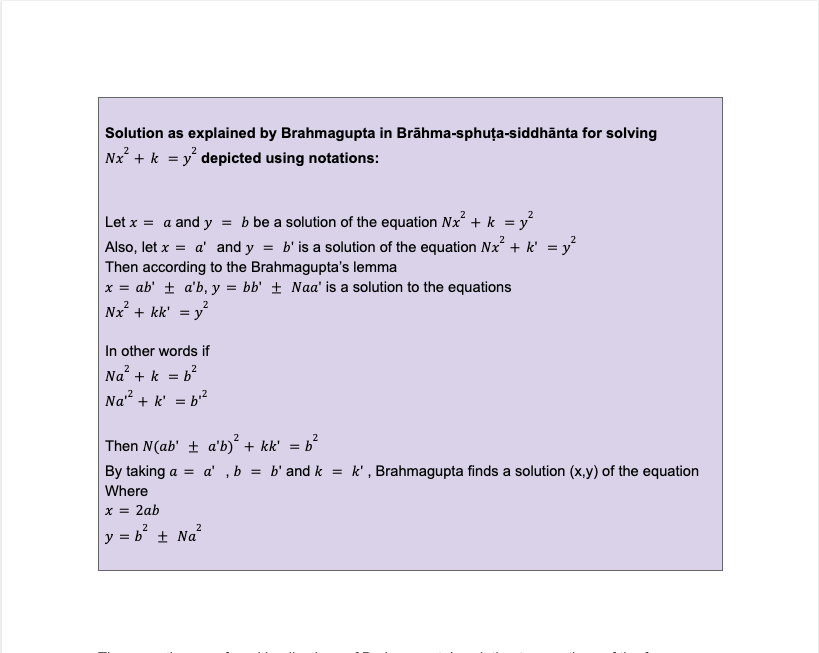
I am also providing the same recipe / identity as explained by Brahmagupta using a contemporary notations
I am also providing the same recipe / identity as explained by Brahmagupta using a contemporary notations
13/N
There are three profound implications of Brahmagupta’s solution to equations of the form Nx^2+k =y^2
There are three profound implications of Brahmagupta’s solution to equations of the form Nx^2+k =y^2
14/N
The first implication is that it is the first iterative solution to problems of this kind in Number Theory which gives an increasingly better approximation of a solutions. It reminds one of modern numerical methods used in computational algebra today.
The first implication is that it is the first iterative solution to problems of this kind in Number Theory which gives an increasingly better approximation of a solutions. It reminds one of modern numerical methods used in computational algebra today.
15/N
The second implication is that Brahmagupta’s Brāhma-sphuṭa-siddhānta is the first recorded documentation of the powerful law of composition used in Number Theory today.
The second implication is that Brahmagupta’s Brāhma-sphuṭa-siddhānta is the first recorded documentation of the powerful law of composition used in Number Theory today.
16/N
The idea of the law of composition is fundamental in modern Number Theory. It combines two mathematical objects of a certain type to produce a third object of the same type. Brahmagupta and other ancient Indian mathematicians called this principle “Bhavana”
The idea of the law of composition is fundamental in modern Number Theory. It combines two mathematical objects of a certain type to produce a third object of the same type. Brahmagupta and other ancient Indian mathematicians called this principle “Bhavana”
17/N
The Bhavana principle says that if two solutions of the equation Nx2+k =y2 are known, then any number of solutions can be found by composition of previous solutions.
The Bhavana principle says that if two solutions of the equation Nx2+k =y2 are known, then any number of solutions can be found by composition of previous solutions.
18/N
In fact, even if we have one solution, we can get other solutions via applying Bhavana principle on the first solution by itself.
In fact, even if we have one solution, we can get other solutions via applying Bhavana principle on the first solution by itself.
19/N
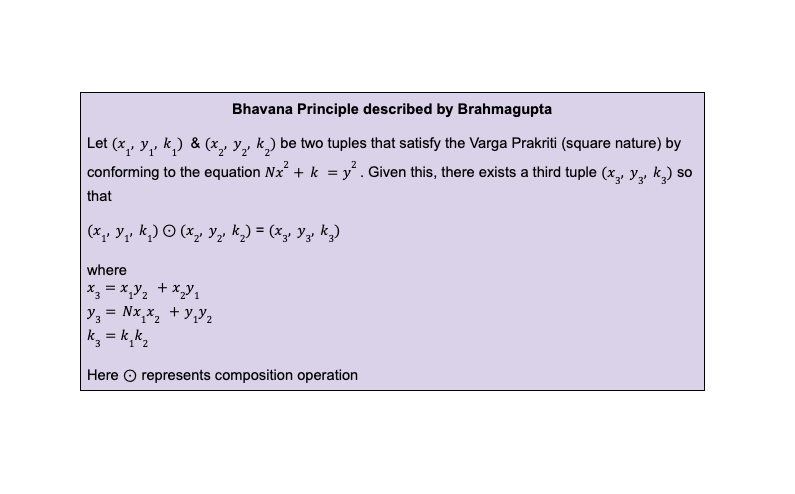
If we put it formally, Bhavana principle described by Brahmagupta combines two solutions (x1, y1, k1) and (x2, y2, z2) of the varga-prakriti Nx^2+k = y^2 to produce a third solution (x3, y3, z3). The details are attached below
If we put it formally, Bhavana principle described by Brahmagupta combines two solutions (x1, y1, k1) and (x2, y2, z2) of the varga-prakriti Nx^2+k = y^2 to produce a third solution (x3, y3, z3). The details are attached below
20/N
Another ancient Indian mathematician Jayadeva while describing the Chakravala algorithm as quoted in the mathematical text Sundarī (1073 CE) by Udayadivākara refers to the Bhavana principle.
Another ancient Indian mathematician Jayadeva while describing the Chakravala algorithm as quoted in the mathematical text Sundarī (1073 CE) by Udayadivākara refers to the Bhavana principle.
21/N
Just before stating the Bhavana recipe, Jayadeva mentions अशेषाकरणव्यापि भावनाकरणं - “the Bhavana pervades endless mathematical operations”. That shows the huge importance given on Bhavana by great mathematicians of ancient India.
Just before stating the Bhavana recipe, Jayadeva mentions अशेषाकरणव्यापि भावनाकरणं - “the Bhavana pervades endless mathematical operations”. That shows the huge importance given on Bhavana by great mathematicians of ancient India.
22/N
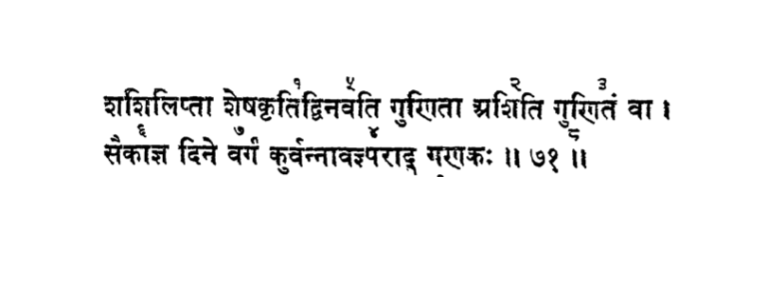
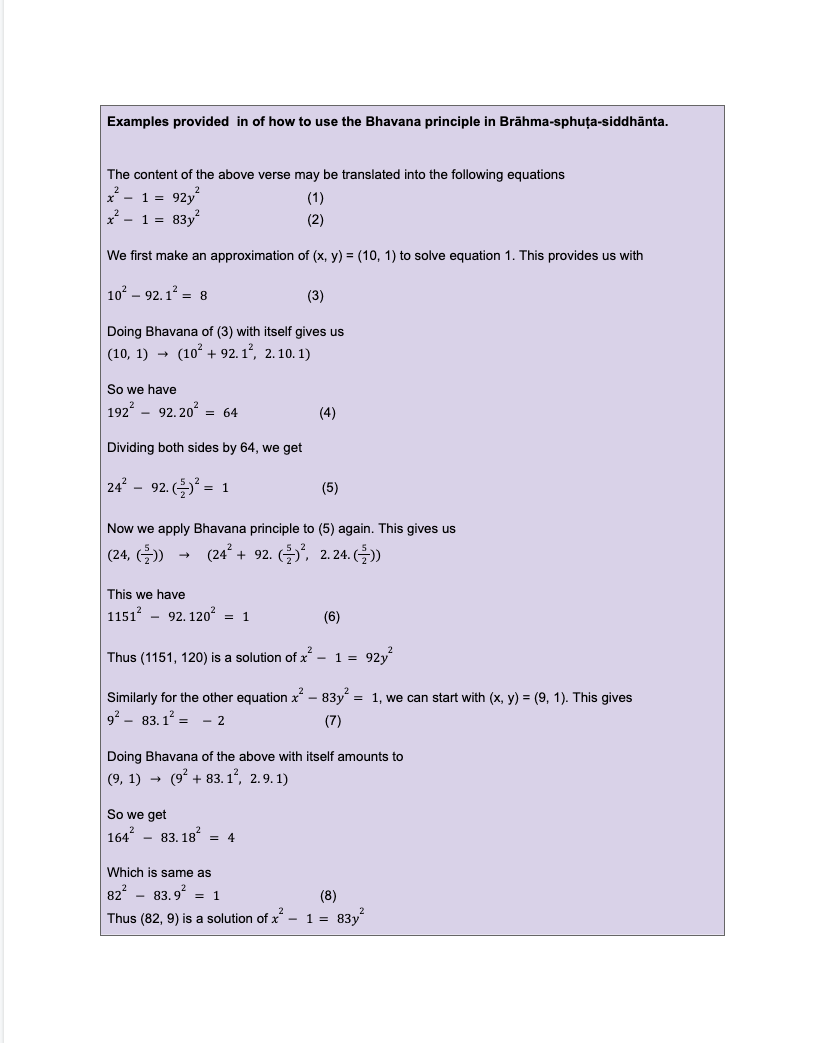
Brahmagupta himself gives several examples to illustrate his recipe to find solutions to equations of the form Nx^2 + k = y^2 in Brāhma-sphuṭa-siddhānta. Two such examples are attached below.
Brahmagupta himself gives several examples to illustrate his recipe to find solutions to equations of the form Nx^2 + k = y^2 in Brāhma-sphuṭa-siddhānta. Two such examples are attached below.
23/N
Below I provide an analysis of the same examples given by Brahmagupta
Below I provide an analysis of the same examples given by Brahmagupta
24/N
Brahmagupta’s Bhavana principle has been described in detail by Bhaskara II (no later than 1150 AD) for solving the equation Nx^2 + k = y^2. Bhaskara uses the terms prakriti, kshepaka, hrasva-mula & kanishtha-mula for N, k, x & y terms respectively
Brahmagupta’s Bhavana principle has been described in detail by Bhaskara II (no later than 1150 AD) for solving the equation Nx^2 + k = y^2. Bhaskara uses the terms prakriti, kshepaka, hrasva-mula & kanishtha-mula for N, k, x & y terms respectively
25/N
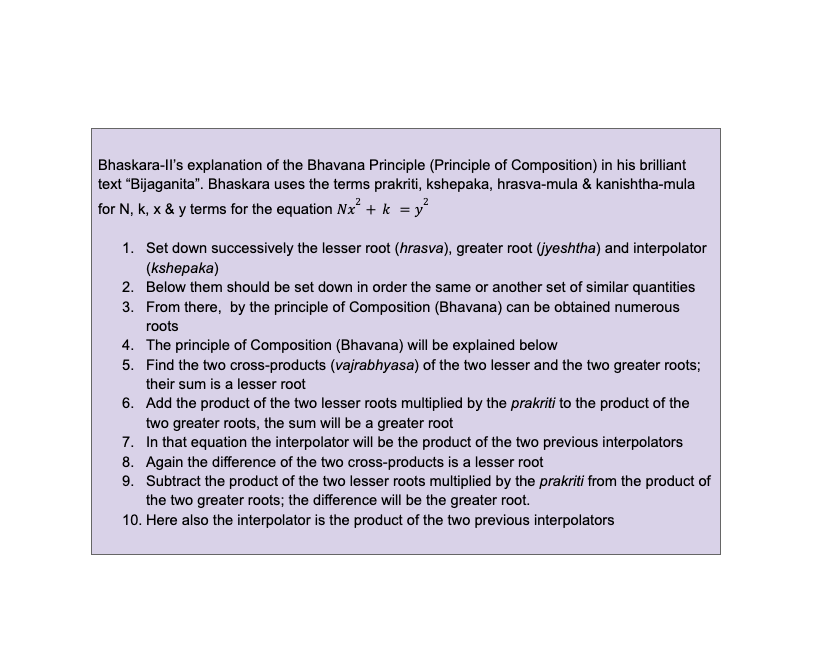
Below I am providing an explanation of the Bhavana principle as provided by Bhaskara-II
Below I am providing an explanation of the Bhavana principle as provided by Bhaskara-II
26/N
Using Brahmagupta’s Bhavana and Aryabhata’s kuttaka, subsequent Indian mathematicians developed a cyclic method called Chakravala which describes all integer solutions of Nx^2 + k = y^2, for any arbitrary non-square positive integer N.
Using Brahmagupta’s Bhavana and Aryabhata’s kuttaka, subsequent Indian mathematicians developed a cyclic method called Chakravala which describes all integer solutions of Nx^2 + k = y^2, for any arbitrary non-square positive integer N.
27/N
The mathematician Jayadeva is the earliest known expositor of the Chakravala algorithm. He describes the problem of solving Nx^2 + 1 = y^2 as being as difficult as setting a fly against the wind
The mathematician Jayadeva is the earliest known expositor of the Chakravala algorithm. He describes the problem of solving Nx^2 + 1 = y^2 as being as difficult as setting a fly against the wind
28/N
In his treatise Bijaganita (1150 CE), Bhaskaracharya gives an elegant exposition of a variant of Jayadeva’s method, illustrating it with difficult examples like N = 61 and N = 67.
In his treatise Bijaganita (1150 CE), Bhaskaracharya gives an elegant exposition of a variant of Jayadeva’s method, illustrating it with difficult examples like N = 61 and N = 67.
29/N
The Bhavana and Chakravala are applied by Indian Mathematician Narayaṇa (1350 CE) to generate a sequence of progressively better rational approximations to square-root of N , when N is not a perfect square
The Bhavana and Chakravala are applied by Indian Mathematician Narayaṇa (1350 CE) to generate a sequence of progressively better rational approximations to square-root of N , when N is not a perfect square
30/N
Brahma-Sphuta-Siddhantha became known to the Arab world in the eighth century & was translated into Arabic, at the instance of the Caliph. Three centuries later this work was translated into Latin in Spain & came into the hands of Fibonacci, then a trader in Italy.
Brahma-Sphuta-Siddhantha became known to the Arab world in the eighth century & was translated into Arabic, at the instance of the Caliph. Three centuries later this work was translated into Latin in Spain & came into the hands of Fibonacci, then a trader in Italy.
31/N
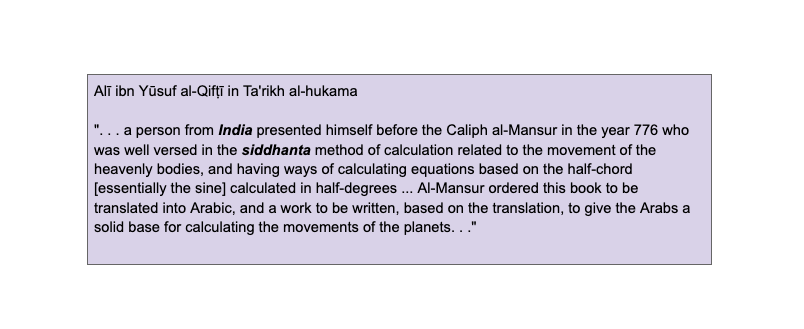
Alī ibn Yūsuf al-Qifṭī (ca. 1172–1248); an Egyptian historian in his work “Ta'rikh al-hukama” (History of Learned Men) mentions how Caliph al-Mansur ordered the translation of important Indian mathematical works.
Alī ibn Yūsuf al-Qifṭī (ca. 1172–1248); an Egyptian historian in his work “Ta'rikh al-hukama” (History of Learned Men) mentions how Caliph al-Mansur ordered the translation of important Indian mathematical works.
32/N
The third implication of the Bhavana principle explained by Brahmagupta for solving the indeterminate equation Nx^2 + k = y^2 is that it also provides an iterative & elegant way to approximate rational solutions to the square root of N (non-square)
The third implication of the Bhavana principle explained by Brahmagupta for solving the indeterminate equation Nx^2 + k = y^2 is that it also provides an iterative & elegant way to approximate rational solutions to the square root of N (non-square)
33/N
Here I want to point out an important observation which can potentially show that the Bhavana principle or the Principle of Composition in Number Theory was known to ancient Indians as early as 800 BC.
Here I want to point out an important observation which can potentially show that the Bhavana principle or the Principle of Composition in Number Theory was known to ancient Indians as early as 800 BC.
34/N
According to current estimates, Brahma-Sphuta-Siddhanta (which contains description of the Bhavan principle) was composed approximately during 628 CE.
According to current estimates, Brahma-Sphuta-Siddhanta (which contains description of the Bhavan principle) was composed approximately during 628 CE.
35/N
However we find Baudhayana Shulba of India which was composed no later than 800 BCE, refers to a recipe to approximate rational solutions to the square root of a non-square number with high precision.
However we find Baudhayana Shulba of India which was composed no later than 800 BCE, refers to a recipe to approximate rational solutions to the square root of a non-square number with high precision.
36/N
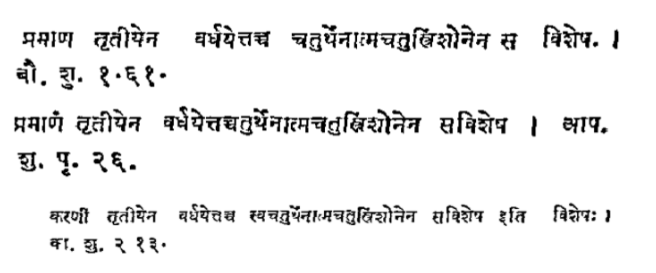
Baudhayana Shulba Sutra 1:61, Katyayana Shulba Sutra 2:13 & Apastamba Shulba Sutra provide a computational expression for the finding square root estimation of a non-square integer
Baudhayana Shulba Sutra 1:61, Katyayana Shulba Sutra 2:13 & Apastamba Shulba Sutra provide a computational expression for the finding square root estimation of a non-square integer
37/N
Baudhayana Shulba Sutra 1:61, Katyayana Shulba Sutra 2:13: One should increase the measure (of the side of the square whose double producer is to be found) by its third part & again by the fourth part of this third less by the thirty fourth part of this fourth.
Baudhayana Shulba Sutra 1:61, Katyayana Shulba Sutra 2:13: One should increase the measure (of the side of the square whose double producer is to be found) by its third part & again by the fourth part of this third less by the thirty fourth part of this fourth.

38/N
Shulba texts themselves did not mention how this expression was derived. There have been several attempts to explain how the Shulbakaras of ancient India could come up with such an elegant expression to find the square root of a number.
Shulba texts themselves did not mention how this expression was derived. There have been several attempts to explain how the Shulbakaras of ancient India could come up with such an elegant expression to find the square root of a number.
39/N
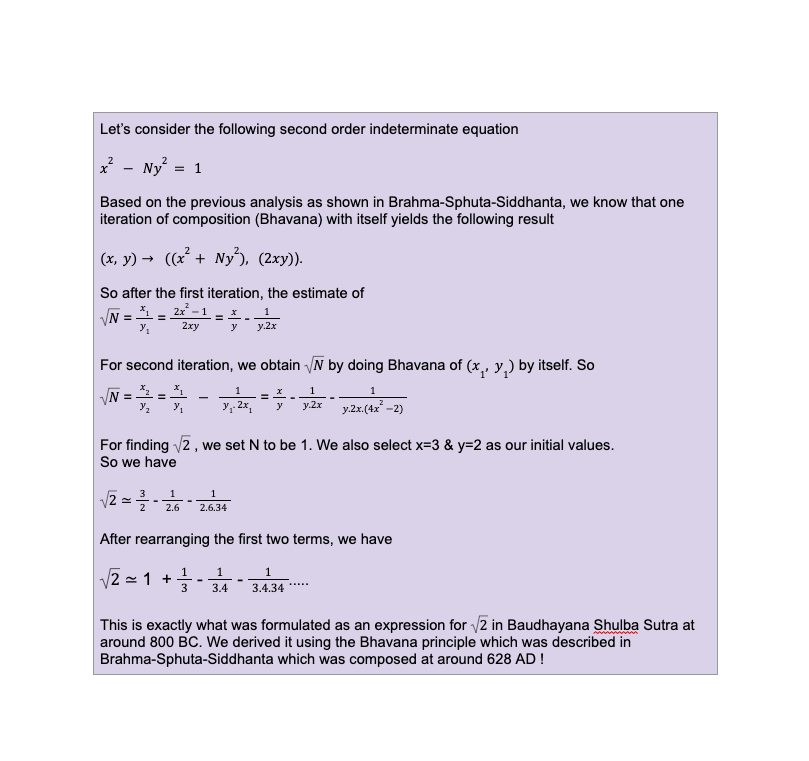
Here I show a way to find square root of a number directly by using the Bhavana principle as described in Brahmagupta’s Brahma-Sphuta-Siddhanta
Here I show a way to find square root of a number directly by using the Bhavana principle as described in Brahmagupta’s Brahma-Sphuta-Siddhanta
40/N
So the rational estimate for finding square root of a non-square integer that was prescribed in Baudhayana Shulba Sutra at around 800 BC can be derived from the Bhavana principle mentioned in Brahma-Sphuta-Siddhanta which is estimated to be composed at around 628 CE
So the rational estimate for finding square root of a non-square integer that was prescribed in Baudhayana Shulba Sutra at around 800 BC can be derived from the Bhavana principle mentioned in Brahma-Sphuta-Siddhanta which is estimated to be composed at around 628 CE
41/N
Thus it is highly probable that the Bhavana principle to solve second order indeterminate equations was already known to ancient Indians as early as 800 BC. This is mind boggling considering the implication of the Bhavana principle in modern number theory!
Thus it is highly probable that the Bhavana principle to solve second order indeterminate equations was already known to ancient Indians as early as 800 BC. This is mind boggling considering the implication of the Bhavana principle in modern number theory!
42/N
I would like to conclude this thread with the different shades of meaning of the Sanskrit word Bhavana (भावना). This has a deep implication on how the word has been used in Brahma-Sphuta-Siddhanta
I would like to conclude this thread with the different shades of meaning of the Sanskrit word Bhavana (भावना). This has a deep implication on how the word has been used in Brahma-Sphuta-Siddhanta
43/N
The word Bhavana denotes a profound concept in Dharmic philosophy. In a practical sense, it denotes composition. However the root meaning is found in Upanishads and Shaiva Agamas
The word Bhavana denotes a profound concept in Dharmic philosophy. In a practical sense, it denotes composition. However the root meaning is found in Upanishads and Shaiva Agamas
44/N
In Bhavana Upanishad, the word Bhavana is used to connote the process of Self (आत्मन्) manifesting itself in infinite expressions to know itself.
In Bhavana Upanishad, the word Bhavana is used to connote the process of Self (आत्मन्) manifesting itself in infinite expressions to know itself.
45/N
Bhavana in Shaiva Agama refers to “creative contemplation” of the Self. According to Iśvarapratyabhijñāvivṛtivimarśinī 2.133. - “A manifestation necessarily requires a cause as regards both it is arising (bhavana) and it is not arising (abhavana).”
Bhavana in Shaiva Agama refers to “creative contemplation” of the Self. According to Iśvarapratyabhijñāvivṛtivimarśinī 2.133. - “A manifestation necessarily requires a cause as regards both it is arising (bhavana) and it is not arising (abhavana).”
46/N
Ancient Indian Mathematicians aptly chose the word भावना to denote a mathematical process in Number Theory which iteratively manifests new mathematical realities by combining elemental aspects of a problem.
Ancient Indian Mathematicians aptly chose the word भावना to denote a mathematical process in Number Theory which iteratively manifests new mathematical realities by combining elemental aspects of a problem.
47/N
This mathematical process is reflective of how in Dharmic Darshana Self is described to manifest itself in infinite ways only to find oneness with all of them.
This mathematical process is reflective of how in Dharmic Darshana Self is described to manifest itself in infinite ways only to find oneness with all of them.
48/N
References
References
جاري تحميل الاقتراحات...