

#Thread
Separating facts from fiction in Kalapahad episode.
There have been various myths surrounding Kalapahad, the infamous general of Afghan sultan of Bengal who desecrated Jagannath temple of Puri. These fictional accounts are so numorous and deeply 1/n
Separating facts from fiction in Kalapahad episode.
There have been various myths surrounding Kalapahad, the infamous general of Afghan sultan of Bengal who desecrated Jagannath temple of Puri. These fictional accounts are so numorous and deeply 1/n
Ingrained in the minds of the masses that it is almost impossible to remove it. This is a small attempt to use primary sources and discuss his origin and also discuss how the story of him being a hindu renegade became mainstream. 2/n
Let me first mention this that research on Kalapahar has been done extensively in last few decades in Odisha as he is probably the most hated person here . Initial historians didn't try to know the reality and believed on folklores directly. Some even created new 3/n
Ones out of thin air. The primary reason behind this is the Hindu sounding name "Kala Pahar". And this name was not prevalent among muslims in 19th and 20th century resulting in such folklores. So, let's first discuss that point.
Was Kalapahar a Hindu name or Afghan name? 4/n
Was Kalapahar a Hindu name or Afghan name? 4/n
The reality is "Kalapahar" is an Afghan name. The famous Afghan origin Lodi dynasty sultan Bahulol Lodi had a nephew named Kalaphar(Muhammud Farmuli). During Sikandar lodi's rule he was the governor of Oudh and fought wars. Similarly, other texts like Tarikh-i-Sher Shahi and 5/n
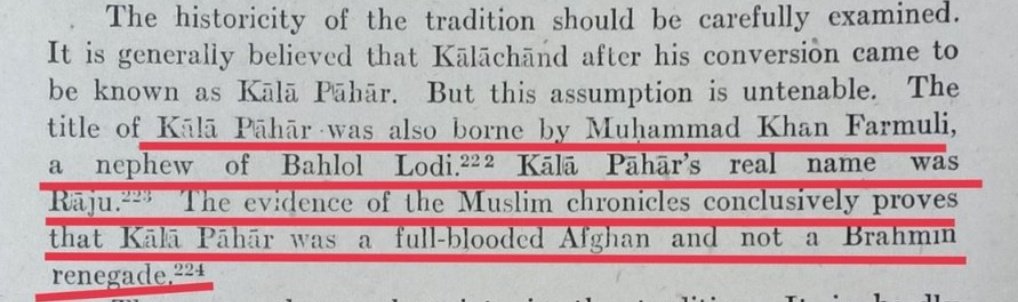
Waqiat-i-Mustaqi mentions the name Kalapahar. So, this settles the first point that Kalapahar was an Afghan name or title. Now, let's try to discuss some contemporary primary sources to know the origin of Kalapahar. Munktakhabut Tawarikh written by Al Badauni notes 6/n
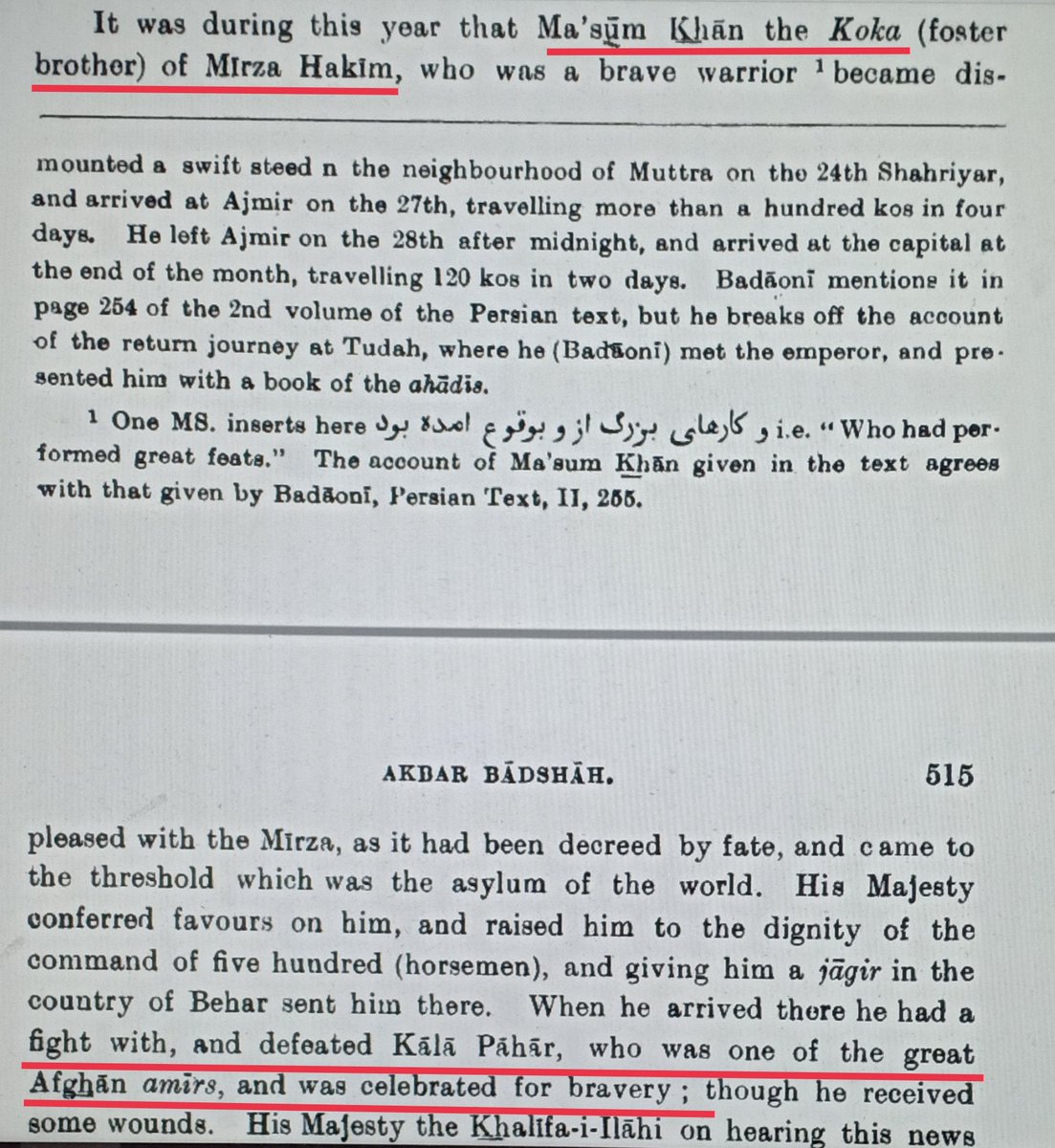
"Masum Khan....defeated Kala Pahar, who was one of the great Afghan Amirs"
Here Masum Khan was a general of Akbar and had to fight with Afghans of Bengal and ultimately with Kalapahar.
Corroborating the same Tarikh-i-Akbari says "Masum Khan...7/n
Here Masum Khan was a general of Akbar and had to fight with Afghans of Bengal and ultimately with Kalapahar.
Corroborating the same Tarikh-i-Akbari says "Masum Khan...7/n
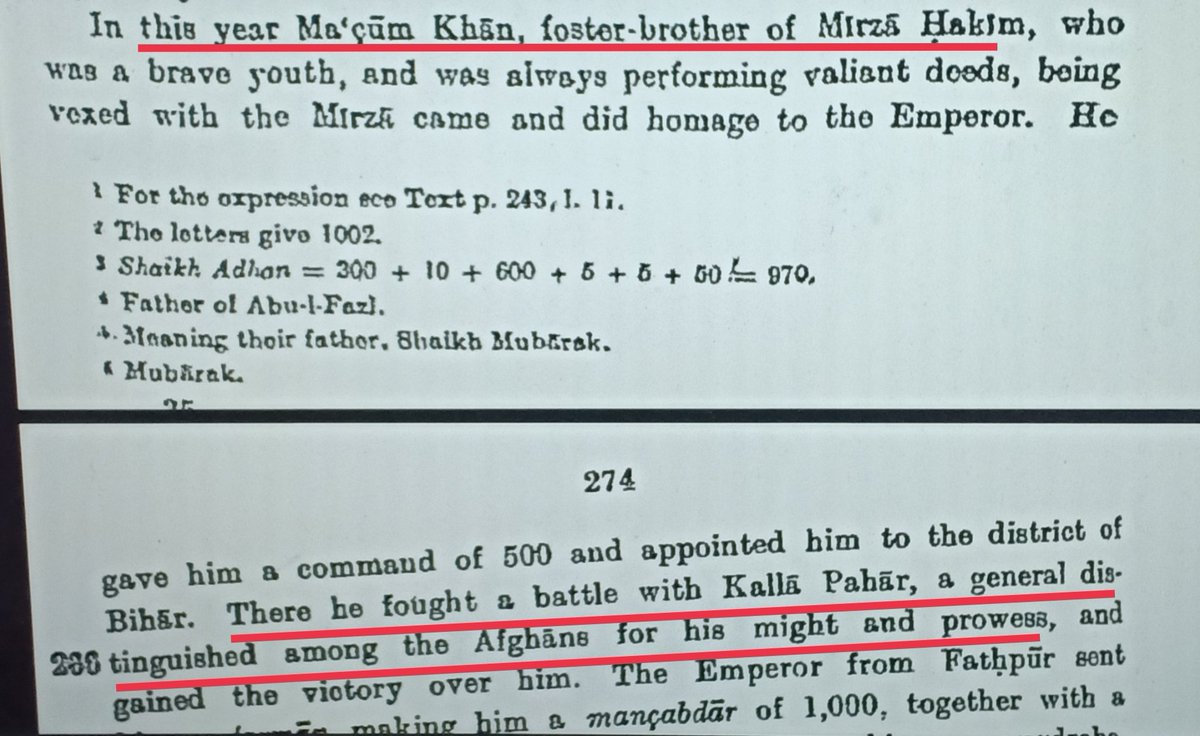
Fought a battle with Kalapahar, a general distinguished among the Afghans for his might"
Again corroborating it Ferista says To fight Mughals, Dawood Khan Karrani gathered some of the Afghan chiefs of Bengal and Bihar and later mentions Kalapahar to be 1 such Bengal officer 8/n
Again corroborating it Ferista says To fight Mughals, Dawood Khan Karrani gathered some of the Afghan chiefs of Bengal and Bihar and later mentions Kalapahar to be 1 such Bengal officer 8/n
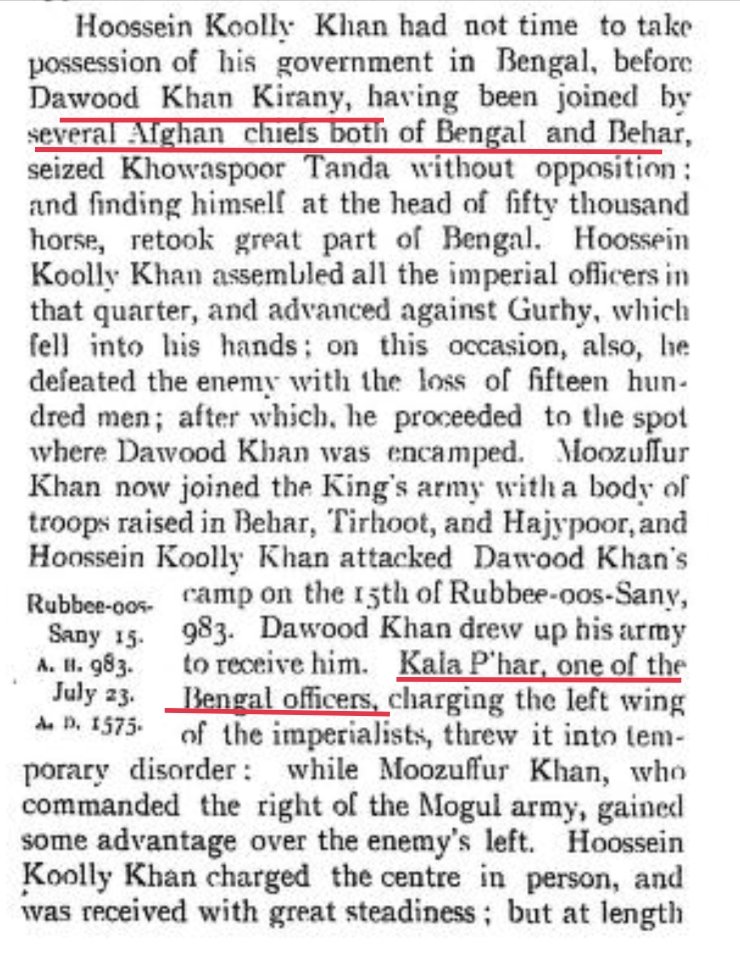
The same army fought Masum Khan which was mentioned by Badauni and Tarikh-i-Akbari so all three agrees on the Afghan origin of Kalapahar. Badauni and Tarikh-i-Akbari are contemporary so should be of highest importance while considering this. Now, let's verify the opposing 9/n
Theory. Here there are multiple contradictory accounts in Assam, Bengal and Odisha.
The first ever Brahmin origin theory comes from Buranji, an Assamese text. That text mentions Kalapahar was born in Benaras in a Brahmin family and came to Gour and fell in love with 10/n
The first ever Brahmin origin theory comes from Buranji, an Assamese text. That text mentions Kalapahar was born in Benaras in a Brahmin family and came to Gour and fell in love with 10/n
Daughter of Sultan Hussain Saha (not Suleiman Karani during whose rule Kalapahar invaded Odisha in reality, tradition of Bengal says it to be Suleiman though). This doesn't talk about Puri Jagannath temple rather talks about Kamakya temple.
This was written in late 17/18th 11/n
This was written in late 17/18th 11/n
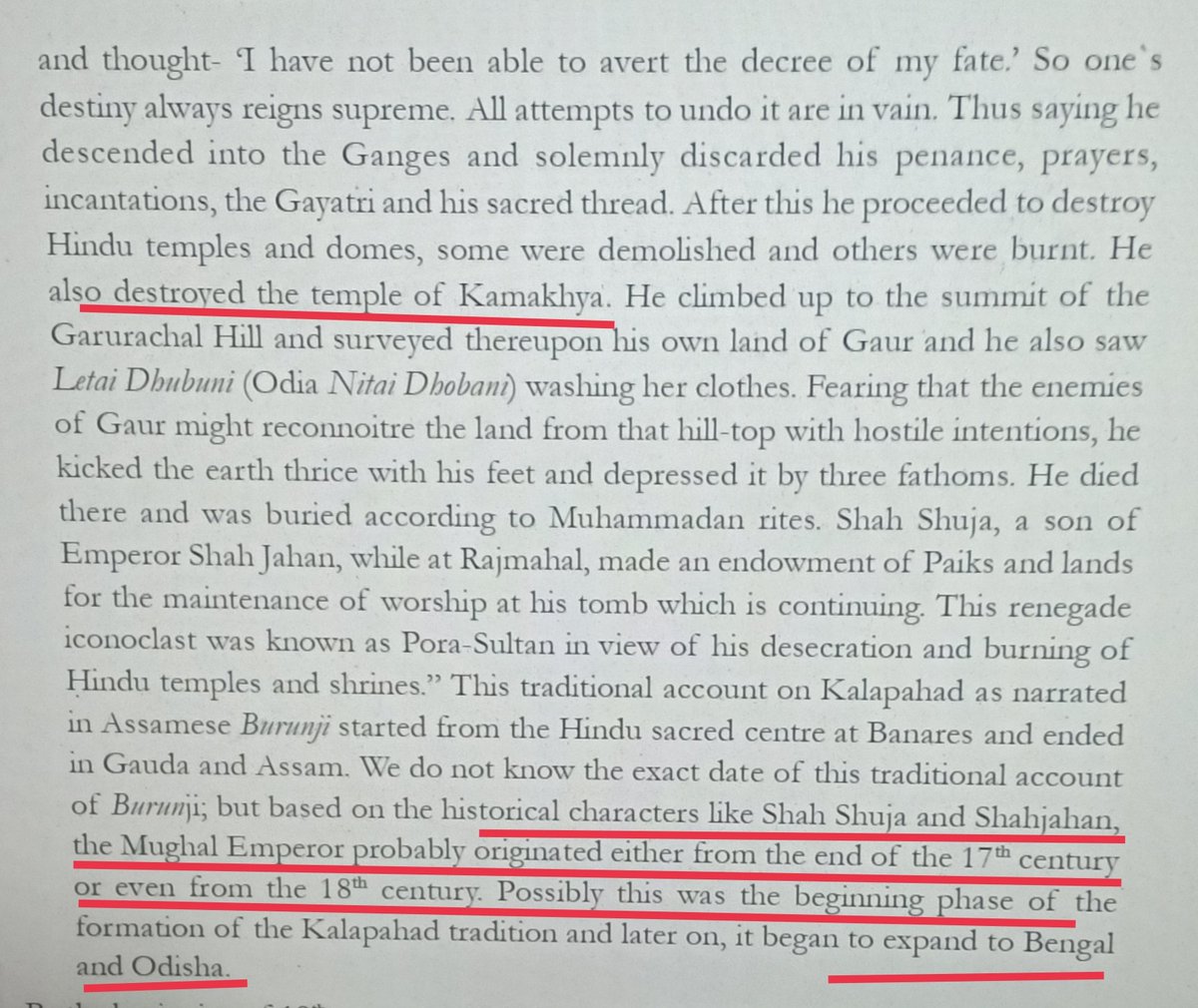
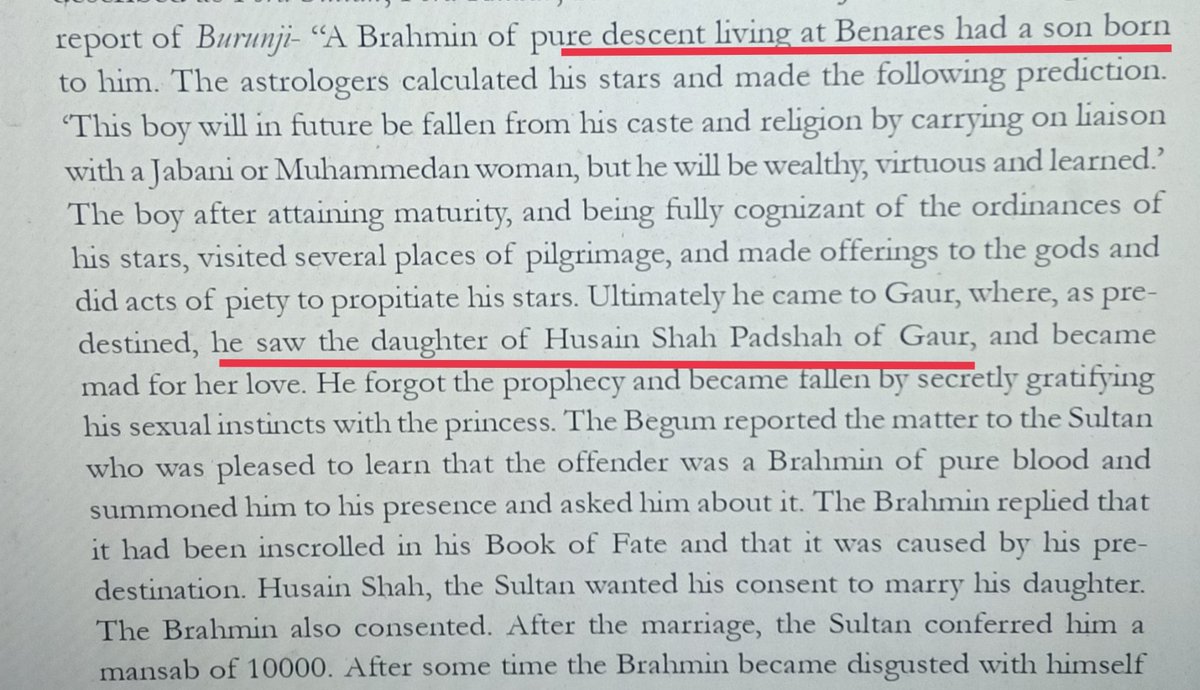
Century as it talks about sahajahan and shuja period. So, not even contemporary. The next record we have is of Riyaz-us-Salatin, where it clearly talks about Kalapahar invasion of Odisha and desecration of temples. But, it doesn't mention anything about his hindu origin 12/n
In contemporary Odishan sources like Kataka Rajavamsabali or the Madala Panji doesn't mention anything about his hindu origin at all. This is important as they are contemporary and Madala Panji deals with all details of temple of Puri. The real name of Kalapahar is 13/n
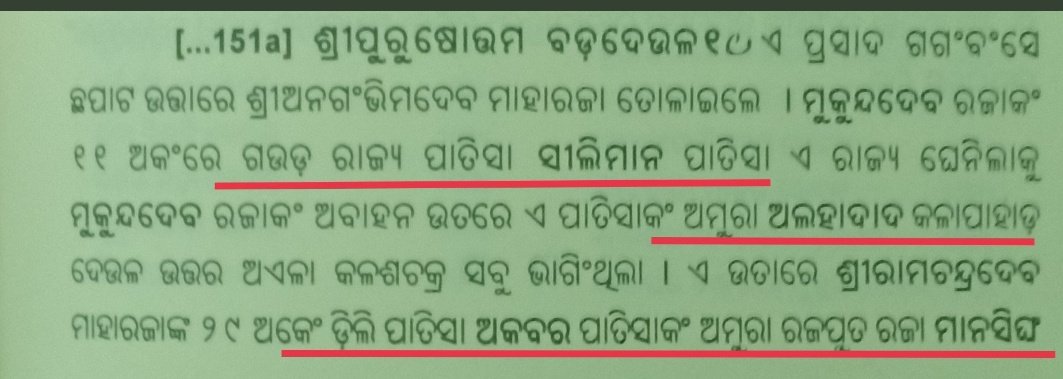
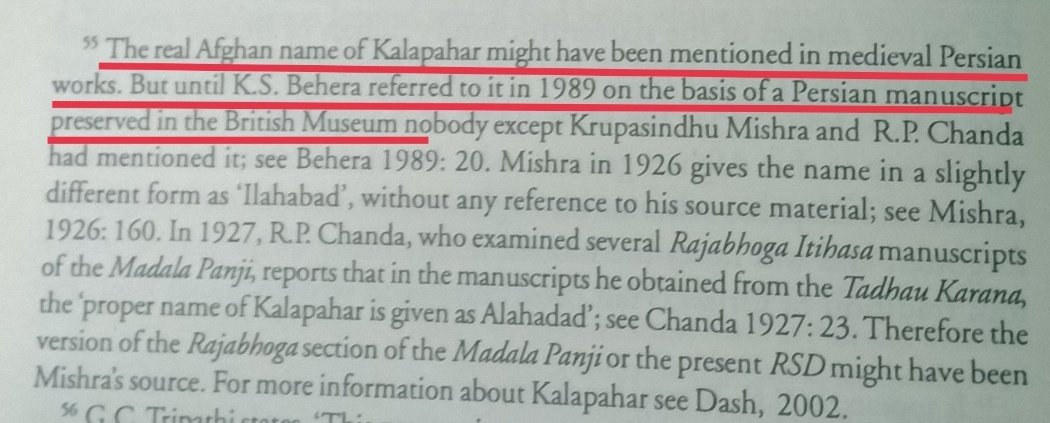
Mentioned to be Allahadad Kalapahar. As per historian KS Behera he also found the mention of the name in Persian manuscript in British museum. But no mention of him being hindu renegade. However, there are two Odia manuscripts named Gopi Bhasa and Chumbaka Malika of late 14/n
18th century (after Assamese text Buranji). But, here the story is different he is said to attract the attention of princess of king but the goddess didn't like it so she made some stratagem and made him eat meat and fish and he lost caste.
Now, in the 19th century this 15/n
Now, in the 19th century this 15/n
Tradition took new shape, In Bengal Gobinda Chandra sen without any reference mentioned the brahmin origin of Kalapahar with addition of a new story of him trying to do reconversion to Hinduism in Puri Jagannath temple. Pyarimohan acharya also mentions this shortens version 16/n
Earlier used by sterling. It was a time when Hinduism was said to be superstitious. Therefore, some of the modern thinking authors used it for show casing how close nature of Hinduism resulted in destruction of idols. A lot of articles, debates etc happened on this at that 17/n
Time. Now, in Bengal Durga Charan Sanyal used used this reconversion attempt story in his book Banglar Samajika Itihasa where out of no where he added name, location of birth, father's name etc to build up a narrative without any reference. Contrary to what Buranji said ie. 18/n
(Kalapahar moved from benaras to Gour and fell in love with Hussain Saha's daughter) he changed everything making him native of Bengal and to match that with real history which he obviously knew associated with Suleiman Karani. Similarly N N Basu in his Viswakosa gave 19/n
The name Raju to Kalapahar again without any reference to associate with Hinduism.
To summerise, there was no primary source claiming Brahmin origin of Kalapahar. The 1st one was Buranji of Assam which was written almost 100 years after and gives incorrect data(Hussain Saha 20/n
To summerise, there was no primary source claiming Brahmin origin of Kalapahar. The 1st one was Buranji of Assam which was written almost 100 years after and gives incorrect data(Hussain Saha 20/n
Who was of 1520 not Suleiman Karani) next source
Riyaz-us-Salatin doesn't mention hindu origin. Two late 18th century Odia source mention it but they are not contemporary and follow Buranji 's path. Then in later period due to severe pressure from Hindu reformist movement 21/n
Riyaz-us-Salatin doesn't mention hindu origin. Two late 18th century Odia source mention it but they are not contemporary and follow Buranji 's path. Then in later period due to severe pressure from Hindu reformist movement 21/n
A no of authors tried to use this traditional account to attack on caste and so called superstitious nature of Hinduism and mostly without any reference to primary source as a typical historian would have done. It became so mainstream that early historians accepted this 22/n
With face value. Only after post Independence some historians tried to search and observed not a single contemporary both Hindu and Muslim account calls him a brahmin renegade. Infact several Persian texts call him Afghan. So, this settles the debate that Kalapahar was 23/n
A blue blooded Afghan not a hindu renegade as some suggest
Ref:Tarikh-i-Akbari V2
Tarikh-i Firishta
Munktakhabut Tawarikh
Niamat Ullah
Madala Panji
Buranji
Gajapati kings of Orissa & their successors
..Kalapahad reinterpreted,KC Dash
Modern Indian sensibility,Ishita B Dubey24/n
Ref:Tarikh-i-Akbari V2
Tarikh-i Firishta
Munktakhabut Tawarikh
Niamat Ullah
Madala Panji
Buranji
Gajapati kings of Orissa & their successors
..Kalapahad reinterpreted,KC Dash
Modern Indian sensibility,Ishita B Dubey24/n
Loading suggestions...