
Silver Karsha Pana in my collection and their story. Please read on. This busts the myth of Romila Thaper and leftist historians.
#Thread
#Thread
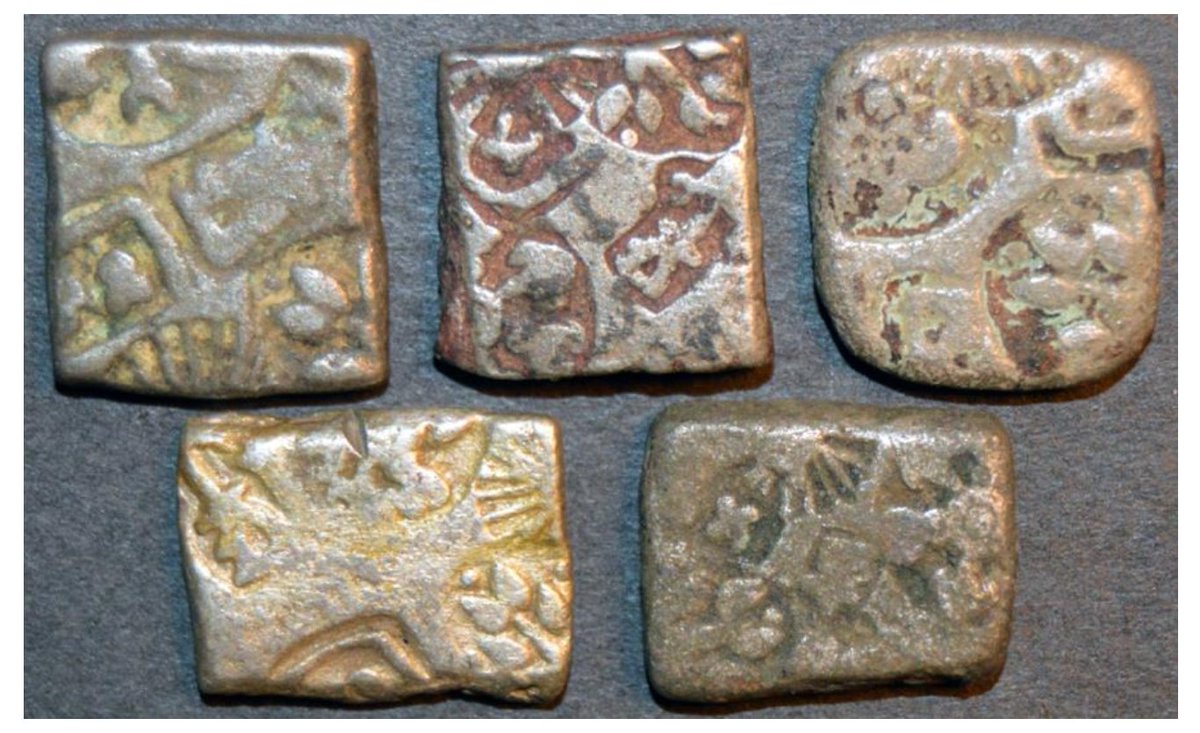
These tentatively come from Devavarman (or Devadharman) was a king of the Maurya Empire. He ruled in the period 202–195 BCE These coinage is 2200 years old! I am using them to disprove NCERT and Romila Thaper that money was introduced by Shershah.
Look at them they are cut uniformly and provided around six stampings (five in the front and one obverse). The unequalness you see is because of wear and tear of 2000 years.
Karshapana is earliest metallic currency ever known to humans.
Karshapana is earliest metallic currency ever known to humans.
Panini, in Adhyaya V and Pada I of Ashthadhyai mentions trade using term "tena kritam". He mentions 7 kinds of coins namely KarshaPana, Nishka, Satamana and so forth.
DR Bhandarkar in 1921 correctly estimated the coin making was started earlier than 700 BC! That is the history of money which Romila Thaper hid.
Panini flourished in around 550 BCE . India truly introduced the currency to the world. It was Sanathan and not Shershah.
Panini flourished in around 550 BCE . India truly introduced the currency to the world. It was Sanathan and not Shershah.
6th or 7th century BC, the Jataka tales were written. There is a story where the coinage is discussed. The story mentions Nishkas and Karshapana. Nishka is made of gold (higher value) Karshapana is made of silver (lower value)
Gamani Chanda Jataka says King decided that Chanda shall pay 24 Karshapana for a pair of oxen. This proves Karshapana were used as currency and not as a token as claimed by some historians. Karshapana is not token. It is money.
The word Karsha Pana itself means "punched" coin. This word is precursor to Kannada/Tamil word Kasu. Interestingly Pana become Hana or Panam in South Indian languages. Chola kings introduced Kasu to whole of Asia in around one millennium AD.
English word Cash comes from Kannada word Kasu which itself comes from Karshapana shown above. Without Sanathan there would be no cash, no trade.
Karshapana weighs around 146 to 147 grains or approximately 9.5 gms. The stamping on these coins have five symbols from a possible set of 277. We do not know what is the significance but there is an interesting thing.
Theobald, probably in 1890s, observed that symbols on Karshapana also appear in Assyria, Egypt, India and Scotland! Fourteen of these signs are identical with those sculpted in Scotland. Sanathan is truly "Vasudhaiva Kutumbakam"
Arthashastra describes two types of currency. Karsha pana or punched money and Rupya Pana or Fiat currency. Karsha pana is intrinsically worth the metal on which it is punched. So Karshapana is punched on a silver square weighing 146 grains is worth silver of its weight.
Where as Rupya pana has the worth as provided by a rupa (face) provided on the coin. That is the fiat money. Arthashastra distinguishes these currencies.
For Karsha pana you must have the silver or gold with you. But with Rupya pana you can basically create money out of thin air by stamping a kings face on the coin made of anything (So that is the story of Benjamins)
Rupyapana is shortened Rupya or Rupee. That is the ancestor of INR, Bangladeshi Taka, Russian Ruble, Pakistani Rupee. Indonesian Rupee and so on. Rupyapana is Sanskrit for "fiat money". Shershah bankrupted the kingdom with wars and printed fiat currency and then lost.
Leftist distorians wrote, Shershah introduced Rupee and we must be thankful for his great invention.
I hope I have busted the mythmaking by Romila Thaper.
I will write a book on this when I have more time. Thanks.
I hope I have busted the mythmaking by Romila Thaper.
I will write a book on this when I have more time. Thanks.
@htTweets please make Karan Thaper interview Romila and ask her to respond why she wrote fake history that "Shershah invented money". Share this widely to expose the leftist cabal of Gandhi clan and their fake history.
Loading suggestions...