
Semites and their Arabian Peninsula Origins
بقلم الفارس الحجازي و شباب Haplogroup E-v65
إهداء لكل العرب
The Winckler–Caetani theory, named after its two most distinguished proponents, Hugo Winckler and Leone Caetani,
بقلم الفارس الحجازي و شباب Haplogroup E-v65
إهداء لكل العرب
The Winckler–Caetani theory, named after its two most distinguished proponents, Hugo Winckler and Leone Caetani,
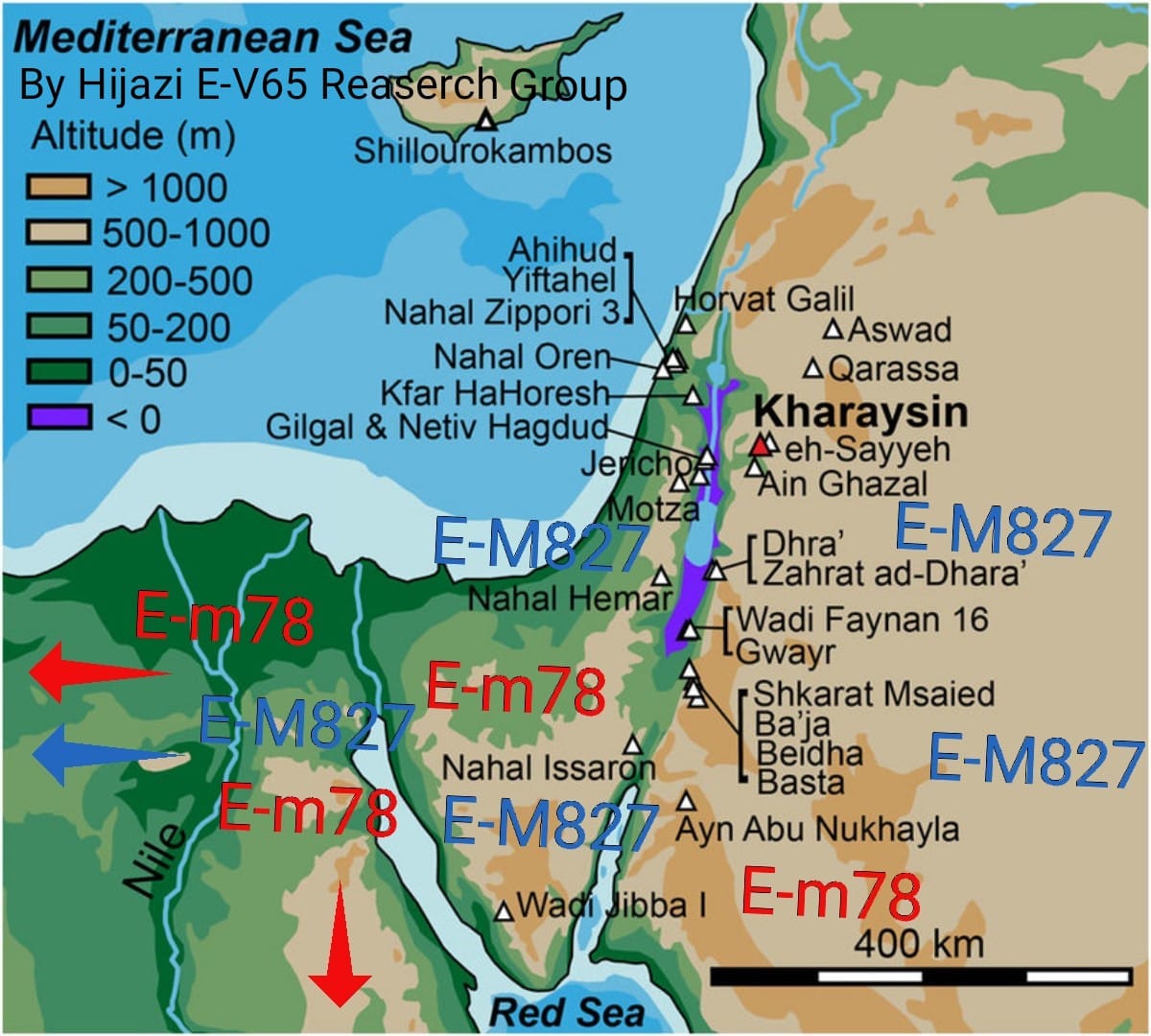
It claims that Arabia was originally a land of great fertility and the first home of the Semitic peoples. Through the millennia, it was undergoing a process of steady desiccation, a drying up of wealth and waterways and spread of the desert at the expense of the cultivable land.
The declining productivity of the peninsula, together with the increase in the number of inhabitants, led to a series of crises of overpopulation and consequently to a recurring cycle of invasions of the neighboring countries by the Semitic peoples of the peninsula.
It was these crises that carried the Assyrians, the Aramaeans, Canaanites (including the Phoenicians and Hebrews), and finally the Arabs themselves into the Fertile Crescent.
This theory has recently been replaced and significantly updated by Juris Zarins who proposes that a Circum Arabian Nomadic Pastoral Complex developed in the period from the climatic crisis of 6,200BCE,
partly as a result of an increasing emphasis in PPNB cultures upon animal domesticates, and a fusion with Harifian hunter gatherers in Southern Palestine, with affiliate connections with the cultures of Fayyum and the Eastern Desert of Egypt.
Cultures practicing this lifestyle spread down the Red Sea shoreline and moved east from Syria into Southern Iraq.
Nomadic pastoralism was a result of the Neolithic revolution and the rise of agriculture. During that revolution, humans began domesticating animals and plants for food and started forming cities.
Juris Zarins has proposed that pastoral nomadism began as a cultural lifestyle in the wake of the 6200 BC climatic crisis when Harifian pottery making hunter-gatherers in the Sinai fused with Pre-Pottery Neolithic B agriculturalists to produce the Munhata culture,
a nomadic lifestyle based on animal domestication, developing into the Yarmoukian and thence into a circum-Arabian nomadic pastoral complex, and spreading Proto-Semitic languages.
The Natufian culture is a Late Epipaleolithic archaeological culture of the Levant, dating to around 15,000 to 11,500 years ago.
The culture was unusual in that it supported a sedentary or semi-sedentary population even before the introduction of agriculture. The Natufian communities may be the ancestors of the builders of the first Neolithic settlements of the region, which may have been the earliest.
Fusion with animal domestication elements of the Pre-Pottery Neolithic B (PPNB) culture is hypothesised by Juris Zarins, to have led to the circum-Arabian Nomadic Pastoral Complex,
a group of cultures that invented nomadic pastoralism, and may have been the original culture which spread Proto-Semitic languages throughout the region.
Canaanite culture developed in situ from multiple waves of migration merging with the earlier Circum-Arabian Nomadic Pastoral Complex, which in turn developed from a fusion of their ancestral Natufian and Harifian cultures with Pre-Pottery Neolithic B (PPNB) farming cultures,
practicing animal domestication, during the 6200 BC climatic crisis which led to the Neolithic Revolution/First Agricultural Revolution in the Levant.
According to Christy G. Turner II, there is an archaeological and physical anthropological reason for a relation between the modern Semitic-speaking populations of the Levant and the Natufian culture.
Semites and Haplogroup E
According to Lazaridis et al. (2016), Natufian skeletal remains from the ancient Levant predominantly carried the Y-DNA haplogroup E1b1b.
According to Lazaridis et al. (2016), Natufian skeletal remains from the ancient Levant predominantly carried the Y-DNA haplogroup E1b1b.
Of the five Natufian specimens analysed for paternal lineages, three belonged to the E1b1b1b2, E1b1 and E1b1b1b2 subclades (60%).
Haplogroup E1b1b was also found at moderate frequencies among fossils from the ensuing Pre-Pottery Neolithic B culture, with the E1b1b1 and E1b1b1b2 subclades observed in two of seven PPNB specimens (~29%).
Y-DNA haplogroup E1b1b1b2 has been found in 75% of the ʿAin Ghazal population, along with 60% of PPNB populations (and is present in all three stages of PPNB) and in most Natufians. The scientists suggest that the Levantine early farmers may have spread southward into East Africa
, bringing along Western Eurasian and Basal Eurasian ancestral components separate from that which would arrive later in North Africa. Underhill (2002) associates the spread of the haplogroup with the Neolithic Revolution,
believing that the structure and regional pattern of E-M35 subclades potentially give "reagents with which to infer specific episodes of population histories associated with the Neolithic agricultural expansion"
Loading suggestions...