

1/During case conference (& on rounds), we often see master clinicians come up w/ brilliant diagnoses before the HPI is even finished.
But how did they get there?
And how can you teach yourself & others those skills?
This week: how to teach diagnostic reasoning more explicitly
But how did they get there?
And how can you teach yourself & others those skills?
This week: how to teach diagnostic reasoning more explicitly

2/ This week, we will discuss how to teach clinical reasoning.
Clinical reasoning can be divided into 2 distinct domains.
1⃣Diagnostic reasoning
2⃣Management reasoning
This week we will focus on diagnostic reasoning, and we will cover management reasoning next week.
Clinical reasoning can be divided into 2 distinct domains.
1⃣Diagnostic reasoning
2⃣Management reasoning
This week we will focus on diagnostic reasoning, and we will cover management reasoning next week.

3/ If you want a great primer on the differences between diagnostic and management reasoning, check out this paper in @AcadMedJournal by @CookMedEd @sherbino @lgruppen:
pubmed.ncbi.nlm.nih.gov
pubmed.ncbi.nlm.nih.gov

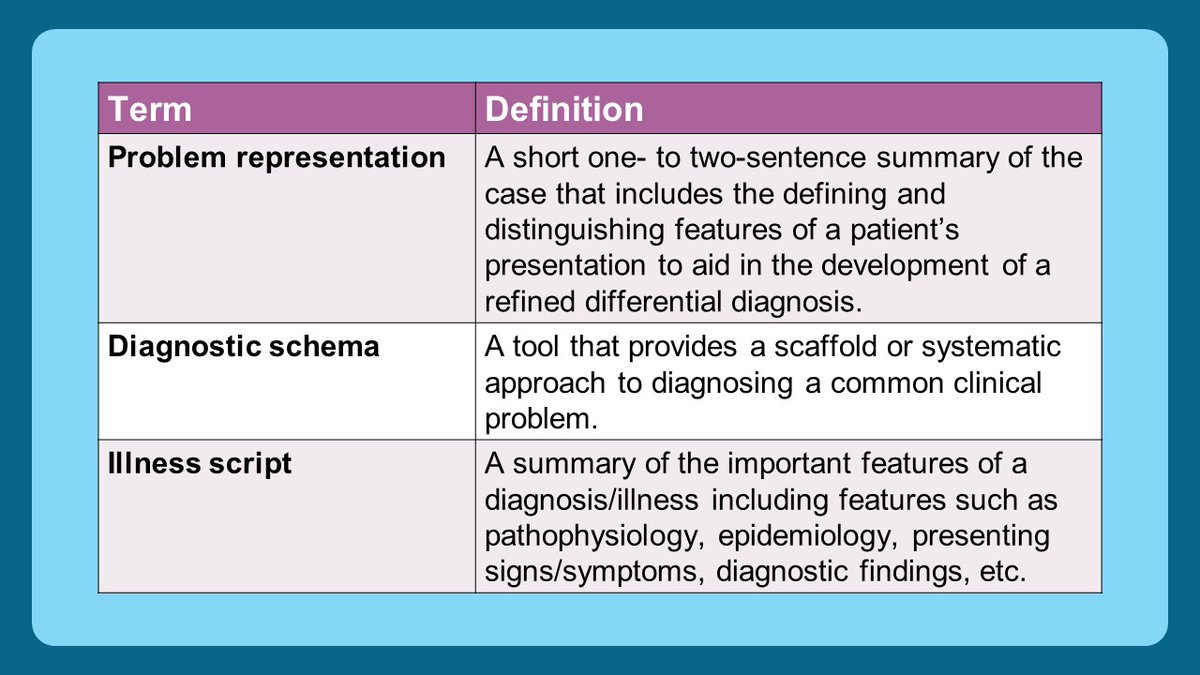
4/ When teaching diagnostic reasoning, there are 3 key features to highlight in the diagnostic process:
🔹Problem representation
🔹Diagnostic schema
🔹Illness script
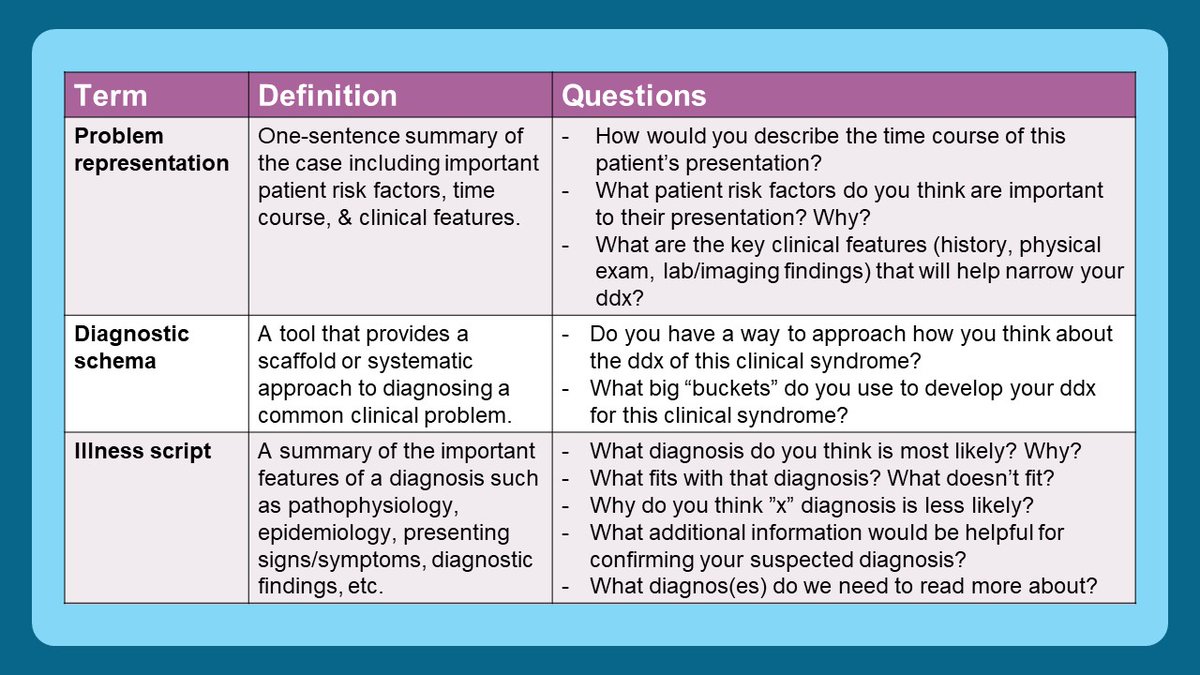
If these terms are new to you, see their definitions below or read more here: clinicalreasoning.org
🔹Problem representation
🔹Diagnostic schema
🔹Illness script
If these terms are new to you, see their definitions below or read more here: clinicalreasoning.org
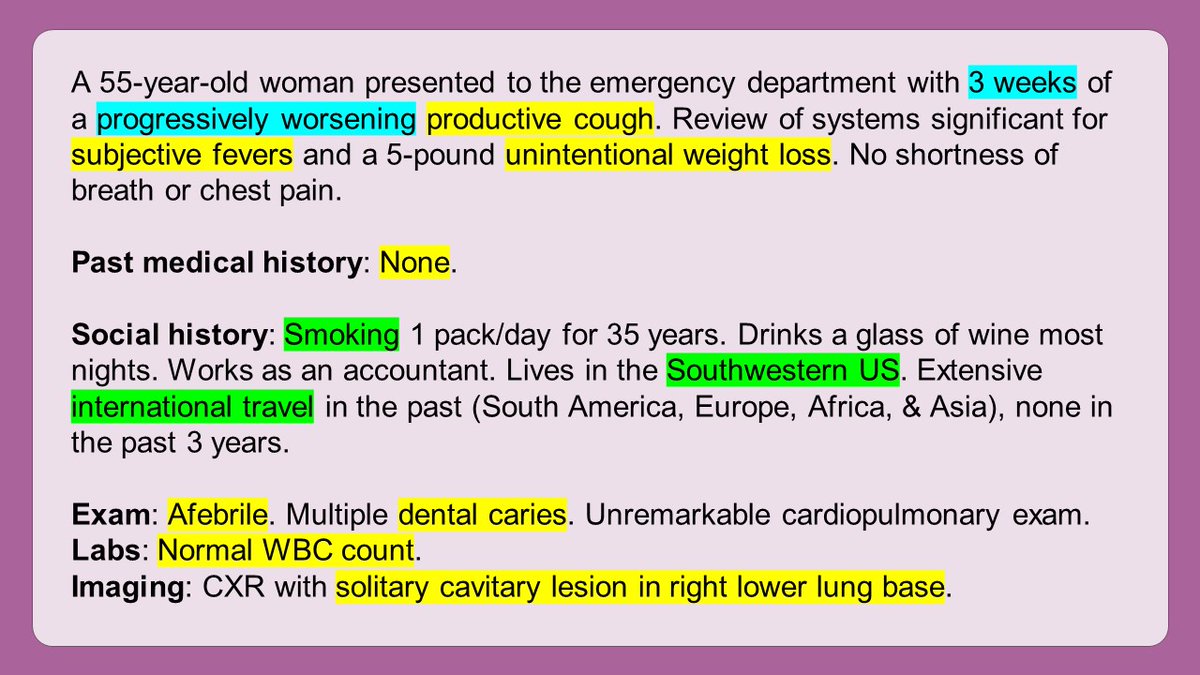
5/ Let's demonstrate how we can teach these 3 components of diagnostic reasoning using a case.
Let's use an example of a patient who presented with a cough and was found to have a cavitary lung lesion.
See full case description below.
👇👇👇
Let's use an example of a patient who presented with a cough and was found to have a cavitary lung lesion.
See full case description below.
👇👇👇

6/ The problem representation refers to the distillation of the important features of a case. It's analogous to the assessment statement.
To help learners with this, ask them to identify & describe:
🔵temporal course
🟢pertinent risk factors
🟡pertinent signs & symptoms
To help learners with this, ask them to identify & describe:
🔵temporal course
🟢pertinent risk factors
🟡pertinent signs & symptoms
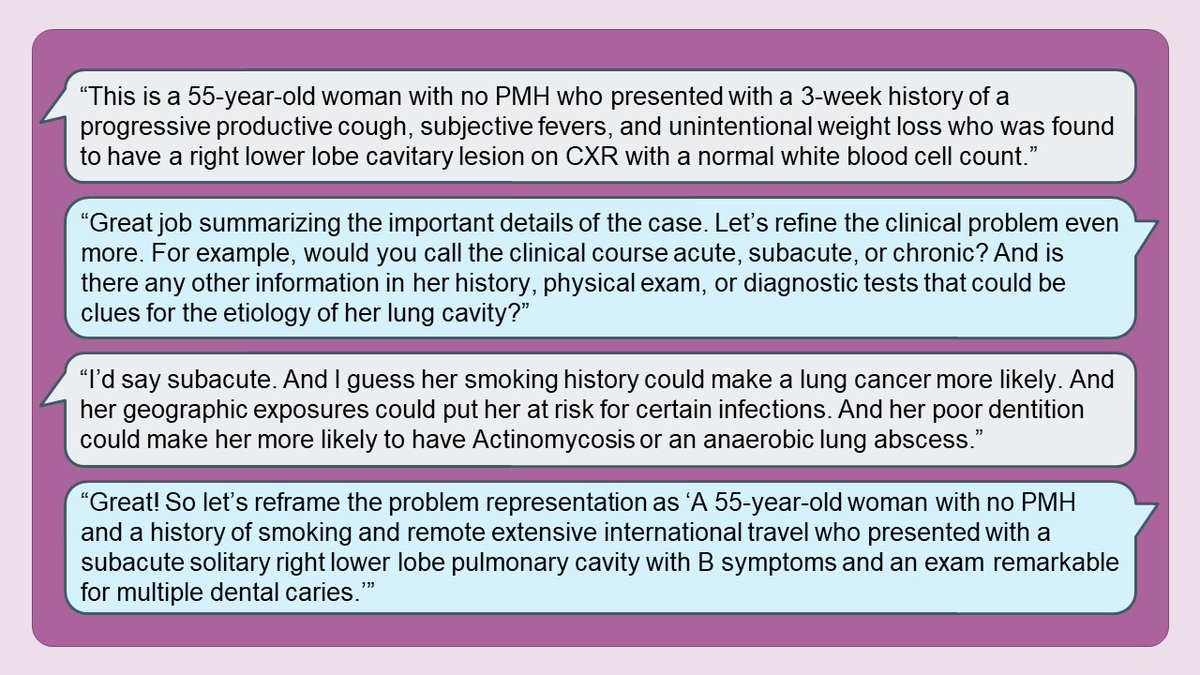
7/ Remember to have them highlight pertinent positives AND negatives in their problem representation.
Here's an example of how you might help a learner refine their initial problem representation to make it easier for them to access a diagnostic schema in the next step.
Here's an example of how you might help a learner refine their initial problem representation to make it easier for them to access a diagnostic schema in the next step.
8/ Once we have settled on a problem representation, I ask learners for their ddx.
HOWEVER, instead of just asking for the ddx, I ask them, "What's your general approach to this problem?"
This allows them to share their diagnostic schema.
HOWEVER, instead of just asking for the ddx, I ask them, "What's your general approach to this problem?"
This allows them to share their diagnostic schema.
9/ If learners don't have a diagnostic schema, then I share my own in a short chalk talk.
Great resources for diagnostic schemas include @CPSolvers & @AndreMansoor's Frameworks for IM.
Here's one on cavitary lung lesions from @CPSolvers:
clinicalproblemsolving.com
Great resources for diagnostic schemas include @CPSolvers & @AndreMansoor's Frameworks for IM.
Here's one on cavitary lung lesions from @CPSolvers:
clinicalproblemsolving.com
10/ Once learners have a ddx, we usually ask them to commit to a diagnosis & explain their rationale.
This is an opportunity to teach disease-specific knowledge via illness scripts.
Here's an illness script for GPA, which could be on our ddx for this pt: clinicalproblemsolving.com
This is an opportunity to teach disease-specific knowledge via illness scripts.
Here's an illness script for GPA, which could be on our ddx for this pt: clinicalproblemsolving.com

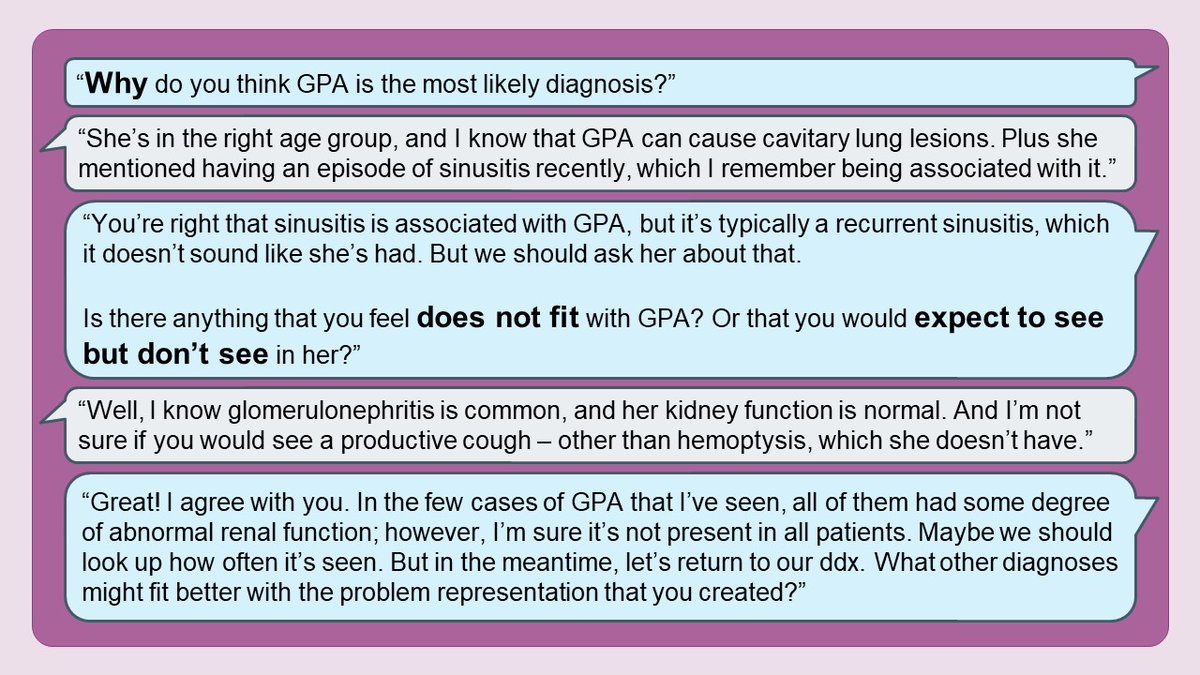
11/ My suspicion for GPA in this patient is much lower, so I could use this opportunity to explore their reasoning and determine their knowledge gaps. Then, I can provide targeted teaching.
Here's an example of how I might do that.
Here's an example of how I might do that.
12/ For learners that are having difficulty committing to a diagnosis, it may be helpful to have them create a compare & contrast table for the top 3 diseases on their ddx to help them target their reading.
H/t to @VarunPhadke2 who taught me this trick.
H/t to @VarunPhadke2 who taught me this trick.
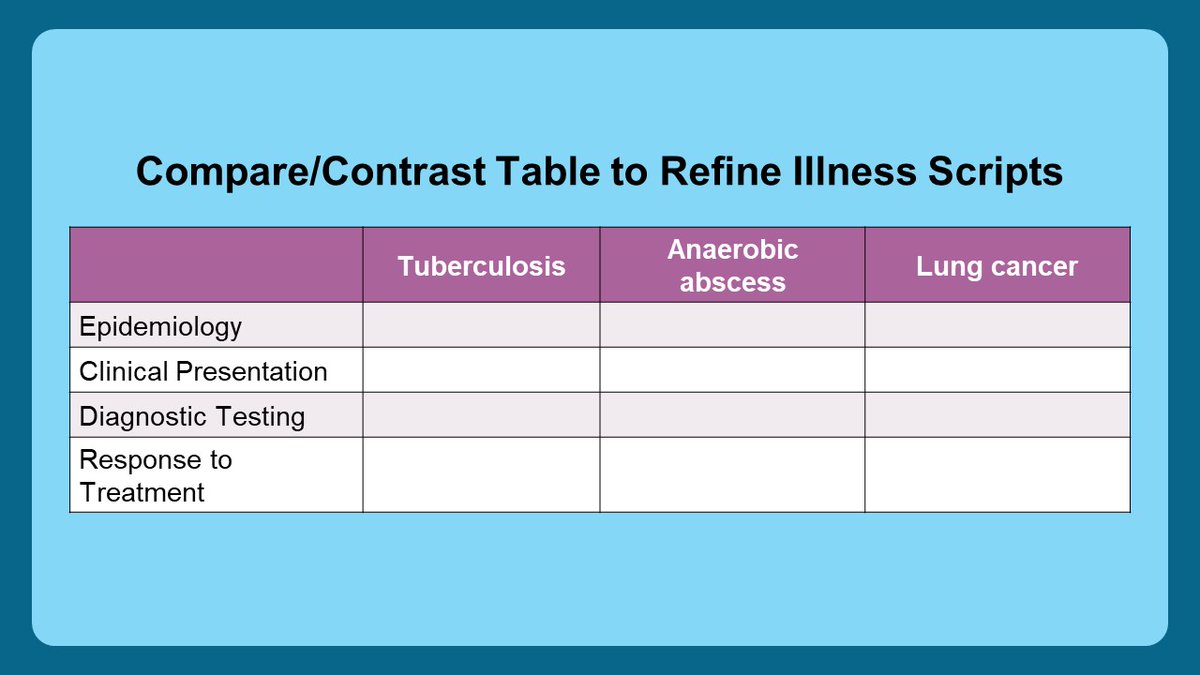
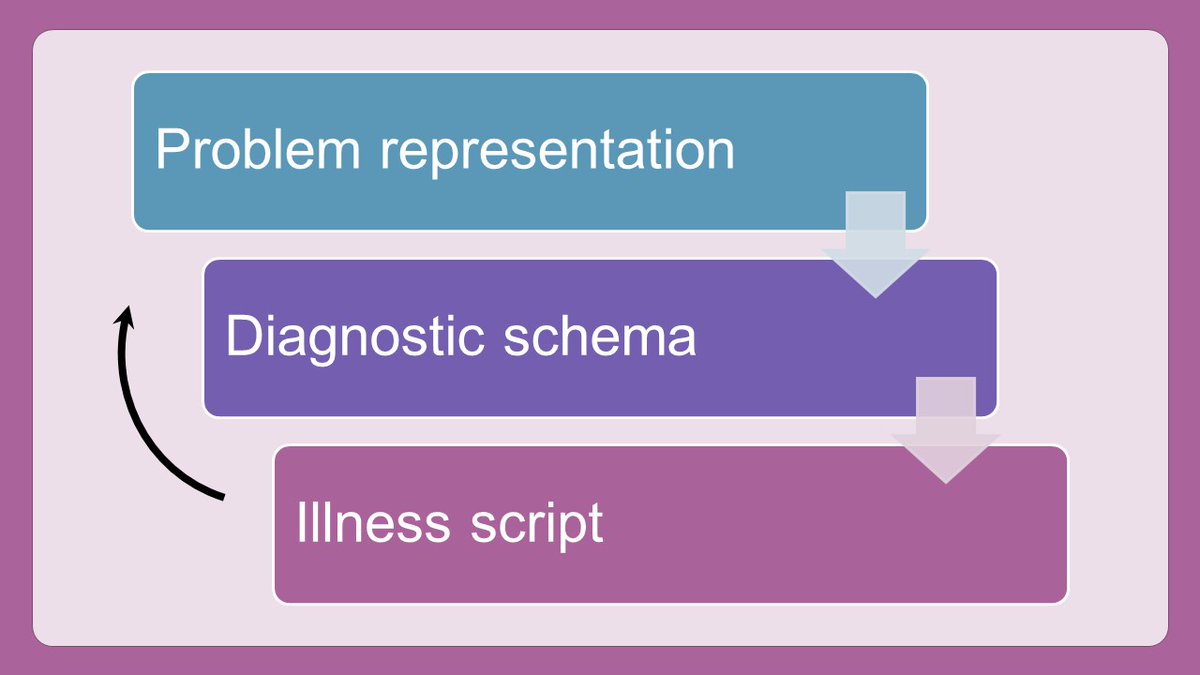
13/ As more information comes back, you will need to continue to refine the problem representation, diagnostic schema, & illness scripts.
It's an iterative process!
Asking learners how new information (eg, neg resp cx) alters their thinking is a great way to teach each day!
It's an iterative process!
Asking learners how new information (eg, neg resp cx) alters their thinking is a great way to teach each day!
14/ If you want additional resources to refine diagnostic reasoning for yourself or your learners, check out these resources:
🔹@CPSolvers
🔹@COREIMpodcast
🔹@febrilepodcast (for ID)
🔹@JournalGIM Exercises in Clinical Reasoning articles
🔹@NEJMEvidence new morning report series
🔹@CPSolvers
🔹@COREIMpodcast
🔹@febrilepodcast (for ID)
🔹@JournalGIM Exercises in Clinical Reasoning articles
🔹@NEJMEvidence new morning report series
15/ Here's a summary of some ?s you can use to teach diagnostic reasoning.
Remember, you don't have to teach ALL of this for EVERY patient. It's just a menu of options.
And instead of always asking learners, consider using these ?s as guides for explaining YOUR dx reasoning.
Remember, you don't have to teach ALL of this for EVERY patient. It's just a menu of options.
And instead of always asking learners, consider using these ?s as guides for explaining YOUR dx reasoning.
16/ But sometimes we already know the diagnosis - so how should we teach about clinical reasoning in that case?
Well, join the @MedEdTwagTeam next week as I delve into how to teach management reasoning!
Well, join the @MedEdTwagTeam next week as I delve into how to teach management reasoning!
Loading suggestions...