
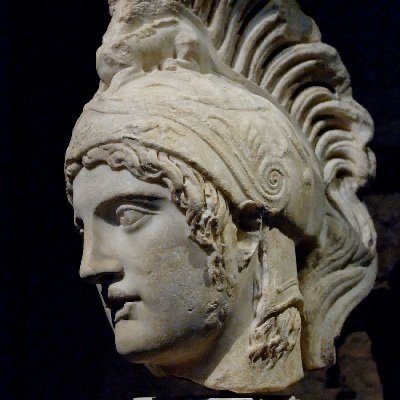
'She brought some of her sanitary towels and threw them before him, and said, "You love this, young man, and there is nothing beautiful about it’.
— Hypatia of #Alexandria to a student who apparently fell in love with her.
— Hypatia of #Alexandria to a student who apparently fell in love with her.


Extremely beautiful and popular to both moderate christians and pagans of Alexandria, she came to loggerheads with the parabalani (more on them later)
when she sided with the christian governor (Orestes) against the terror of these ‘monks’ (led by a fanatical priest Cyril of Alexandria) since they massacred the Jewish population of the city, supposedly numbering hundreds of thousands.
She was blamed to be witch (slur those days for intellectual pagans) and an atheist who was responsible for ‘paganising’ Orestes, who in his own admission was a baptised christian!
As soon as she stood on the street, the parabalani, under the guidance of a Church magistrate called Peter – 'a perfect believer in all respects in Jesus Christ'- surged round and seized 'the pagan woman'.
They then dragged Alexandria's greatest living mathematician through the streets to a church. Once inside, they ripped the clothes from her body then, using broken pieces of pottery as blades, flayed her skin from her flesh.


The Parabalānī ("persons who risk their lives as nurses", from Ancient Greek: παραβαλανεῖς) or Parabolani (from παραβολᾶνοι or παράβολοι) were the members of a militant brotherhood in early Christianity.
Generally drawn from the lower strata of society, they also functioned as attendants to local bishops and were sometimes used by them as bodyguards and in violent clashes with their opponents. In this case, the fanatical Cyril of Alexandria.
en.wikipedia.org
en.wikipedia.org

Described as marauding bands of bearded, black-robed zealots, armed with little more than stones, iron bars and an iron sense of righteousness had been terrorizing the east of the Roman Empire.
Not only were the monks vulgar, stinking, illeducated and violent they were also, said their critics, phoneys.
They pretended to adopt lives of austere self-denial but actually they were no better than drunken thugs, a black-robed tribe ‘who eat more than elephants and, by the quantities of drink they consume, weary those that accompany their drinking with the singing of hymns’.
After going on their rampage these men would then, he said, ‘hide these excesses under an artificially contrived pallor’ and pretend to be holy, self-denying monks once again.
Drunks they might have been but, as Libanius saw, they were ferociously effective. ‘After demolishing one [temple], they scurry to another, and to a third, and trophy is piled on trophy’ – and all this ‘in contravention of the law’.
A description of their deeds and iconoclasm (a mental disease imho).
I couldn’t help but notice the similarities they have with you know who (second image).
I couldn’t help but notice the similarities they have with you know who (second image).


Loading suggestions...