
Business
Finance
manufacturing
Chemicals
Chemical Manufacturing
Rubber Processing
Specialty Chemicals

#YashoIndustries Long Thread 🧵🧵
Like & Retweet for Max reach !
CMP - ₹1865
Introduction
Yasho Industries is a Mumbai-based Specialty chemicals manufacturer which was incorporated in 1985 by Mr. Vinod Jhaveri.
Like & Retweet for Max reach !
CMP - ₹1865
Introduction
Yasho Industries is a Mumbai-based Specialty chemicals manufacturer which was incorporated in 1985 by Mr. Vinod Jhaveri.
The company started operations with aromatic chemicals and specialty chemicals. In 2000, the company started manufacturing rubber chemicals and lubricant additives which are used in rubber processing industries.
Business Segments
The company has four business verticals with the highest revenue contribution from rubber chemicals. Rubber chemicals, Lubricant additives and specialty chemicals together contribute 59% of total revenues and the rest
The company has four business verticals with the highest revenue contribution from rubber chemicals. Rubber chemicals, Lubricant additives and specialty chemicals together contribute 59% of total revenues and the rest
is from antioxidants and aroma chemical business. Going forward the company expects the revenue contribution from rubber, lubricant and specialty will be 65-70% of total revenues.

Aroma Chemicals
The company manufactures clove oil and its derivatives in the segment and is a market leader for these products.
The aroma chemicals are used by F&F companies in the formulation of flavours and fragrances.
The company manufactures clove oil and its derivatives in the segment and is a market leader for these products.
The aroma chemicals are used by F&F companies in the formulation of flavours and fragrances.

The aroma chemical industry is such that peers in the industry tend to avoid manufacturing chemicals which are manufactured by others. Thus cross selling and customer retention is higher.
There are a total 35 products in the segment with single digit margin.
There are a total 35 products in the segment with single digit margin.
These products are high volume low value products used by FMCG and F&F industry.
The KSM for aroma chemicals is clove leaf oil which is imported from Indonesia and Madagascar.
The KSM for aroma chemicals is clove leaf oil which is imported from Indonesia and Madagascar.

Antioxidants
Fatty oils and oil-based foods are prone to auto-oxidation that results in a rancid taste and unpleasant odour. To prevent oxidation reactions and increase the shelf life of food, antioxidants such as TBHQ, BHA and Ascorbyl palmitate are used.
Fatty oils and oil-based foods are prone to auto-oxidation that results in a rancid taste and unpleasant odour. To prevent oxidation reactions and increase the shelf life of food, antioxidants such as TBHQ, BHA and Ascorbyl palmitate are used.

Company uses conventional methods to manufacture these products using hydroquinone giving them the competitive disadvantage over Clean Science and Technologies ltd.
The segment has single digit margins with a total of 14 products.
The segment has single digit margins with a total of 14 products.

Rubber Chemicals
Rubber chemicals is used to manufacture rubber products like tyres, automotive components like hoses, seals, conveyor belts, and others
It is the highest contributing segment with healthy double digit margins.
Rubber chemicals is used to manufacture rubber products like tyres, automotive components like hoses, seals, conveyor belts, and others
It is the highest contributing segment with healthy double digit margins.

Due to high dependency on aroma chemicals and increasing competition on antioxidants markets, the company diversified the product portfolio into rubber chemical segment.
The Tyre industry is the leading consumer of rubber, with over 70% of the global market share.
The Tyre industry is the leading consumer of rubber, with over 70% of the global market share.
A broad spectrum of chemicals are employed in the rubber industry for a multitude of applications. The chemicals widely used in rubber industry are
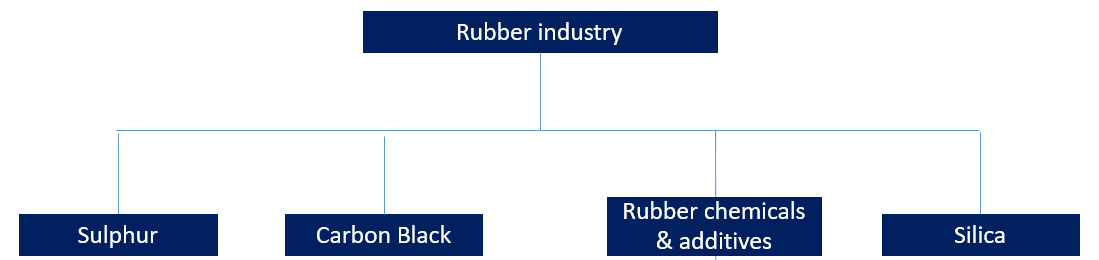
Sulphur- Sulphur is a key component in the rubber processing industry. Tyres are made out of vulcanised rubber. The vulcanization process is what makes the tires hard and heat resistant. The vulcanization, or curing process, is based on the reaction of unsaturated rubber
hydrocarbon molecules with sulphur in the presence of zinc oxide and other inorganic bases. A number of early developments have spurred the growth of the rubber industry since the initial discovery of vulcanization by Goodyear in 1844 and the growth and global spread of rubber
plantations.Sulfur remains the most successful and economical cross linking agent even today.
Other chemicals used for cross linking of polymers are Sulphur Monochloride, Tellurium, Selenium, Thiuram accelerators, Polysulphide polymers, p-Quinone Dioxime S, Metallic Oxides,
Other chemicals used for cross linking of polymers are Sulphur Monochloride, Tellurium, Selenium, Thiuram accelerators, Polysulphide polymers, p-Quinone Dioxime S, Metallic Oxides,
Organic Peroxides, Di-isocyanates,etc. (mostly for specialised applications).
Carbon Black: Carbon black is a very pure form of carbon which is added to rubber formulation in powder form. It helps the rubber not erode from friction which is critical for tires that are on the road all day thus acting as a type of reinforcement
inside the rubber of the tire and making it stronger. Some tires may be made up of as much as 30% carbon black.
Silica: When a tire generates less friction, it helps the tire last longer.Silica is added to tires to reduce rolling resistance.
Silica: When a tire generates less friction, it helps the tire last longer.Silica is added to tires to reduce rolling resistance.
It helps increase fuel economy, because less power is needed to push the car when it is met with less resistance
Rubber Chemicals: Not all tires are made entirely from naturally occurring rubber. Synthetic rubber has some advantages over natural rubber, because
Rubber Chemicals: Not all tires are made entirely from naturally occurring rubber. Synthetic rubber has some advantages over natural rubber, because
it is more pure and because it is very cost effective. Unlike natural rubber which is derived from the SAP of rubber trees, synthetic rubber is derived from crude naphtha. It has been reported that some 500 chemically, more or less, well-defined substances are used in the
Swedish rubber industry itself.
Additives are used by the companies to enhance the process efficiency and product durability. Additives can thus be classified according to their functions which include: Vulcanizing agents,
Additives are used by the companies to enhance the process efficiency and product durability. Additives can thus be classified according to their functions which include: Vulcanizing agents,
Curing agents, accelerators, antidegradants (antiozo- nants, antioxidants), activators, retarders, blowing agents, processing aids, rein- forcing agents. mould release agents, plasticizers, solvents, bonding agents and fillers
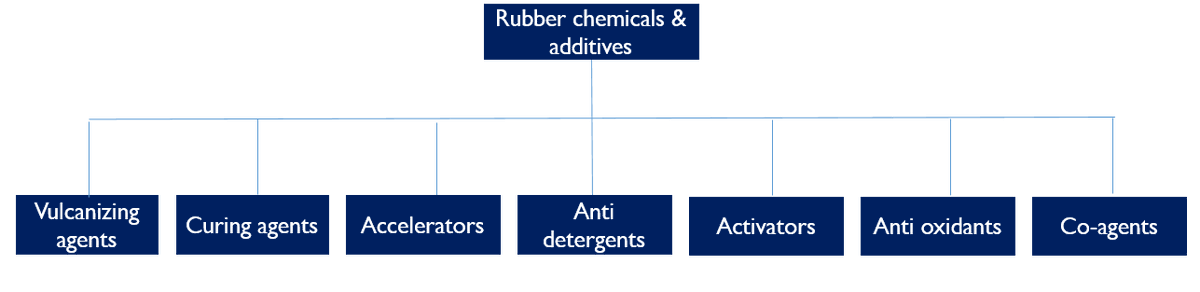
The rubber chemicals manufactured by Yasho industries are accelerators, antioxidants and co-agents.
Accelerators: These are critical and essential chemicals which accelerate the sulphur cross linking reaction (vulcanization)
Accelerators: These are critical and essential chemicals which accelerate the sulphur cross linking reaction (vulcanization)
and impart desired physical properties to rubber products and enable manufacturing of products on a large scale at an optimum cost. Accelerator also decreases the quantity of sulphur necessary for vulcanization and thus improves 'aged' properties of the rubber vulcanizates.

Accelerators are also classified as Primary or Secondary accelerators based on the role they play in a given compound.Generally, Thiazoles and Sulfenamide accelerators play a role of being Primary Accelerators due to their characteristics such as good processing safety, a broad

vulcanization plateau and optimum cross link density.The basic accelerators such as Guanidines, Thiurams, and Dithiocarbamates etc are used as Secondary accelerators to activate the primary accelerator.
Over 150 different chemicals belonging to different classes of composition are known to function as accelerators for rubber vulcanization of which around 50 accelerators are most commonly used by the Rubber Industry.
Antioxidants: These are essential chemicals which ensures that the normal or desired life cycle of a rubber product is achieved. All unsaturated polymers are vulnerable to Reactive Environmental Factors such as: Oxygen, Heat, UV light etc which degrade
polymers causing substantial changes in the physical properties of the rubber products. These chemicals do not eliminate elastomer degradation, but they substantially inhibit the rate of autoxidation.
MB, ZMB, ZMMB are few products which comes under this segment
MB, ZMB, ZMMB are few products which comes under this segment

Co-agents: Co-agents are used along with binders and additives which enhance the performance of the manufacturing process..
ZDA, ZDMA, TAIC etc comes under this segment
ZDA, ZDMA, TAIC etc comes under this segment

Company has 87 products across different classifications in the rubber chemicals segment having application in tyres, selaents, conveyor belt and other rubber products

Rubber chemicals constitute 4% of the rubber consumption.
The Tyre industry is the leading consumer of rubber chemicals. Rubber processing chemicals are being used for making tyres more durable and providing them strength to withstand any harsh environment
The Tyre industry is the leading consumer of rubber chemicals. Rubber processing chemicals are being used for making tyres more durable and providing them strength to withstand any harsh environment
Radial truck and bus tyres segment is directly proportional to infrastructure growth in the country which is also a growth engine for tyre industry.
While the sub segment (agriculture) is largely known as non-cyclical in nature, the other sub
While the sub segment (agriculture) is largely known as non-cyclical in nature, the other sub
segment (industrial, construction and mining) is generally considered as cyclical and the performance of it is largely linked to the overall economic outlook of the world. Automobile and tyre sector growth is directly proportional to infrastructure growth
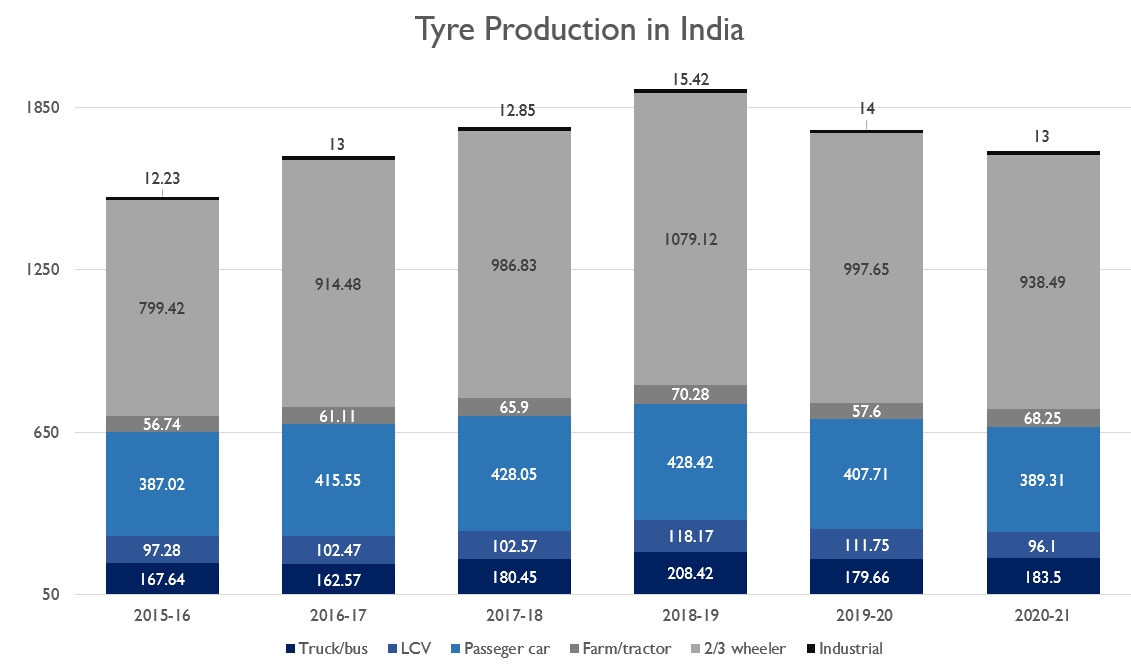
There are more than 250 different chemicals which are used in manufacturing of tyres.With chemical industry downfall in China and shutdown of rubber chemical companies is a key driver of opportunities for Yasho industries.
China is currently contributing to 75% of global rubber chemicals supply although their domestic demand does not exceed 35% of the global demand
Lubricant additives
Yasho manufactures a range of Additives for Industrial / Automotive Lube & Greases like-
• Antioxidants (Phenolic / Aminic)
• Molybdenum based Friction Modifiers / Anti Wear agents
• Dithiocarbamates
• Thiadiazoles Corrosion Inhibitor &
Yasho manufactures a range of Additives for Industrial / Automotive Lube & Greases like-
• Antioxidants (Phenolic / Aminic)
• Molybdenum based Friction Modifiers / Anti Wear agents
• Dithiocarbamates
• Thiadiazoles Corrosion Inhibitor &

Extreme pressure additives
• Triazole Metal Deactivators
• Triazole Metal Deactivators

Lubricants are used to reduce friction and wear, dissipate heat from critical parts of equipment, remove and suspend deposits that may affect performance and protect metal surface damage from degradation and corrosion.
Base oils themselves perform most of the functions of lubricants. But they can only do part of the job. Additives are needed when a lubricant’s base oil doesn’t provide all the properties the application requires.They typically range between
0.1 to 30 percent of the oil volume, depending on the machine.

Product Details

Specialty products
Yasho Industries manufactures various Specialty Chemicals used in different segment of industry such as Electroplating chemicals, Intermediates for API / Bulk Drugs, UPR Resins / Fibre Composites Resins, Thermoplastics Urethanes (Polyurethanes),
Yasho Industries manufactures various Specialty Chemicals used in different segment of industry such as Electroplating chemicals, Intermediates for API / Bulk Drugs, UPR Resins / Fibre Composites Resins, Thermoplastics Urethanes (Polyurethanes),
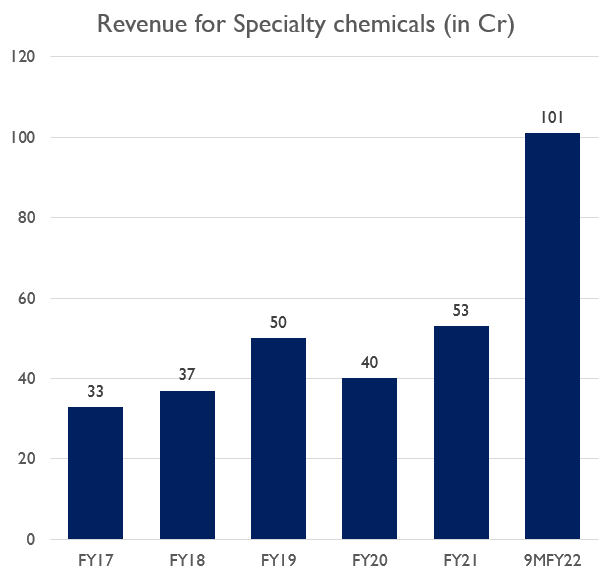
Printing Inks & Agrochemicals.

Capacity and expansion

In the last 3-4 years, the company has expanded their capacity from 6,000 MTPA to 11,000 MTPA.
This expansion was primarily to suffice ongoing demand into rubber, lubricant and specialty chemicals segments.
This expansion was primarily to suffice ongoing demand into rubber, lubricant and specialty chemicals segments.
The plant facilities are designed to be a multi-purpose plant, which gives an edge to be flexible with market demand.
Export and EBITDA/Tonne

Loading suggestions...