

Stephen King is one of the best-selling writers of our time.
Selling 350,000,000+ copies of his books.
Here are 17 of his writing rules you can use in the next 3 minutes to 10x your writing:
Selling 350,000,000+ copies of his books.
Here are 17 of his writing rules you can use in the next 3 minutes to 10x your writing:
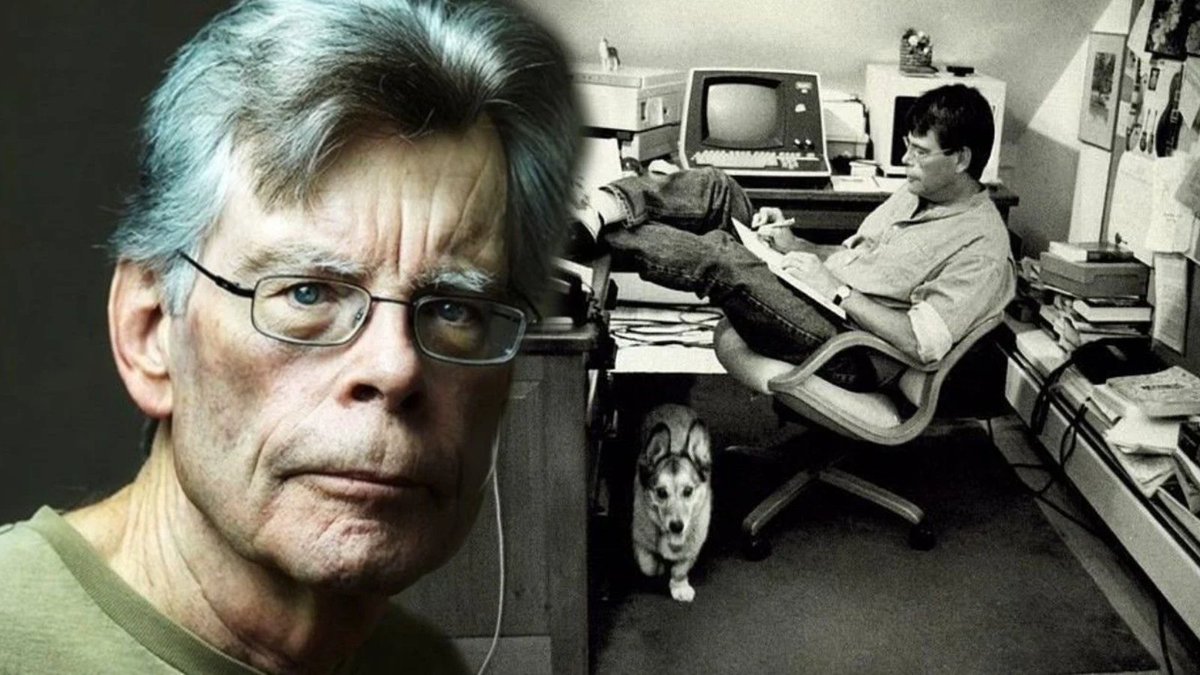
“...most books about writing are filled with bullshit. The shorter the book, the less the bullshit.”
- Stephen King
- Stephen King
Never use multiple words when one will do.
A lot of → Many
In order to → To
Hard to do → Difficult
For the purpose of → To
On an annual basis → Yearly
Unknown people → Strangers
Respectable writing respects the readers’ time.
A lot of → Many
In order to → To
Hard to do → Difficult
For the purpose of → To
On an annual basis → Yearly
Unknown people → Strangers
Respectable writing respects the readers’ time.
“[Adverbs are] like dandelions. If you have one on your lawn, it looks pretty and unique. If you fail to root it out... you find 5 the next day… 50 the day after… then.... your lawn is totally, completely, and profligately covered with dandelions.
- Stephen King
- Stephen King
Delete adverbs.
She didn’t “Yell loudly.”
She “Screamed.”
The car wasn’t “Really big.”
The car was “Gigantic.”
The man didn’t “Run quickly ahead.”
The man “Raced ahead.”
Use the right words and you won't waste them.
She didn’t “Yell loudly.”
She “Screamed.”
The car wasn’t “Really big.”
The car was “Gigantic.”
The man didn’t “Run quickly ahead.”
The man “Raced ahead.”
Use the right words and you won't waste them.
“Whether it’s a vignette of a single page or an epic trilogy like ‘The Lord of the Rings,’ the work is always accomplished one word at a time.”
- Stephen King
- Stephen King
If you can’t write 1000 words, write 500.
If you can’t write 500 words, write 100.
If you can’t write 100 words, write 1.
Don’t focus on how much you finish.
Focus on the habit of starting.
The rest will come.
If you can’t write 500 words, write 100.
If you can’t write 100 words, write 1.
Don’t focus on how much you finish.
Focus on the habit of starting.
The rest will come.
“There’s should be no telephone in your writing room, certainly no TV or videogames for you to fool around with.”
- Stephen King
- Stephen King
How to get into deep work:
1. Use noise-canceling headphones
2. Turn phone on "Do Not Disturb"
3. Block off 2 hours
4. Use website/app blockers
5. Write down 3-5 tasks
6. Listen to Hans Zimmer
7. Focus on 1 task at a time
This is how you get 4 hours of work done in 2.
1. Use noise-canceling headphones
2. Turn phone on "Do Not Disturb"
3. Block off 2 hours
4. Use website/app blockers
5. Write down 3-5 tasks
6. Listen to Hans Zimmer
7. Focus on 1 task at a time
This is how you get 4 hours of work done in 2.
“Timid writers like passive verbs for the same reason that timid lovers like passive partners. The passive voice is safe.”
- Stephen King
- Stephen King
Passive voice is weak and hard to understand.
“The water was drank by the boy.”
Turns into:
“The boy drank the water.”
Now the sentence has less clutter and more clarity.
“The water was drank by the boy.”
Turns into:
“The boy drank the water.”
Now the sentence has less clutter and more clarity.
"An opening line should invite the reader to begin the story. It should say: Listen. Come in here. You want to know about this.”
- Stephen King
- Stephen King
7 ways to hook your reader:
• Ask a question
• Create curiosity
• Hint at a benefit
• Use simple words
• Use words “you” and “your”
• Start in the middle of the action
• Keep the opening sentence short
They won’t read your last line if you don’t hook them on the 1st.
• Ask a question
• Create curiosity
• Hint at a benefit
• Use simple words
• Use words “you” and “your”
• Start in the middle of the action
• Keep the opening sentence short
They won’t read your last line if you don’t hook them on the 1st.
“I like to get ten pages a day, which amounts to 2,000 words. That’s 180,000 words over a three-month span, a goodish length for a book.”
- Stephen King
- Stephen King
Write every day.
The average book length is 90,000 words.
If you write 250 words a day for 1 year…
That’s 91,250 words.
You don’t need intensity, you need consistency.
The average book length is 90,000 words.
If you write 250 words a day for 1 year…
That’s 91,250 words.
You don’t need intensity, you need consistency.
“If you want to be a writer, you must do two things above all others: read a lot and write a lot. There’s no way around these two things that I’m aware of, no shortcut.”
- Stephen King
- Stephen King
Reading gives you the tools to write.
3 of the best books I’ve read on writing:
1. Writing Tools - Roy Peter Clark
2. On Writing Well - William Zinsser
3. 100 Ways to Improve Your Writing - Gary Provost
Apply the principles in these books and you’ll be ahead of 99% of writers.
3 of the best books I’ve read on writing:
1. Writing Tools - Roy Peter Clark
2. On Writing Well - William Zinsser
3. 100 Ways to Improve Your Writing - Gary Provost
Apply the principles in these books and you’ll be ahead of 99% of writers.
“Description begins in the writer’s imagination but should finish in the reader’s.”
- Stephen King
- Stephen King
Show, don’t tell
Don’t say “She was angry.”
Say “Her fists clenched tight as she stared the man down.”
Longer? Yes.
But the words make it easy to visualize, making it more engaging.
Don’t say “She was angry.”
Say “Her fists clenched tight as she stared the man down.”
Longer? Yes.
But the words make it easy to visualize, making it more engaging.
“One cannot imitate a writer’s approach to a particular genre, no matter how simple what that writer is doing may seem.”
- Stephen King
- Stephen King
Find your own style.
If you’re copying a writer, then by definition, you’ll never surpass them.
You’ll always be a subset.
To get good, copy. But to be great, develop your own style.
If you’re copying a writer, then by definition, you’ll never surpass them.
You’ll always be a subset.
To get good, copy. But to be great, develop your own style.
When you sit down to write, write. Don’t do anything else except go to the bathroom, and only do that if it absolutely cannot be put off.”
- Stephen King
- Stephen King
You kill your creativity when you edit while you write.
Editing engages the analytical part of your brain.
Writing engages the creative part of your brain.
Doing both is like stepping on the gas and hitting reverse.
Write first, edit later.
Editing engages the analytical part of your brain.
Writing engages the creative part of your brain.
Doing both is like stepping on the gas and hitting reverse.
Write first, edit later.
“One of the really bad things you can do to your writing is to dress up the vocabulary, looking for long words because you’re maybe a little bit ashamed of your short ones.”
- Stephen King
- Stephen King
Keep your words simple.
Don’t say: “Utilize”
Say: “Use"
Don't say: "Affirmative"
Say: “Yes”
Don’t say: “Idiosyncratic”
Say: “Distinct”
The smarter you try to sound, the dumber you look.
Don’t say: “Utilize”
Say: “Use"
Don't say: "Affirmative"
Say: “Yes”
Don’t say: “Idiosyncratic”
Say: “Distinct”
The smarter you try to sound, the dumber you look.
“The object of fiction isn’t grammatical correctness but to make the reader welcome and then tell a story.”
- Stephen King
- Stephen King
Lemme tell ya somethin’…
Academic writing may get you good grades, but it sounds robotic.
Don’t be afraid to break the rules with your words.
Academically correct?
Nah.
Sound human?
Yup.
Readers want conversations, not lectures.
Academic writing may get you good grades, but it sounds robotic.
Don’t be afraid to break the rules with your words.
Academically correct?
Nah.
Sound human?
Yup.
Readers want conversations, not lectures.
“You can tell without even reading if the book you’ve chosen is apt to be easy or hard, right? Easy books contain lots of short paragraphs...Paragraphs are almost as important for how they look as for what they say; they are maps of intent.”
- Stephen King
- Stephen King
Use white space.
Which piece of writing is easier for you to read? The one where it’s a solid block of text, with no spacing? Or the following example?
See how easy this is?
It doesn’t take much effort because I’m giving you a break.
Use this concept in your writing.
Which piece of writing is easier for you to read? The one where it’s a solid block of text, with no spacing? Or the following example?
See how easy this is?
It doesn’t take much effort because I’m giving you a break.
Use this concept in your writing.
“I think that every novelist has a single ideal reader; that at various points during the composition of a story, the writer is thinking, ‘I wonder what he/she will think when he/she reads this part?’”
- Stephen King
- Stephen King
Create an avatar of your ideal reader:
• What’s their job?
• How old are they?
• Where do they live?
• What are their goals?
• What are their hobbies?
• Are they a man or woman?
• What keeps them up at night?
To write for one person, ask multiple questions.
• What’s their job?
• How old are they?
• Where do they live?
• What are their goals?
• What are their hobbies?
• Are they a man or woman?
• What keeps them up at night?
To write for one person, ask multiple questions.
“You need to revise for length. Formula: 2nd Draft = 1st Draft — 10%.”
- Editor, writing to Stephen King
- Editor, writing to Stephen King
When writing:
• Write fast and stupid
• Don't worry about mistakes
• Focus on getting your ideas down
When editing:
• Cut the fluff
• Simplify words
• Shorten sentences
Write to develop ideas, edit to clarify them.
• Write fast and stupid
• Don't worry about mistakes
• Focus on getting your ideas down
When editing:
• Cut the fluff
• Simplify words
• Shorten sentences
Write to develop ideas, edit to clarify them.
“You learn best by reading a lot and writing a lot, and the most valuable lessons of all are the ones you teach yourself.”
- Stephen King
- Stephen King
Just like you don't become fit by reading about fitness, you don't become a writer by reading.
Do both.
Read to learn the principles, write to master them.
Do both.
Read to learn the principles, write to master them.
Stephen King's rules for writing:
1. Cut fluff
2. Avoid adverbs
3. Write 1 word at a time
4. Delete distractions
5. Avoid passive voice
6. Hook readers
7. Write every day
8. Read and write
9. Show, don't tell
10. Find your style
1. Cut fluff
2. Avoid adverbs
3. Write 1 word at a time
4. Delete distractions
5. Avoid passive voice
6. Hook readers
7. Write every day
8. Read and write
9. Show, don't tell
10. Find your style
Stephen King's rules for writing:
11. Write 1st, edit later
12. Keep it simple
13. Don't worry about grammar
14. Use white space
15. Create an reader avatar
16. Revise for length
17. Learn by doing
11. Write 1st, edit later
12. Keep it simple
13. Don't worry about grammar
14. Use white space
15. Create an reader avatar
16. Revise for length
17. Learn by doing
This thread took me 5 hours to research, write, and edit.
If you enjoyed this thread and want to help others improve their writing...
Couldya do me a favour and retweet the 1st tweet?
And if you want more content like this, follow me @WrongsToWrite
If you enjoyed this thread and want to help others improve their writing...
Couldya do me a favour and retweet the 1st tweet?
And if you want more content like this, follow me @WrongsToWrite
Loading suggestions...