

What is on-chain analytics?
🧵👇🏼
🧵👇🏼
2/ In crypto, every on-chain transaction on the public network is recorded and stored on the blockchain. Remember that time when you did a swap USDC for ETH on uniswap? Or you yield farm by providing liquidity on sushiswap?
3/ Or when you minted your favorite NFT?
Those transactions are all stored on the blockchain for everyone to see. Since all these can be tracked on-chain there are many things we can look at, from token holdings in a wallet,
Those transactions are all stored on the blockchain for everyone to see. Since all these can be tracked on-chain there are many things we can look at, from token holdings in a wallet,
4/ buying/selling of tokens, depositing into a staking pool, minting NFT, providing liquidity etc.
5/ But these are all very raw on-chain information where there is no context of who the market participants are. Picture 1 is an example you would see on Etherscan of a swap transaction executed through uniswap.
6/ You will see the timestamp, the wallet that executed this transaction, the counterparty (uniswap), what was done for this transaction, the tokens involved and the gas paid. A lot of information. But without knowing who executed the transaction, it is very hard to gain an edge.
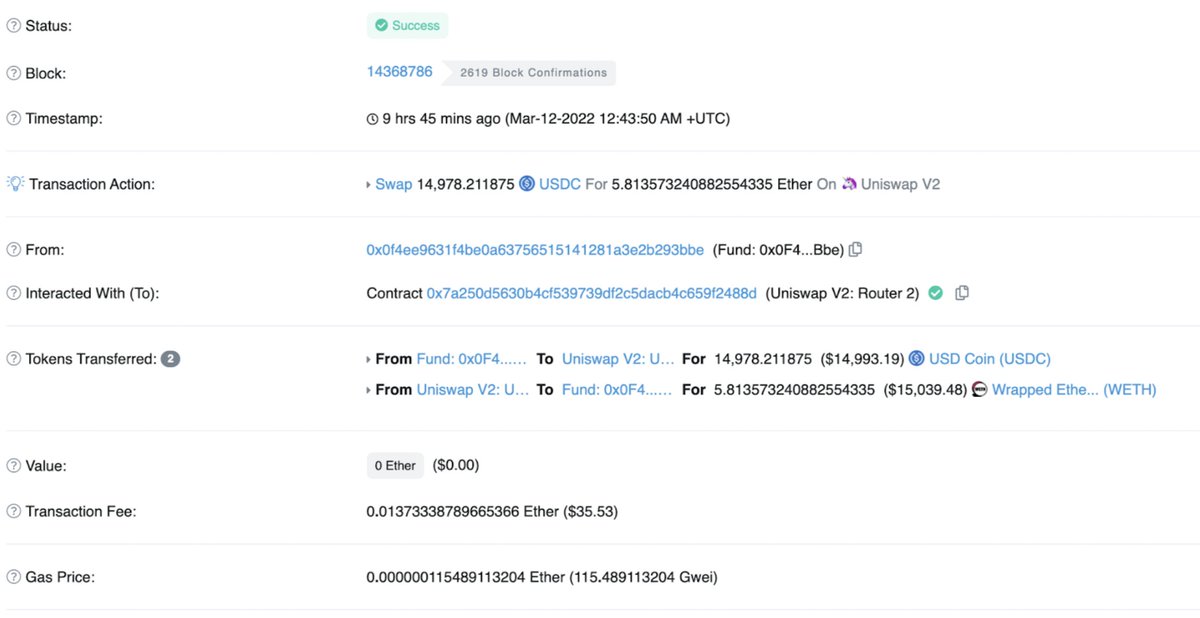
7/ This is where Nansen comes in to give you an edge. Nansen labels wallet addresses and gives you an idea of which market participants to pay attention to. More importantly, it gives context into a transaction. (Both are the same transaction)

8/ Every transaction that happens on-chain is recorded on the blockchain, it is available to everyone to see and track. Nansen takes this a step further, and gives you more context on who is executing the transaction.
9/ But how can this give you an edge? We will explore how to take advantage of this in the coming chapters.
10/ For the whole guide, head over to -
Loading suggestions...