
Greetings again from a Finnish leftist, especially to everyone identifying as progressive or leftist but living far away from Russia at the moment! I'll try to explain a bit how it feels like to live in a country neighboring Russia, and why we seem to disagree about e.g. NATO.1/
I'm now 40. For the last 15 years or so, I've increasingly identified myself as a leftist, largely because my job has been to study climate mitigation. I've concluded that inequality is not just a wrong in itself, but also one of the key reasons preventing sustainability. 2/
In fact, inequality and injustice are the causes in so many ills that opposing and reducing them everywhere should, in my opinion, be the priority of every policy. I think we need to reduce injustices within countries, between countries, and between humans and other species. 3/
So I do believe that I would fit whatever definition of "progressive" you'd like to use. I've been talking about these issues in Finland so much that many call me a "communist" (which I'm not, more a democratic socialist with anarchist leanings). 4/
On the other hand, I've born into, and living in a country which has been the subject of the Kremlin's aggression in the living memory, and knows what it actually means when the Kremlin wants you to be "neutral." 5/
Both my grandfathers had to fight in a war to prevent Finland from being occupied. Both were poor; one of my great-grandfathers could not afford a chimney, so every time my granddad's home was heated, everyone had to stay outside until smoke cleared. Even in Finnish winter. 6/
That granddad was also wounded in 1944 and carried Soviet steel inside him until he died. By the way, he never hated Soviets or Russians (to us, pretty much the same thing). He understood they too didn't want to be there fighting against him. 7/
Now some of you have been saying that he deserved to be wounded and his pals deserved to die because Finland was at the time allied with the actual Nazis. Yes, our leading politicians made that decision in late 1940. 8/
That was after we had fought off one invasion, with huge casualties. After we had pleaded for help from Western democracies, who gave us far too little, far too late. After Germans had taken over Denmark and Norway, and no help from the West could even reach us anymore. 9/
And after the Soviets had actually asked Hitler - this was revealed in the captured Nazi diplomatic archives - that they should be allowed to "finish off" the Finns. And concentrated forces to that effect. 10/
Still, the decision to ally with Nazis was a mistake. It was a mistake to attack in 1941, even though the primary war aim was to retake the homes of 12% of Finns, who had lost their ancestral homeland in 1940. Much like Palestinians who lost their homes in 1948 and after. 11/
We paid for that mistake, dearly. Not only did we lose a lot more lives than in the Winter War, we also lost even more territory. And had to pay "war reparations" that were, per capita, higher than those demanded from Germany after WW1. We paid them. 12/
This after a war where we were attacked after trying to stay neutral. Because Stalin believed our territory could be used to stage an attack against Leningrad, and because he wanted to rectify the "error" of Lenin, who had "allowed" Finland to become independent from Russia. 13/
(You may now see why Putin's announcement about rectifying the "errors" Lenin made when "creating" countries during the breakup of the Russian Empire raised alarm in Finland.) 14/
After the war, we had to learn to live in strict self-censorship. Officially, the events had to be papered over, and discussed very very carefully if at all. Even moderate criticism of the Soviet Union could spell the end of the critic's career, even though speech was "free." 15/
During the Cold War, we lived in a fear of Soviet occupation. We tried to prepare an independent defense, hoping that occupation would look expensive and we could negotiate some terms. We knew we wouldn't get meaningful help from anyone, the Swedes PERHAPS excepted. 16/
In actual fact, we were forced to sign an agreement of "Friendship, Mutual Cooperation, and Assistance", which included a clause where Finland would effectively join the Warsaw Pact in a conflict between the Pact and NATO. Both sides targeted nuclear weapons against us. 17/
Ambitious politicians quickly learned how to exploit the situation for their own gain. We had a president who ruled for 25 YEARS, because he projected an image of himself as the guarantor of Finnish "neutrality". 18/
We were so afraid that we allowed him to remain in office, in the end without bothering with elections.
Other politicians were even less scrupulous. 19/
Other politicians were even less scrupulous. 19/
Joining any economic or other "club" that smelled of Western interests was difficult at best, often impossible. We did not get Marshall aid, and could join the European Free Trade Area only after a very long struggle. 20/
Needless to say, politicians who did not toe the line were ousted. Basically everything right from center was out from the government, and the Kremlin viewed the Social Democrats with the greatest suspicion too. (The centrist Agrarian Union was their favorite.) 21/
And we were the lucky ones. The Baltic countries did not resist the same demands Stalin presented to us in 1939, and they were first occupied and then annexed. 22/
Those deemed too independence-minded were either shot or shipped to Siberia, and Russians were brought as colonists. Much like in Palestine today.
In Eastern Europe, puppet governments ruled, increasingly propped up with Soviet arms. 23/
In Eastern Europe, puppet governments ruled, increasingly propped up with Soviet arms. 23/
I was ten when the Soviet Union ceased to exist, on 25th Dec 1991. I already had had an inkling that there was this monster next door that we shouldn't even mention except obliquely, lest we summon it accidentally. I recall that every adult I knew was visibly relieved. 24/
It is hard to explain to someone who hasn't seen every adult in his life being simultaneously relieved. But there it was. Grandmother, who had never commented on politics and never would again, said that was the best Christmas present in world history. 25/
After the Soviet collapse, we were concerned that a civil war might break out, or that we'd have to deal with hundreds of thousands of Russian refugees escaping economic collapse. But these were still minor fears compared to the fear of being occupied. 26/
In the early 1990s, we also suffered one of the worst economic recessions in world history, exacerbated by the loss of Soviet trade. That was bad, too, but at least we didn't have to be afraid of war. 27/
The latter half of the 1990s were good for us. Nokia's success lifted us from the recession faster than anyone expected. The world seemed changed, even though there were bad news from faraway places like the Balkans. But we thought we could isolate from the world again. 28/
Nevertheless, we were always concerned that Russia might one day become a bully again. We watched with concern the attempted coups in 1991 and 1993. I recall playing Civilization with the "Russian" civilization and naming the leader "Rutskoy". 29/
But we were a bit afraid still, and refused to join NATO for instance, even when the Baltic states joined. We hoped for the best, that Russia would become a "normal" state. Especially we in the younger generation rather liked the Russians. 30/
We nevertheless retained our conscription and "obsolete" military that was focused on resisting and defeating a mechanized invasion of our homes, even when other European countries - even Estonia - focused on "crisis management", or in other words, colonial wars 2.0. 31/
I wondered whether I should do civil service instead, but in the end, I went along and did my conscript service in 2000, too. We trained to fight the forces of an unspecified country called "Yellow", which just happened to use a lot of Soviet-designed equipment. 32/
Of course, everyone knew what "Yellow" meant, and we felt free enough to say "Russia" occasionally. It was kind of a running gag to wonder about the similarities between the "Yellow" equipment and organization, and the Russian motor rifle and tank regiments. 33/
After the conscript service, I did my share of mandatory refresher exercises as well. We might practice drawing our equipment from storage and deploying post haste to screen the outskirts of Helsinki, for instance. 34/
I learned to look at motorways and country roads for good locations where to ambush a "Yellow" column.
I guess not many of you living far away from Russia have had to think how you'd blow up the bridges closest to home if tanks came a'knocking. 35/
I guess not many of you living far away from Russia have had to think how you'd blow up the bridges closest to home if tanks came a'knocking. 35/
Or which basements you'd use as strongpoints, and where you'd evacuate the living - and the inevitable dead.
We knew a war would mean horrific slaughter, of us Finns and of Russians. 36/
We knew a war would mean horrific slaughter, of us Finns and of Russians. 36/
I can't say how common this is, but I at least have spent probably years of my time thinking about how to fight, if necessary. Because I've been afraid that I would have to. 37/
Those hours and days are time I can't ever get back. It's time I could've used to write scientific papers, for instance. 38/
Now you could say that that's my problem, that we are just obsessed and paranoid and victims of propaganda. Perhaps so. On the other hand, what we always feared could happen to us has now come to pass in Ukraine. Even the paranoid may have enemies. 39/
We looked at how Russia turned increasingly autocratic and hostile under Putin. We looked at how the promising seeds of civil society were extinguished. 40/
We looked at the rise of Nashis and other "Putin Jugend". (I recall thinking that such indoctrination is going to end in war, but I didn't believe myself.) 41/
We looked at how Russian troll farms began to amplify and support far right and other loonies abroad. We looked at how Russian money and information operations corrupted politics in Europe and beyond. 42/
We did nothing. We just hoped things would change for the better. They changed for the worse. Putin started wars to bolster his popularity or support his allies, in Chechnya, in Georgia, in Syria. We did nothing. 43/
But this time, we know what would probably happen if we just tried to hide from the world, like in the 1930s. Best case, we would have to bow to the pressure from the Kremlin, like we did during the Cold War. 44/
Only this time, the favorites of the Kremlin are the loony Right. I've noted before that this would mean the Hungarization of Finland: a de facto far right autocracy, nominally legal due to measures that make legal opposition unsuccessful. 45/
Racism, sexism, and crony capitalism would be unchallenged. Environmental issues would be relegated to back burner at best, probably totally ignored. 46/
Worst case, unless Putin's regime collapses AND is replaced by something better, after Russian military recovers, we could be next in line to experience Greater Russian imperialism. 47/
So I support Finland joining NATO. I believe we will now do so, quite possibly before the end of this year although not immediately. I know very well that NATO is not some kumbayah-singing club full of benign intentions. But it's not forcing its members to join, or stay in. 48/
I understand that from far away, it's not easy to understand what is actually happening. I have little idea about what the relations between different Latin American countries really are, for example. 49/
So I try not to tell these people from other countries what they should do, or presume to know what's best for them. I believe humans everywhere are quite capable of making their own decisions. I demand every human and every society should have that right. 50/
It galls me to see so many people who identify as progressives and "for the people" turn into cynical Metterniches and Kissingers whenever countries in Eastern Europe are concerned. We are not pawns in your great power game. We have agency. 51/
The same of course applies everywhere. I wouldn't dare to tell the Palestinians, for instance, that they must seek accommodation with Israel. I hope they find a way to coexist, but if they choose to resist the occupation, they have every right to do so. 52/
If the people in Iran, for instance, wanted to join an alliance that helps defend them against U.S. threats, I'd be happy if they could find one. I'd prefer they won't ally with Russia or other autocratic nations, but I understand them if they do. 53/
I'd also like to ditch NATO and create a purely European, purely defensive alliance that expressly agrees to use force only in direct defense of its members. Collective defense is a good idea - it reduces the need for individual countries to militarize their societies. 54/
(One reason why the Finnish society is quite a bit more conservative than other Scandinavian societies is, in my opinion, the militarization of society, dictated by the desire to survive on our own. If NATO membership ultimately reduces these pressures, I'd be happy.) 55/
But as long as better alternatives are absent, I want Finland to join NATO, and stand against imperialism both far away, and nearby. To us, the direct threat is close to home.
Apologies for long thread, didn't have time to write a shorter one.
56/
Apologies for long thread, didn't have time to write a shorter one.
56/
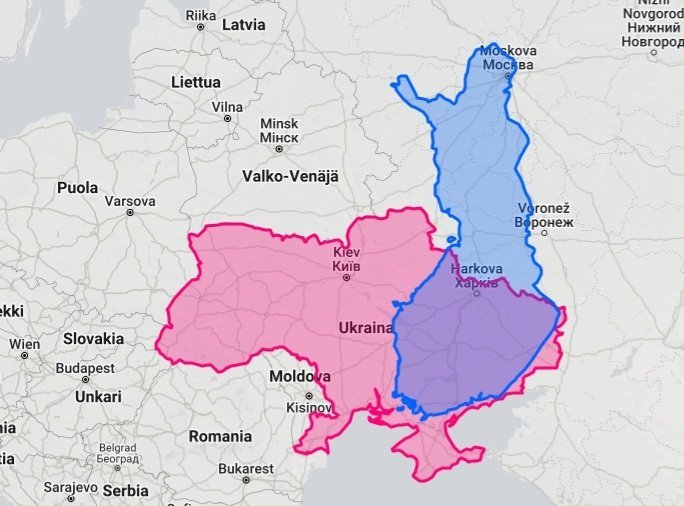
PS. Here's Finland and Ukraine to scale. Ukraine has about 44 million inhabitants, Finland 5.5 million, and we have 1340 km of border against Russia.
PPS. Here's very rough approximation of what a similar invasion might look like in Finland.
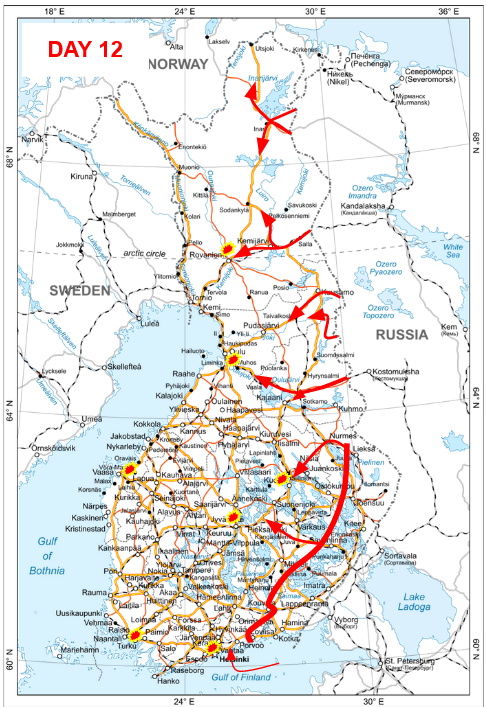
Note that in Finnish case, getting to the same results would probably take longer than 12 days - this is just to illustrate how deeply the Russian army has penetrated into Ukraine.
PPPS.
جاري تحميل الاقتراحات...