

On this day in 1971, Prime Minister Wasfi Tal was assassinated in Egypt, one of Jordan's greatest prime ministers. Tal was born in Arapgir near the Turkish-Iraqi border in 1919.
1/
1/
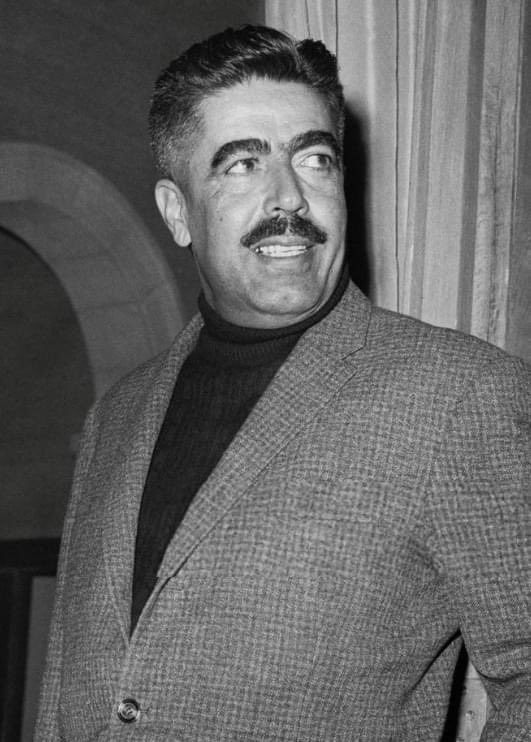
His father was Mustafa Wahbi Tal (Arar), Jordan's foremost poet, who married a Kurdish woman called Munifa Baban during his visit to Istanbul. Tal lived in Arapgir away from his father speaking Kurdish until 1924, when he moved with his mother to Irbid and later learnt Arabic.
Tal studied in Irbid and completed his high school education in Salt. He and his colleagues were so influenced by the Arab nationalist ideas of their teacher, that they formed a secret organization called the Black Hand.
One of the students threw an old grenade at the Salt Governor's empty house in 1936, to express opposition to the lack of a clear government policy on the events in Palestine, and ended up in arrest of all students. They were released only after Tal's father Arar intervened.
He finished his primary education with distinction in 1938, so Tal received a government scholarship to study science and philosophy at the American University of Beirut. The university had a library full of invaluable books.
Tal developed a passion for reading during his university studies. German philosopher Friedrich Nietzsche's books were his favorite, along with other books and novels about history, politics, philosophy, military studies and animals.
After graduating from university in 1941, he returned to the Emirate of Transjordan and started his job as a teacher in Karak and then in Salt.
Tal joined the British Army in Palestine to gain military training and later joined the Arab Liberation Army (ALA). The ALA was formed by the Arab League in late 1947 to defend Palestine.
After the fall of Nazareth into Zionist forces' hands, Tal became commander of the Yarmouk forces stationed in Syria. He attempted to break the truce in order to continue the fighting, but was jailed by Syrian President Husni Za'im for three months.
He returned to Jordan from prison and then to East Jerusalem where he founded the Arab nationalist Hadaf (Target) newspaper.
He held many positions in the Jordanian state in the 1950s, including: Statistics officer, income tax advisor, advisor at the Jordanian embassy in West Germany, chief of protocol at the Royal Court, director general of the radio,
acting head of the Guidance and National Media Department, and Jordan's ambassador to the Republic of Iraq in 1960.
In 1955, Tal started to voice his opinions opposing Gamal Abdul Nasser's policies, which were skeptical of the feasibility of his policy concerning positive neutrality from the Cold War between the Soviet Union and the West.
He called for improving the Arab world's relationship with the West in order to face Israel. Tal was so saddened by the revolution that swept the Hashemite monarchy in Iraq and left it under Soviet influence that he spent 10 days eating only yogurt, according to his wife Sa'dieh.
In 1960, after then Prime Minister Hazza' Majali's assassination, Tal's high school friend, his negative convictions of Abdul Nasser deepened.
After the fall of the United Arab Republic (UAR) between Egypt and Syria in 1961, Jordan breathed a sigh of relief. Consequently, King Hussein asked Tal to form a government.
King aimed at announcing a new phase in Jordan, marked by focus on internal affairs, economic development and political liberalization.Tal, who was 42 years old, formed a government of experts who were first-time ministers so his government gained unanimous parliament confidence.
Tal gave priority to his policy of curbing bureaucracy in the public sector, so he expelled hundreds of employees in a few months because of their corruption and inefficiency, after the promulgation of a new law on civil service.
However, Tal, who openly opposed Abdul Nasser's policies, had to resign after two revolts in Iraq and Syria led to the rise of the Ba'th Party in 1963. This was because Jordan then stood alone facing Egypt, Syria and Iraq, who started to talk about forming a tripartite union.
The union was never successful because of disagreements, so King Hussein appointed Tal as prime minister again in 1965.
In that year, a general amnesty law was promulgated that allowed the return of political exiles to Jordan. King Hussein also requested Tal to administer himself the burning of security files at the Intelligence Directorate, in a move that was widely popular.
Tal’s government resigned in the wake of the 1966 Samu’ Battle. Tal was then appointed Chief of the Royal Court. He strongly opposed Jordan's participation in a war against Israel because of its unpreparedness.
Jordan joined the war because of its mutual defense treaty with Egypt, which led to the loss of the West Bank in June 1967.
Tal acted as consultant to King Hussein during the period of Black September in 1970, which witnessed confrontations between the Jordanian Army and the fedayeen organizations.
The King appointed Tal as prime minister in October, and Tal led operations that resulted in the fedayeen's expulsion from Jordan, after they had failed multiple times over the course of months to abide by their agreements with the Jordanian government.
The operations ended in July 1971 after the expulsion of the last fedayeen forces from Ajloun, who then fled to Lebanon via Syria. Tal wanted to direct fedayeen operations to resist Israeli occupation rather than oppose it.
On 28 November 1971, Tal was assassinated in Cairo during a visit to participate in an Arab League session with other Arab ministers by an organization calling itself Black September because of his role in the expulsion of fedayeen from Jordan.
Wasfi Tal gained widespread popularity that was not enjoyed by any other Jordanian prime minister through his personal charisma, intelligence, honesty, humbleness, courage and determination,
and because of his closeness to people, his role in the development of Jordan, in encountering the fedayeen threat, and on top of all that, being a martyr.
جاري تحميل الاقتراحات...