
𝑩𝑨𝑻𝑻𝑳𝑬 𝑶𝑭 𝑷𝑨𝑽𝑨𝑵 𝑲𝑯𝑰𝑵𝑫, 300 𝑴𝑨𝑹𝑨𝑻𝑯𝑨𝑺 𝑽𝑺 10,000 𝑬𝑵𝑬𝑴𝑰𝑬𝑺
By @SanaatanTales
1. How Bajiprabhu Deshpande led just 300 Maratha warriors against an army of 10,000 plus Adil Shahi forces in the narrow Ghod Khind pass (renamed Pavan Khind by Shivaji)
By @SanaatanTales
1. How Bajiprabhu Deshpande led just 300 Maratha warriors against an army of 10,000 plus Adil Shahi forces in the narrow Ghod Khind pass (renamed Pavan Khind by Shivaji)
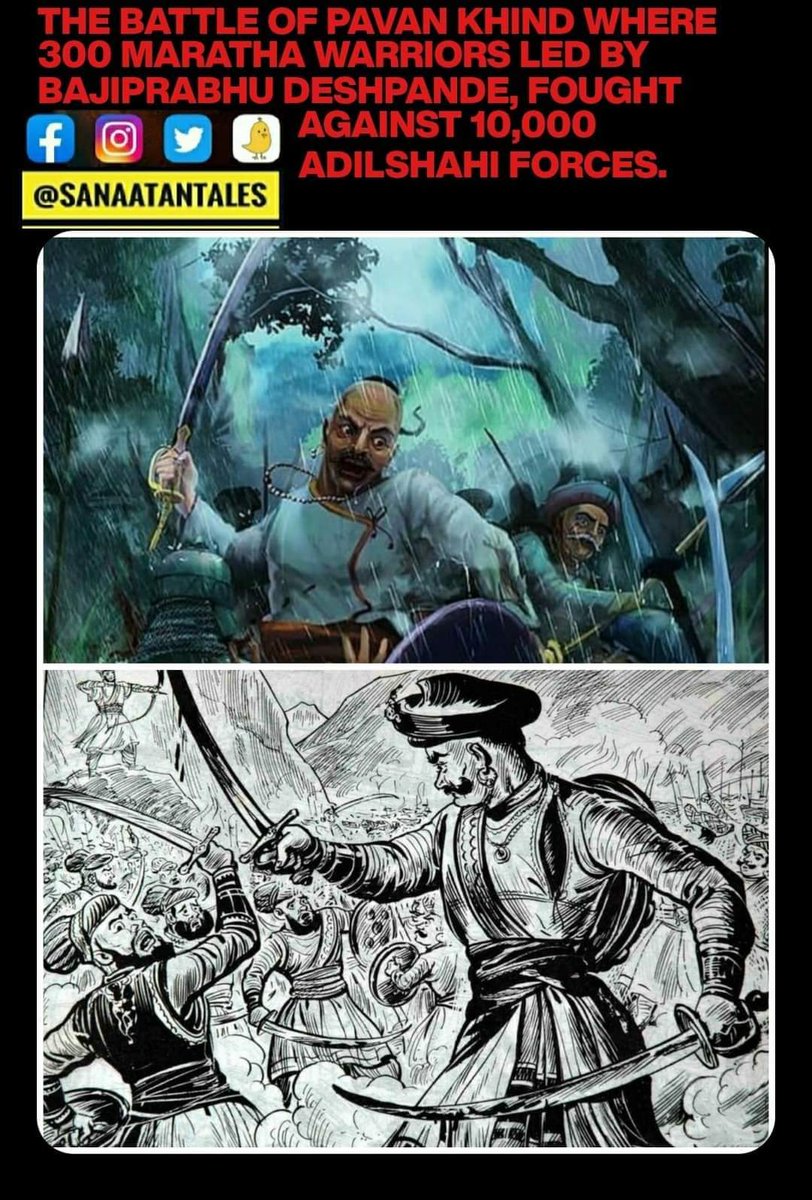
2. Bajiprabhu Deshpande was born in a Marathi Chandrasainya Kayastha Prabhu family in 1615. Chhatrapati Shivaji Maharaj appointed him the military commander of south Maharashtra around the Kolhapur region.
3. Maratha infantry soldiers were trained to fight with their traditional sword known as Dandpatta, also know as Gauntlet sword in English. The patta has a long straight blade ranging in length from 10 to 44 inches, with the gauntlet integrated in the sword.
4. Both Shivaji Maharaj and Bajiprabhu were masters in using Dandpatta. Maratha soldiers especially the infantrymen used to fight with Dandpatta against heavy cavalry.
5. Under Siddhi Johar, the Adilshahi forces laid siege of the Panhala fort and were able to trap Shivaji for almost 5 months. On Guru Poornima night, July 13, 1660, 600 Marathas decided to break the siege. The stormy weather made it more difficult for the Marathas.
6. Under Siddhi Masood, an army of 12,000 strong cavalry was sent to capture Shivaji Maharaj. When the Maratha army reached near the Ghodkhind Pass, Bajiprabhu decided to make a heroic last stand to save their King.
7. He let Shivaji Maharaj and another 300 soldiers escape to Vishalgadh fort and offered to stay back with the remaining soldiers at the Ghodkhind pass to buy enough time for the King to capture the fort.
8. Shivaji Maharaj reluctantly agreed and decided to fire 3 cannon balls to indicate his safe arrival on Vishalgadh. Bajiprabhu’s brother Phulaji also decided to stay back to fight.
9. With Dandpatta in both hands, Bajiprabhu and his loyal 300 Marathi soldiers blocked the Ghodkhind pass, and collided with 12,000 soldiers of Adil Shah.
10. The brave 300 Maratha fought for almost 15 hours. Despite being seriously wounded Bajiprabhi continued fighting. Soldier after soldier was martyred fighting the infinite looking stream of enemy soldiers.
11. But as the battle went on, it was obvious which militarily side was far better and polished in their skills. What could have been a few minutes of fight turned into a massacre of the forces of Adil Shah.
12. Chants of “Har Har Mahadev” echoed as every Maratha sword cut down the Muslim soldiers one after another. The Maratha warriors were like caged tigers in the narrow pass that repulsed and annihilated wave after wave of the incoming enemy soldiers.
13. Even after being outnumbered by almost 1:50 the battle looked like it would go on forever. Baji Prabhu was like a boulder in the way of the incoming enemies, cutting through them with his two swords.
14. Even after being stabbed and cut multiple times, he had decided to not stop untill he heard the 3 cannon shots that would signify the safety of his Maharaja.
15. Many times, it looked like he was about to give in to his injuries and pass out but with iron will summoned, he stood firm and strong and kept on fighting. The great Maratha Baji Prabhu Deshpande would not quit till he had heard the cannon shots.
16. Meanwhile Shivaji Maharaj was able to reach Vishalgadh fort. The fort was already under siege of Bijapuri sardars. Shivaji and his 300 men, despite being tired, defeated the Bijapuri commanders and captured the fort.
17. Shivaji Maharaj’s safe journey to Vishalgadh was signalled by the firing of three cannon shots. Hearing the sound of the cannon, proud and brave Bajiprabhu Deshpande attained martyrdom.
18. To honour Bajiprabhu and the other 299 Maratha soldiers who laid down their life for Swarajya, Shivaji Maharaj named the Ghodkhind pass as Pavan Kind (Holy Pass).
19. Around 4,000 Bijapuri forces were killed or injured. All because of just 300 Maratha soldiers who fought till the end to the chants of ”Har Har Mahadev", a war cry that their descendants still use while serving the Matrabhumi as soldiers of the Indian Army.
Ends
Ends
جاري تحميل الاقتراحات...