

Hello Audiologists, hope you are doing well 👩🏻⚕️🧑🏻⚕️🦻🏻..
Our topic today will be about “Sudden Sensorineural Hearing Loss”
STAY TUNED ✨!
Our topic today will be about “Sudden Sensorineural Hearing Loss”
STAY TUNED ✨!

🔅What is sudden SNHL?
Sudden sensorineural hearing loss (SSNHL) is a type of hearing loss that is usually 30 dB or more among at least three continuous frequencies. The hearing loss will last over a period of 72 hours or less.
Sudden sensorineural hearing loss (SSNHL) is a type of hearing loss that is usually 30 dB or more among at least three continuous frequencies. The hearing loss will last over a period of 72 hours or less.
The hearing loss severity can be from mild to profound hearing loss, and could be temporary or permanent ⚠️.
🔅What are the symptoms of sudden SNHL?
▫️Muffling of speech and other sounds.
▫️Difficulty hearing consonant sounds.
▫️Continuous asking for clarification.
▫️Muffling of speech and other sounds.
▫️Difficulty hearing consonant sounds.
▫️Continuous asking for clarification.
▫️Always tending to turn up the volume of the television.
▫️Avoidance of social gathering.
▫️Difficulty understanding words, especially in background noise.
▫️Avoidance of social gathering.
▫️Difficulty understanding words, especially in background noise.
🔅What are the causes of sudden SNHL?
There are many diseases and conditions that could cause SSNHL.
🔴However, most of the cases who had SSNHL have unidentifiable causes.
There are many diseases and conditions that could cause SSNHL.
🔴However, most of the cases who had SSNHL have unidentifiable causes.
🔅Some of the causes of SSNHL are as the following:
▫️Infections.
▫️Head trauma.
▫️Autoimmune diseases.
▫️Using drugs that treat cancer or severe infections.
▫️Blood circulation problems.
▫️Neurological disorders, such as multiple sclerosis.
▫️Disorders of the inner ear.
▫️Infections.
▫️Head trauma.
▫️Autoimmune diseases.
▫️Using drugs that treat cancer or severe infections.
▫️Blood circulation problems.
▫️Neurological disorders, such as multiple sclerosis.
▫️Disorders of the inner ear.
🔅Evaluation:
1️⃣Audiological evaluation: including Pure Tone Audiometry (PTA), speech test, acoustic reflex, and Auditory Brainstem Response (ABR).
1️⃣Audiological evaluation: including Pure Tone Audiometry (PTA), speech test, acoustic reflex, and Auditory Brainstem Response (ABR).
2️⃣Laboratory investigations: including complete blood counts (CBC), thyroid-stimulating hormone, and serological test for infections and autoimmune diseases.
3️⃣Imaging: MRI to rule out a retrocochlear pathology.
3️⃣Imaging: MRI to rule out a retrocochlear pathology.
🔅Treatment:
From our Audiology intervention, we choose these amplification options based on the case:
From our Audiology intervention, we choose these amplification options based on the case:
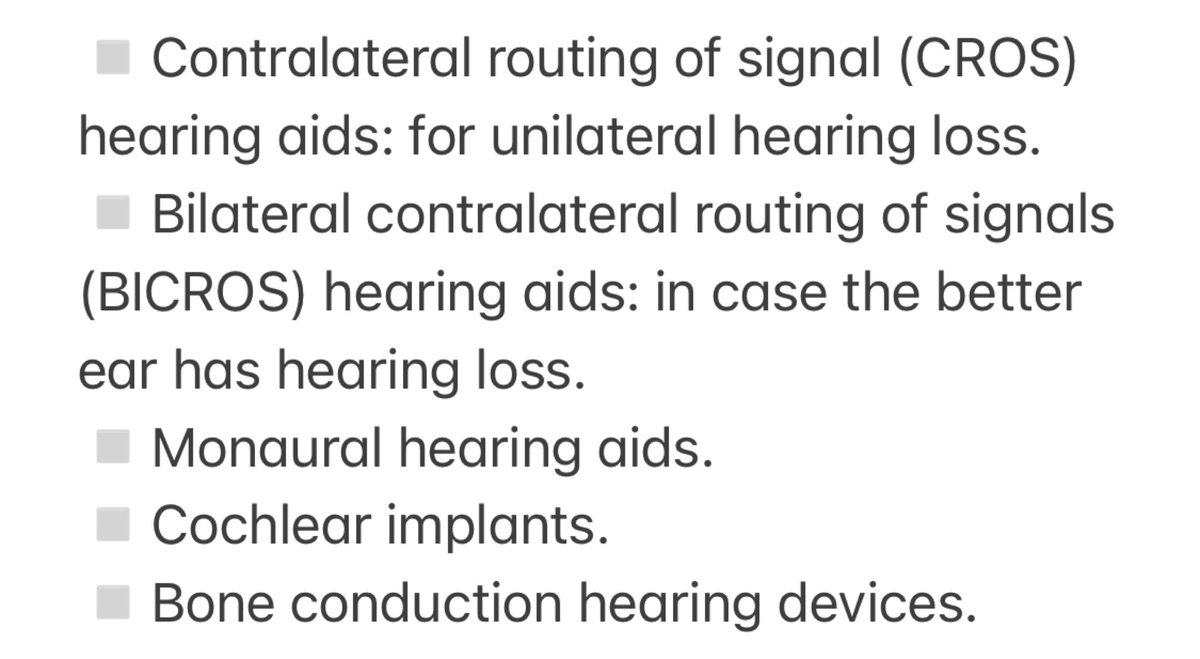
Other treatment from other specialties:
▫️Vasodilator: to increase the blood supply to the cochlea.
▫️Anti-inflammatory agents: such as systematic corticosteroids and intratympanic steroids.
▫️Hyperbaric oxygen: to improve the oxygen supply to the cochlea.
▫️Vasodilator: to increase the blood supply to the cochlea.
▫️Anti-inflammatory agents: such as systematic corticosteroids and intratympanic steroids.
▫️Hyperbaric oxygen: to improve the oxygen supply to the cochlea.
🔅Prognosis:
▫️Age: as the age increases, the rate of hearing recovery decreases.
▫️Duration of HL: hearing will more likely to be improved if the patient presents to a physician within a week offer the onset of sudden HL.
▫️Age: as the age increases, the rate of hearing recovery decreases.
▫️Duration of HL: hearing will more likely to be improved if the patient presents to a physician within a week offer the onset of sudden HL.
▫️Severity of HL: mild degree of HL have higher rate of hearing recovery compared to profound lose.
▫️Configuration of HL: flat audiogram reported to have less rate of hearing recovery. For non-flat audiogram, low frequency HL has better prognosis compared to high frequency HL.
▫️Configuration of HL: flat audiogram reported to have less rate of hearing recovery. For non-flat audiogram, low frequency HL has better prognosis compared to high frequency HL.
▫️Systematic comorbidities: hearing is less likely to be improved in patients with DM, hyperlipidemia, HTN, and metabolic syndrome.
Loading suggestions...