

There are only 2 tools in trading which will prevent you from blowing up your capital :
1. Risk Management Technique
2. Stop Loss
If you don't follow these , You will fail.
1. Risk Management Technique
2. Stop Loss
If you don't follow these , You will fail.
Different Charts = Different SL
Eg. Fixing Stop Loss at 5%. This is a very bad idea.
Stop loss should be based on TA alone.
Every setup is different and a fixed SL will never work.
Eg. Fixing Stop Loss at 5%. This is a very bad idea.
Stop loss should be based on TA alone.
Every setup is different and a fixed SL will never work.
Stop loss = Invalidation level.
Entry is made ONLY as per TA on a valid reason for a directional move. Once the reason for the entry has been lost, the trade must be exited.
The event at which the reason for entry ceases to exist is the invalidation level.
Entry is made ONLY as per TA on a valid reason for a directional move. Once the reason for the entry has been lost, the trade must be exited.
The event at which the reason for entry ceases to exist is the invalidation level.
Stop Loss is a tool to be ABSOLUTELY used as soon as the setup reaches an invalidation point. Always establish the invalidation point before entering a trade.
As soon as the invalidation event turns true, EXIT without a second thought.
As soon as the invalidation event turns true, EXIT without a second thought.
If the entry was made because of a breakout being confirmed, but if it comes as fakeout, the reason for the entry no longer exists and hence, a stop loss must be entered. And trade should be exited at that point.
Let us understand placing the stop Loss with the help of few examples.
I will only be using simple Support/Resistance reasons for entry to keep it simple.
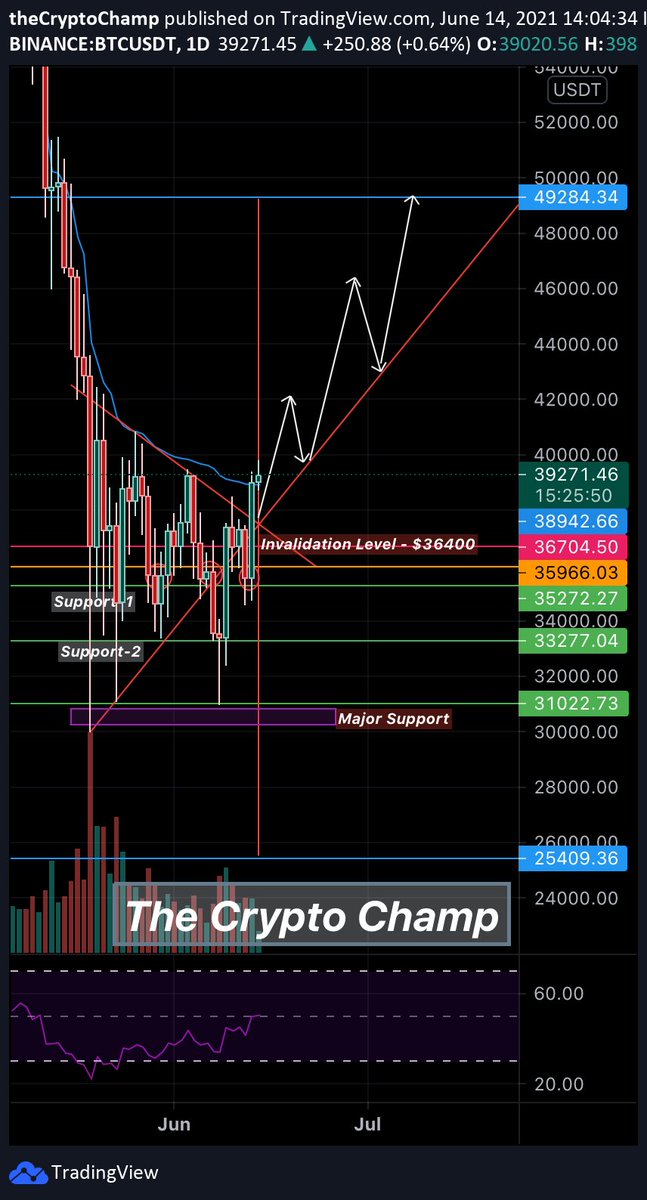
Placing SL during consolidation Break-out.
Note- Place it a little below the invalidation level to prevent stop hunts.
I will only be using simple Support/Resistance reasons for entry to keep it simple.
Placing SL during consolidation Break-out.
Note- Place it a little below the invalidation level to prevent stop hunts.
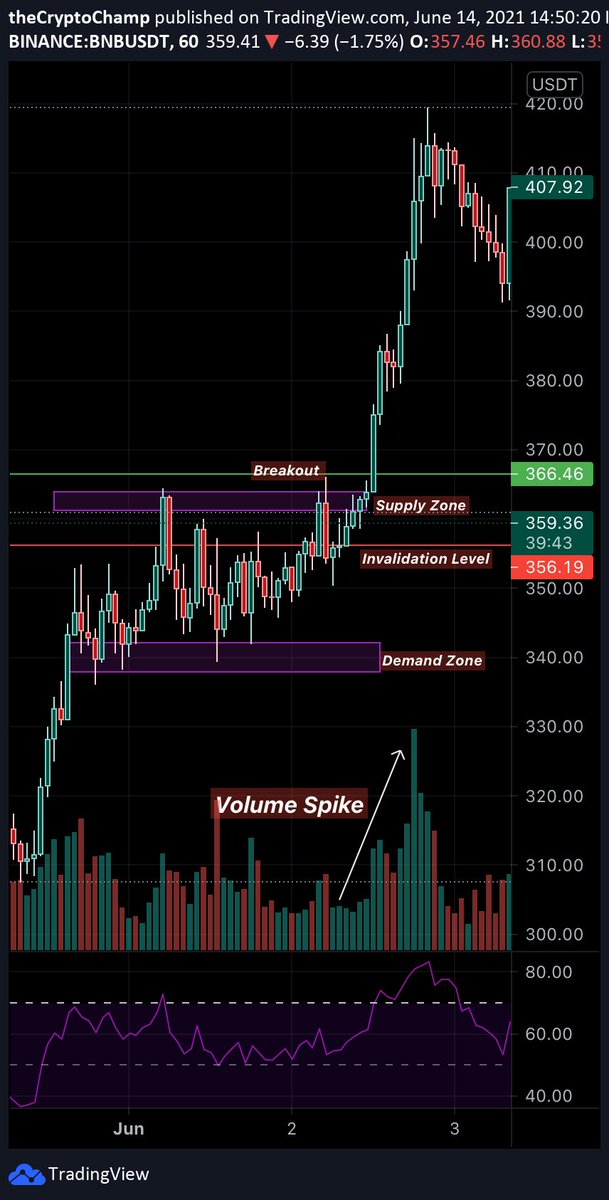
Placing stop loss with
-Supply Demand Zone recognition -Break-out
-Supported by volume Spike
-Supply Zone Flip
-Break-out confirmation
-Supply Demand Zone recognition -Break-out
-Supported by volume Spike
-Supply Zone Flip
-Break-out confirmation
Let's try to understand a bit advanced stop loss using -OBV
-Volume.
Price goes up, volume doesn't. Price goes down, volume goes up. THIS IS BEARISH.
Price goes up, OBV doesn't. Support is broken.
Bullish invalidation = SL Entered.
-Volume.
Price goes up, volume doesn't. Price goes down, volume goes up. THIS IS BEARISH.
Price goes up, OBV doesn't. Support is broken.
Bullish invalidation = SL Entered.
👉 Price increase with increasing Volume - The volume here acts as a support to the uptrend.
👉 Price increase with Decreasing Volume - Points towards an uptrend not supported by volume. It isn't safe to long this uptrend. This kind of price volume movement denotes a correction.
👉 Price increase with Decreasing Volume - Points towards an uptrend not supported by volume. It isn't safe to long this uptrend. This kind of price volume movement denotes a correction.
👉PRICE DECREASES WITH INCREASING VOLUME - When price decreases with increasing volume, the volume here confirms the downtrend.
👉PRICE DECREASES WITH DECREASING VOLUME - This decrease in price is not confirmed by volume and hence can be regarded as a correction in uptrend.
👉PRICE DECREASES WITH DECREASING VOLUME - This decrease in price is not confirmed by volume and hence can be regarded as a correction in uptrend.
Stop Loss is a very controversial topic as some traders don't like to place a SL order as it could lead to stop loss hunting.
Some traders swear by a strict stop loss order being placed as soon as an entry is placed.
Some traders swear by a strict stop loss order being placed as soon as an entry is placed.
The solution to this dilemma is discussed below.
1. Place the SL BELOW the invalidation point to avoid SL hunting by wicks.
2. Exit the trade on invalidation with using SL manually AFTER the invalidation is confirmed to avoid stop loss hunting.
I personally prefer second.
1. Place the SL BELOW the invalidation point to avoid SL hunting by wicks.
2. Exit the trade on invalidation with using SL manually AFTER the invalidation is confirmed to avoid stop loss hunting.
I personally prefer second.
CONCLUSION.
1. Stop loss cannot be a fixed percentage as all trade setups are different. 2. Stop Loss is nothing but an exit at an invalidation level.
Reason for entry no longer valid = Stop Loss.
3. Use ONLY TA to find stop loss. Stop Loss = Invalidation level.
1. Stop loss cannot be a fixed percentage as all trade setups are different. 2. Stop Loss is nothing but an exit at an invalidation level.
Reason for entry no longer valid = Stop Loss.
3. Use ONLY TA to find stop loss. Stop Loss = Invalidation level.
4. Always have the Stop Loss determined before entering a trade.
5. You don't have to post the SL order, you can exit manually on invalidation to avoid false wicks aka Stop hunting.
P.S. Don't be in a rush to move your SL to break-even.
5. You don't have to post the SL order, you can exit manually on invalidation to avoid false wicks aka Stop hunting.
P.S. Don't be in a rush to move your SL to break-even.
Stop loss = Invalidation level.
Entry is made ONLY as per TA on a valid reason for a directional move. Once the reason for the entry has been lost, the trade must be exited.
The event at which the reason for entry ceases to exist is the invalidation level.
Entry is made ONLY as per TA on a valid reason for a directional move. Once the reason for the entry has been lost, the trade must be exited.
The event at which the reason for entry ceases to exist is the invalidation level.
@rattibha unroll
Loading suggestions...