

7 reasons why think immunity to COVID from vaccination or infection will be long-lived (and why I continue to marvel that CEOs of companies who stand to make profit from boosters get to message that boosters needed; instead, please donate vax to India).
1. Memory B cells:
1. Memory B cells:

We discussed this at more length before; remember this amazing memory B cell paper that showed us that 32 people ages 91-101 who survived 1918 flu pandemic STILL had memory B cells that could produce neutralizing antibodies to that strain 9 decades later
nature.com
nature.com
Memory B cells last long time & hang out in germinal centers (like lymph node) until they are needed again and then come out to produce neutralizing antibodies against the pathogen. Do we know COVID-19 vaccines produce memory B cells? Yes from this paper
researchsquare.com
researchsquare.com
where biopsies of lymph nodes showed memory B cells strongly forming after vaccination. Remember, antibodies produced not just against spike protein (you see a lot of reports on this Ab) but against nucleocapsid proteins (buried deeper in virus basically)
bmcinfectdis.biomedcentral.com
bmcinfectdis.biomedcentral.com
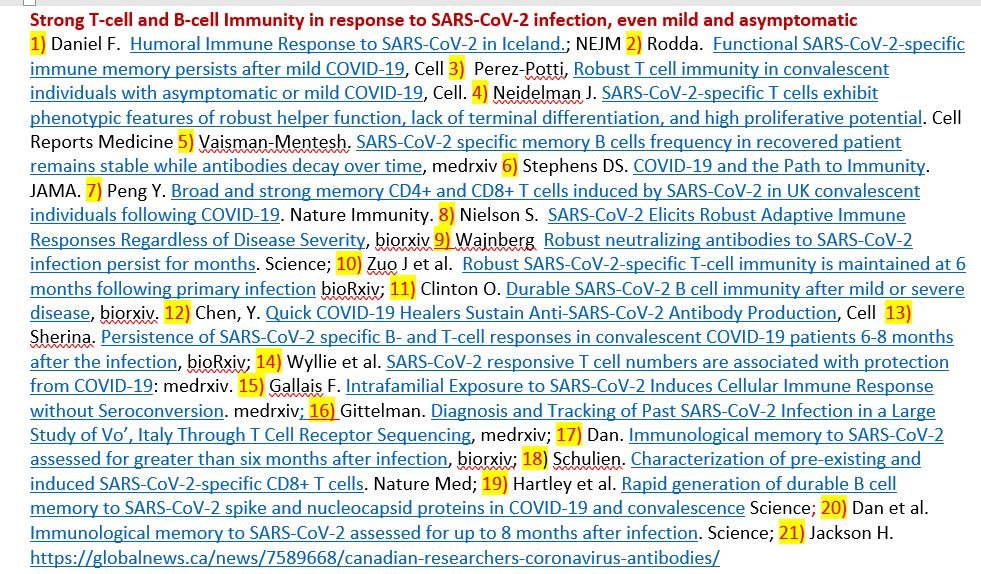
2. T cell immunity generated by these vaccines; we know that for a fact because the phase I/II trials MEASURED T cell immunity generated these vaccines (see column 4 below). Moreover, we know strong T cell immunity generated by natural infection by multiple papers

These papers are below, in the following tweet thread ( and I will spend minute giving you details of my favorite two papers since they give the longest follow-up duration after natural infection showing that T cell responses have long-half lives
This paper by Dan et al. in Science looked at antibodies (from B cells), memory B cells, and memory T cells (both CD4+ and CD8+ cells) from 188 (80 male; 108 female) patients recovered from COVID (93% mild; 7% hospitalized) over 8 months. science.sciencemag.org
Happily, memory B cells (relevant to reason #1) seen in almost all & half-life of T cells were LONG (~125-225 days for CD8+ and ~94-153 days for CD4+), comparable to the 123 days half-life observed for memory CD8+ cells after yellow fever vax (typically given once in a LIFETIME)
3. Memory T cells: Reason #3-related to 2- but MEMORY T cells form (last long time) as evidenced by this paper from @UCSF showing us CD8 T cells continuously differentiate for ~6 months after infection, into cells with features of long-lived memory T cells
biorxiv.org
biorxiv.org

4. T cells from vaccination last long time: Reason #4- We know T cells from vaccines last long time; paper on those who got measles vaccine as children with strong T cell immunity 34 years later. Antibodies can be stimulated by memory B cells-reason 1.
academic.oup.com
academic.oup.com

5. T cells from natural infection with a related coronavirus that caused severe disease last long time. Reason #5. SARS-CoV is a coronavirus that- like SARS-CoV-2 (which causes COVID-19) -causes severe disease. Reminder of its course below. However, a Nature 2020 shows us

5 (continued) that T cell immunity from those who recovered from SARS in 2002-03 still strong 17 years later showing us that T cell immunity to coronaviruses last long time (again, antibodies may fade but can be produced again by memory B cells: reason#1)
nature.com
nature.com
6. 6th reason is that T cell immunity works against variants: hope you are convinced of this - thread here but remember that T cell immunity is very robust, in-breadth, forms across multiple parts of virus (including multiple pieces of spike protein)
7. 7th and final reason is that coronaviruses don't actually mutate that quickly -has strong proofreading mechanism where -if the virus mutates -it goes back and corrects it. Mutations can arise with high rates of replication when transmission is high
journals.plos.org
journals.plos.org
but the virus should not mutate like this when cases are at low levels after mass vaccination. HIV and influenza mutate much more quickly than coronaviruses. So, hope with these 7 reasons, hope I've managed to convince you to wait on booster discussion & vaccinate world
Loading suggestions...