

We hear a lot that vaccines are “95% effective”. But what does that actually mean?
Do 5% of people still get symptomatic COVID-19 after💉?
Will you only get 5% of COVID-19 symptoms after💉?
The answer to the above questions are no. See 🧵below...
1/
Do 5% of people still get symptomatic COVID-19 after💉?
Will you only get 5% of COVID-19 symptoms after💉?
The answer to the above questions are no. See 🧵below...
1/

We call this the ABSOLUTE RISK (AR) of disease
We can say that the absolute risk of symptomatic COVID-19 (primary outcome of trial) was:
AR: 1.31% in the placebo group
AR: 0.0778% in the vaccine group
3/
We can say that the absolute risk of symptomatic COVID-19 (primary outcome of trial) was:
AR: 1.31% in the placebo group
AR: 0.0778% in the vaccine group
3/
From here we can see, it was NOT the case that 5% of the individuals vaccinated developed the primary outcome.
In fact, those unvaccinated were ~17-fold increased risk of developing symptomatic COVID-19 in the trial!
1.31/0.0778 = 17
4/
In fact, those unvaccinated were ~17-fold increased risk of developing symptomatic COVID-19 in the trial!
1.31/0.0778 = 17
4/
So where does the 94.1% efficacy come from?
Well first we will need to calculate the ABSOLUTE RISK REDUCTION
ARR = AR (unvaccinated) – AR (vaccinated)
ARR = 1.31 – 0.0778 = 1.23%
This means that vaccination has reduced the ABSOLUTE risk of symptomatic COVID by 1.23%
5/
Well first we will need to calculate the ABSOLUTE RISK REDUCTION
ARR = AR (unvaccinated) – AR (vaccinated)
ARR = 1.31 – 0.0778 = 1.23%
This means that vaccination has reduced the ABSOLUTE risk of symptomatic COVID by 1.23%
5/
Why can’t we stop there? We don’t we just report that vaccines reduce risk of COVID-19 by 1.23%
Because 1.23% can mean different things:
6/
Because 1.23% can mean different things:
6/
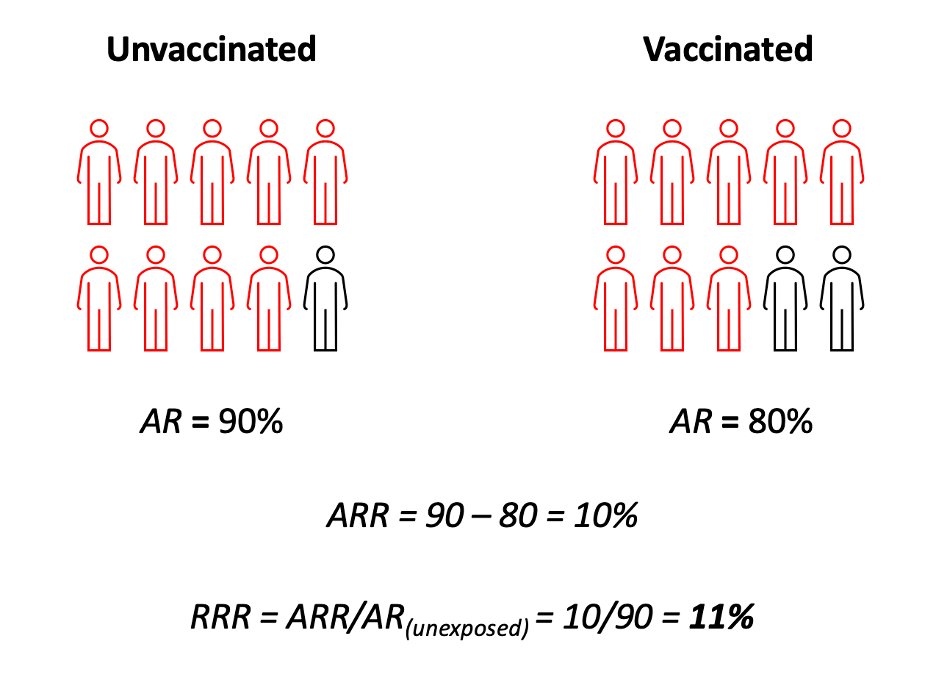
☝️ A 1.23% reduction in a disease that has a baseline risk in the population of 90% doesn’t do much
✌️ A 1.23% reduction in a disease that has a baseline risk in the population of 1.31% has almost eliminated the disease
7/
✌️ A 1.23% reduction in a disease that has a baseline risk in the population of 1.31% has almost eliminated the disease
7/
This is why we divide again by the baseline risk in the population (1.31%) to get:
1.23/1.31 = 94.1% efficacy (when carrying decimals)
This is known as the RELATIVE RISK REDUCTION (RRR) and is how vaccine efficacy is measured
8/
1.23/1.31 = 94.1% efficacy (when carrying decimals)
This is known as the RELATIVE RISK REDUCTION (RRR) and is how vaccine efficacy is measured
8/
In the example below,💉reduce the absolute risk of disease by 10%, but since the baseline risk in the population is very high (90%), the relative risk reduction is low: 11%
9/
9/
In the second example, 💉still reduce the absolute risk of disease by 10%, but now the baseline risk in the population is low, and the relative risk reduction is much higher: 50%
10/
10/
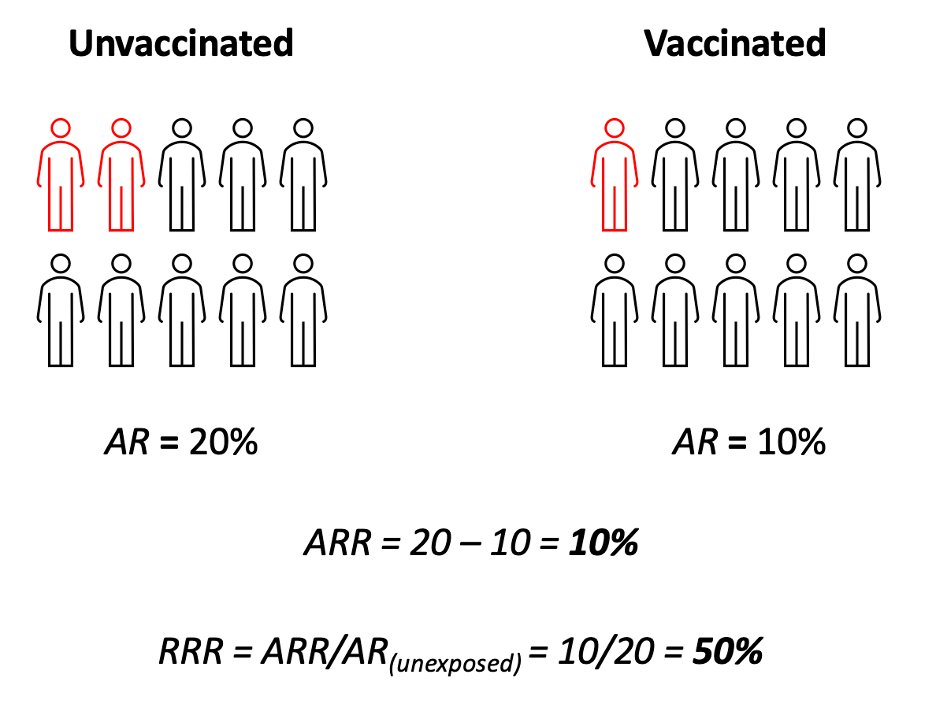
Relative risk reduction (RRR) is useful because it tells you by how much the treatment reduced the risk of bad outcomes (symptomatic COVID-19) relative to the control group who did not have the treatment
11/
11/
Thus we can interpret 95% vaccine efficacy as:
"a 95% reduction in the risk of symptomatic COVID-19 relative to the control group who did not receive the vaccine"
12/
"a 95% reduction in the risk of symptomatic COVID-19 relative to the control group who did not receive the vaccine"
12/
A RRR of 95% stays the same regardless of individuals' risk
ie
Someone at 90% risk of symptomatic COVID will experience a 95% risk reduction (90% -> 4.5%)
Someone at 1% risk of symptomatic COVID will also experience 95% risk reduction (1% -> 0.05%)
13/
ie
Someone at 90% risk of symptomatic COVID will experience a 95% risk reduction (90% -> 4.5%)
Someone at 1% risk of symptomatic COVID will also experience 95% risk reduction (1% -> 0.05%)
13/
Those at highest risk will thus benefit from the greatest absolute risk reduction of the intervention
This is the rationale for vaccinating those at high risk for contracting COVID-19
14/
This is the rationale for vaccinating those at high risk for contracting COVID-19
14/
Summary:
1.) Vaccine efficacy uses the outcome measure known as relative risk reduction (RRR)
2.) RRR is dependent on the ARR and the baseline risk of the disease in the population
3.) A high RRR reduces absolute risk the most in those high risk
15/
1.) Vaccine efficacy uses the outcome measure known as relative risk reduction (RRR)
2.) RRR is dependent on the ARR and the baseline risk of the disease in the population
3.) A high RRR reduces absolute risk the most in those high risk
15/
To read more about RRR and other outcome measures:
ncbi.nlm.nih.gov
ncbi.nlm.nih.gov

Loading suggestions...