

From Mar-Dec Kuwait observed at least two distinct transmission dynamics arising from dissimilar population spatial densities (crowding effects etc).
As a result, there were two concurrent epidemic waves with characteristic time-delay: fast vs slow waves.
Thread 1/n
As a result, there were two concurrent epidemic waves with characteristic time-delay: fast vs slow waves.
Thread 1/n
The waves were driven by two different social dynamics and ultimately responded differently to interventions.
e.g., the implementation of a partial curfew was generally positive in maintaining the slow wave at endemic levels prior to an extended period of fatigue.
Thread 2/n
e.g., the implementation of a partial curfew was generally positive in maintaining the slow wave at endemic levels prior to an extended period of fatigue.
Thread 2/n
The same intervention, however, was generally negative for the fast wave due to structural problems arising from crowded living conditions of migrant workers. More on this soon but one may refer to our pre-print to get an idea.
Thread 3/n
Thread 3/n
This highlights a hidden delimma in understanding temporal trends in case counts, as accurately explained in a study by Al-Khamees & colleagues:
How can one evaluate the effectiveness of a country-wide "blanket" intervention when there are two distinct epi waves ?
Thread 4/n
How can one evaluate the effectiveness of a country-wide "blanket" intervention when there are two distinct epi waves ?
Thread 4/n
This is not a trivial question to answer by cherry-picked temporal data and handwaving logic. Understanding the demographics is a pre-requisite for such questions.
Picking a soothing rationale to justify judgement errors has been a theme in PH circles (see Sweden).
Thread 5/n
Picking a soothing rationale to justify judgement errors has been a theme in PH circles (see Sweden).
Thread 5/n
As such, to evaluate an intervention one must first resolve the data based on the main determinants of the divergence we observed in the epi waves in Kuwait.
Each wave must be evaluated separately before making an embarrassing judgement, particularly by experts.
Thread 6/n
Each wave must be evaluated separately before making an embarrassing judgement, particularly by experts.
Thread 6/n
Here I will discuss how such a thing can be done in a way that informs decision:
Use spatially-structured transmission models©
If anything, our previous studies along with Al-Khamees et al had clearly highlighted that this pandemic is demographically heterogeneous.
Thread 7/n
Use spatially-structured transmission models©
If anything, our previous studies along with Al-Khamees et al had clearly highlighted that this pandemic is demographically heterogeneous.
Thread 7/n
Due to the wave-structure in Kuwait, making conclusions based on analyses of temporal data only can lead to conflicting conclusions, if not counterfactual.
In what follows I will attempt, to the best of my ability, to deconstruct the epi situation in Kuwait.
Thread 8/n
In what follows I will attempt, to the best of my ability, to deconstruct the epi situation in Kuwait.
Thread 8/n
A) The initial faster wave:
Our previous work has shown that this wave was due to peak between May-June and we predicted case numbers of individuals from this wave to drop sharply afterwards.
Evidence: field hospitals observed this after the full curfew.
Thread 9/n
Our previous work has shown that this wave was due to peak between May-June and we predicted case numbers of individuals from this wave to drop sharply afterwards.
Evidence: field hospitals observed this after the full curfew.
Thread 9/n
This observation suggests that the full curfew was effective in crushing the faster wave (led by migrant workers etc).
But that's not the whole story. There is another distinctly slow population wave (people not living in crowded environments). More on this below.
Thread 10/n
But that's not the whole story. There is another distinctly slow population wave (people not living in crowded environments). More on this below.
Thread 10/n
B) The 2nd slow wave
This was naturally flattened due to the fact that interventions slowed transmission down in the population driving this wave with a naturally low contact rate (paper out soon).
This wave is quite complicated and is the cause of our PH dilemmas.
Thread 11/n
This was naturally flattened due to the fact that interventions slowed transmission down in the population driving this wave with a naturally low contact rate (paper out soon).
This wave is quite complicated and is the cause of our PH dilemmas.
Thread 11/n
But why is it complicated? Well, it responded to the interventions differently:
1- The partial curfew flattened it further.
2- Artificially flattened curves are known to negatively impact the behavior of a population over extended periods (e.g. fatigue)
Thread 12/n
1- The partial curfew flattened it further.
2- Artificially flattened curves are known to negatively impact the behavior of a population over extended periods (e.g. fatigue)
Thread 12/n
3- Population behavior changed drastically in Ramadan (more communal underground religious rituals, social activity etc).
4- Eid celebrations and a free pass sanctioned by the government to gather in chalets during a period of a full national curfew!
Thread 13/n
4- Eid celebrations and a free pass sanctioned by the government to gather in chalets during a period of a full national curfew!
Thread 13/n
5- ~40000 individuals evacuated from hardly hit countries were forced onto this wave continuously until the start of the full curfew. It's not too difficult for PH experts to predict the associated behavioral response of this.
Thread 14/n
Thread 14/n
6- The full curfew was lifted off prematurely (after 1.5 × generation time) without the slightest expert consideration of how this wave may have responded to the curfew. It responded differently!
Evidence: rising numbers post-curfew in contrast to the faster wave.
Thread 15/n
Evidence: rising numbers post-curfew in contrast to the faster wave.
Thread 15/n
7- The government publically announced its reopening plans with a narrative that things got better, adding more wood to the brewing fire in the slow wave. This, along with pandemic fatigue, essentially de-flattened the peak of the slow wave and hastened it.
Thread 16/n
Thread 16/n
All in all, the slow wave was as complicated as complicated can be. Things got worse for the slower wave and instead of pushing things further into 2021 it had the effect of placing the peak between Oct-Nov 2020.
Evidence: see Exhibit A below
Thread 17/n
Evidence: see Exhibit A below
Thread 17/n
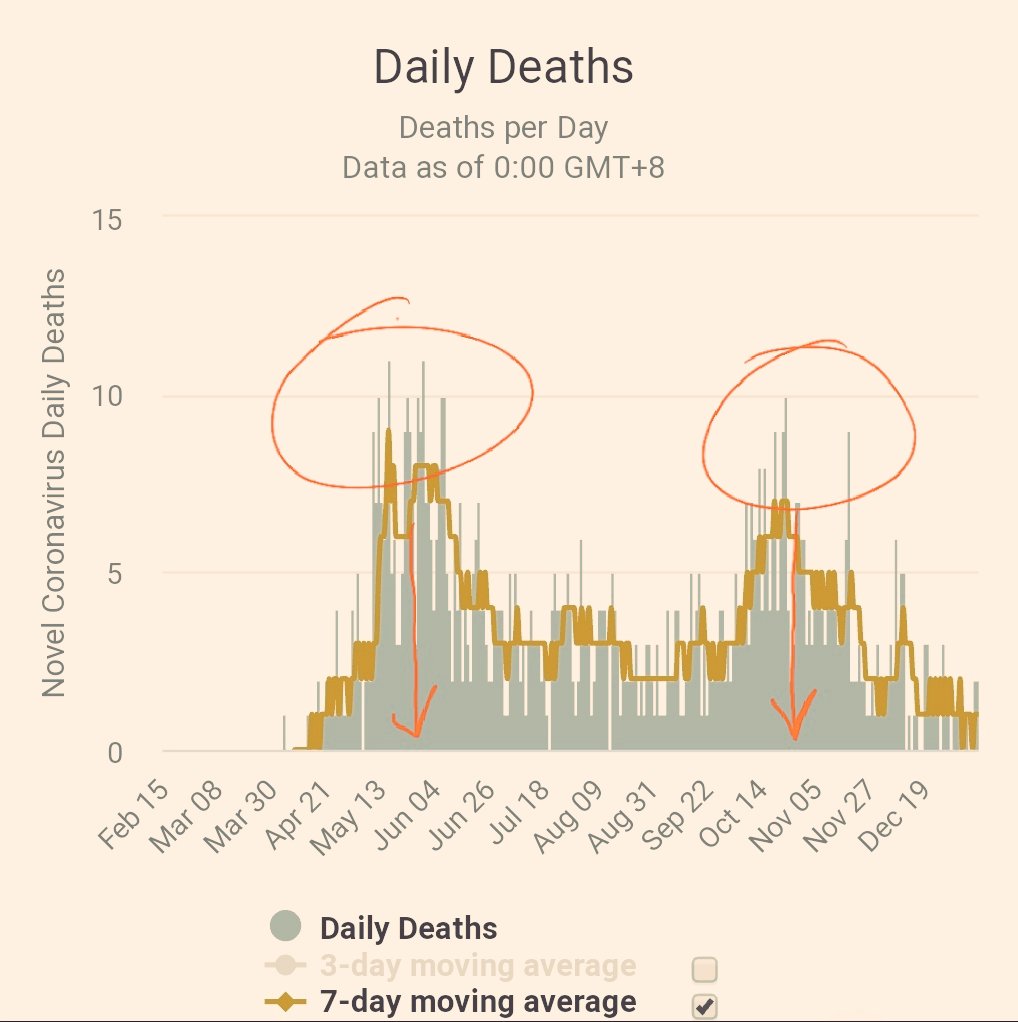
Takehome points:
1- Understand the spatial structure to make informed decisions from mathematical models. Don't just combine waves.
2- The full curfew blunted Wave A succesfully. But fatigue and weak policy implementation may have made things worse for Wave B.
End of thread
1- Understand the spatial structure to make informed decisions from mathematical models. Don't just combine waves.
2- The full curfew blunted Wave A succesfully. But fatigue and weak policy implementation may have made things worse for Wave B.
End of thread
Loading suggestions...