

Unlike most other animals, humans cannot convert uric acid into a more soluble compound.
Precipitated uric acid can cause a host of problems like gout and kidney stones.
What happened to our uricase?: a brief Tweetorial.
Fig. from pnas.org
#NephJC #NephTwitter
Precipitated uric acid can cause a host of problems like gout and kidney stones.
What happened to our uricase?: a brief Tweetorial.
Fig. from pnas.org
#NephJC #NephTwitter
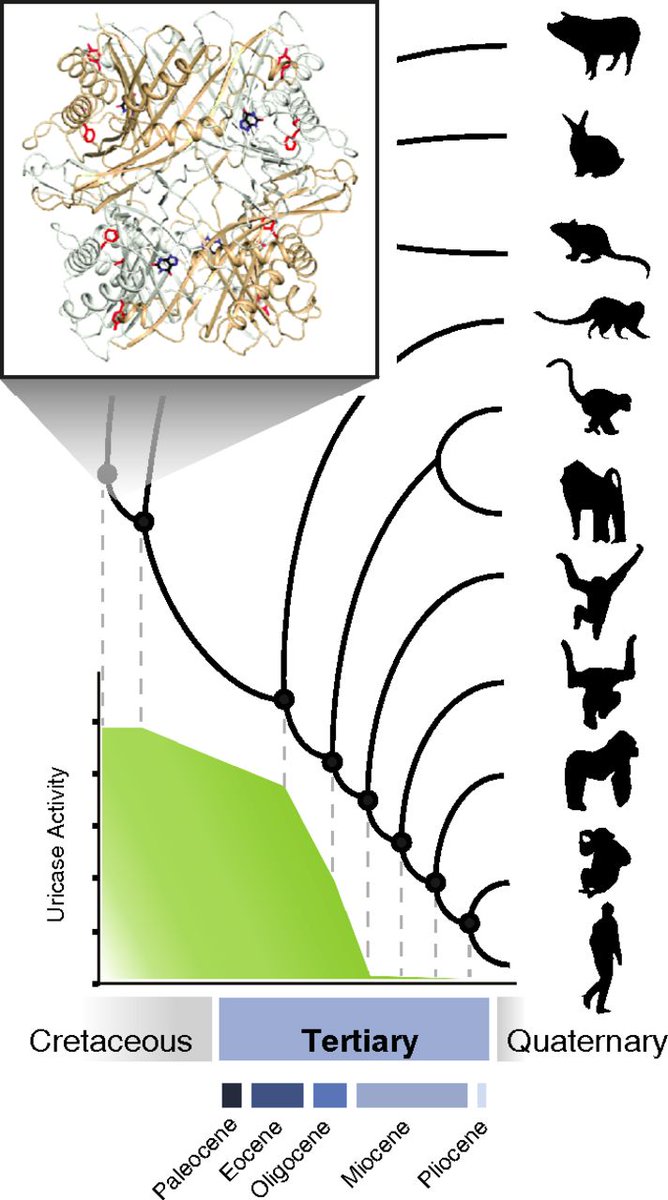
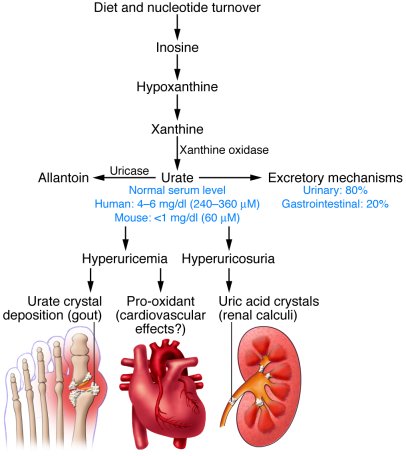
Uricase is many animals' golden knight: it protects against the Disease of Kings by converting urate to allantoin.
Great apes (including humans) do not have a functional uricase.
Why would this ever be an evolutionary favored trait, you ask?
Fig. from: jci.org
Great apes (including humans) do not have a functional uricase.
Why would this ever be an evolutionary favored trait, you ask?
Fig. from: jci.org
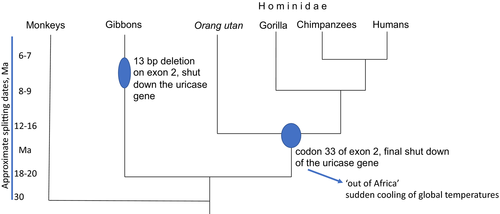
Kratzer et al. looked at great ape genomes and found:
1) Progressive ↓ in uricase activity due to promoter mutations in the Eocene.
2) Appearance of a stop codon in exon 2, effectively shutting down the gene ~ 15 MYA.
Figs. from pnas.org & onlinelibrary.wiley.com
1) Progressive ↓ in uricase activity due to promoter mutations in the Eocene.
2) Appearance of a stop codon in exon 2, effectively shutting down the gene ~ 15 MYA.
Figs. from pnas.org & onlinelibrary.wiley.com
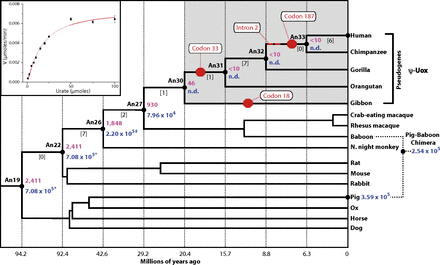
Curiously, gibbons experienced a separate uricase-inactivating event. We call this parallel evolution (en.wikipedia.org). It suggests an evolutionary pressure may have pushed us and our simian cousins to rid ourselves of uricase.
Why would ↑ urate be advantageous?
Why would ↑ urate be advantageous?
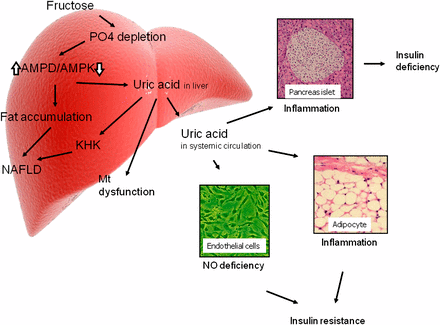
Fructose promotes lipogenesis, a process that is potentiated by its metabolite, uric acid.
When we lost uricase ~15 MYA, the diet of early hominoids was affected by global cooling. ⇡ Uric acid could have helped with energy storage then.
Fig. from diabetes.diabetesjournals.org.
When we lost uricase ~15 MYA, the diet of early hominoids was affected by global cooling. ⇡ Uric acid could have helped with energy storage then.
Fig. from diabetes.diabetesjournals.org.
This doesn’t fully explain why uricase became progressively less potent over several million years leading up to this, however. For more on this, see pnas.org.
∴ There is probably more to the story, but either way, we’re stuck with higher uric acid levels now.
∴ There is probably more to the story, but either way, we’re stuck with higher uric acid levels now.
Modern sequelae of hyperuricemia are explained by a “thrifty gene” hypothesis: in our world of excess, a lack of uricase is no longer adaptive. We’re forced to use anti-urate agents like allopurinol and rasburicase to keep our levels down in different clinical contexts.

In which cases is lowering uric acid clinically indicated?
Allopurinol is helpful for gout and recurrent urate nephrolithiasis (pubmed.ncbi.nlm.nih.gov).
Rasburicase can be kidney-saving (and possibly life-saving) in tumor lysis syndrome.
What about in CKD?
Allopurinol is helpful for gout and recurrent urate nephrolithiasis (pubmed.ncbi.nlm.nih.gov).
Rasburicase can be kidney-saving (and possibly life-saving) in tumor lysis syndrome.
What about in CKD?

Loading suggestions...