

1/
Why does smoking have a protective effect in Ulcerative Colitis (UC) and a deleterious effect in Crohn Disease (CD)?
Generally speaking: Which CD4+ T-cells are the drivers for UC and CD?
@RosenelliEM
#tweetorial #MedEd #MedTwitter #IBD
Why does smoking have a protective effect in Ulcerative Colitis (UC) and a deleterious effect in Crohn Disease (CD)?
Generally speaking: Which CD4+ T-cells are the drivers for UC and CD?
@RosenelliEM
#tweetorial #MedEd #MedTwitter #IBD
2/
UC & CD have some shared cytokine changes relative to a healthy state, yet, each has its own unique cytokine milieu. There is much more to learn about UC and CD before fully understanding the implications of this, but it will generally help to start with what we know:
UC & CD have some shared cytokine changes relative to a healthy state, yet, each has its own unique cytokine milieu. There is much more to learn about UC and CD before fully understanding the implications of this, but it will generally help to start with what we know:
3/
UC & CD both exhibit elevated levels of: IL-12, IL-18, IL-21, and IL-27 as compared to control (1)
UC & CD both exhibit elevated levels of: IL-12, IL-18, IL-21, and IL-27 as compared to control (1)

4/
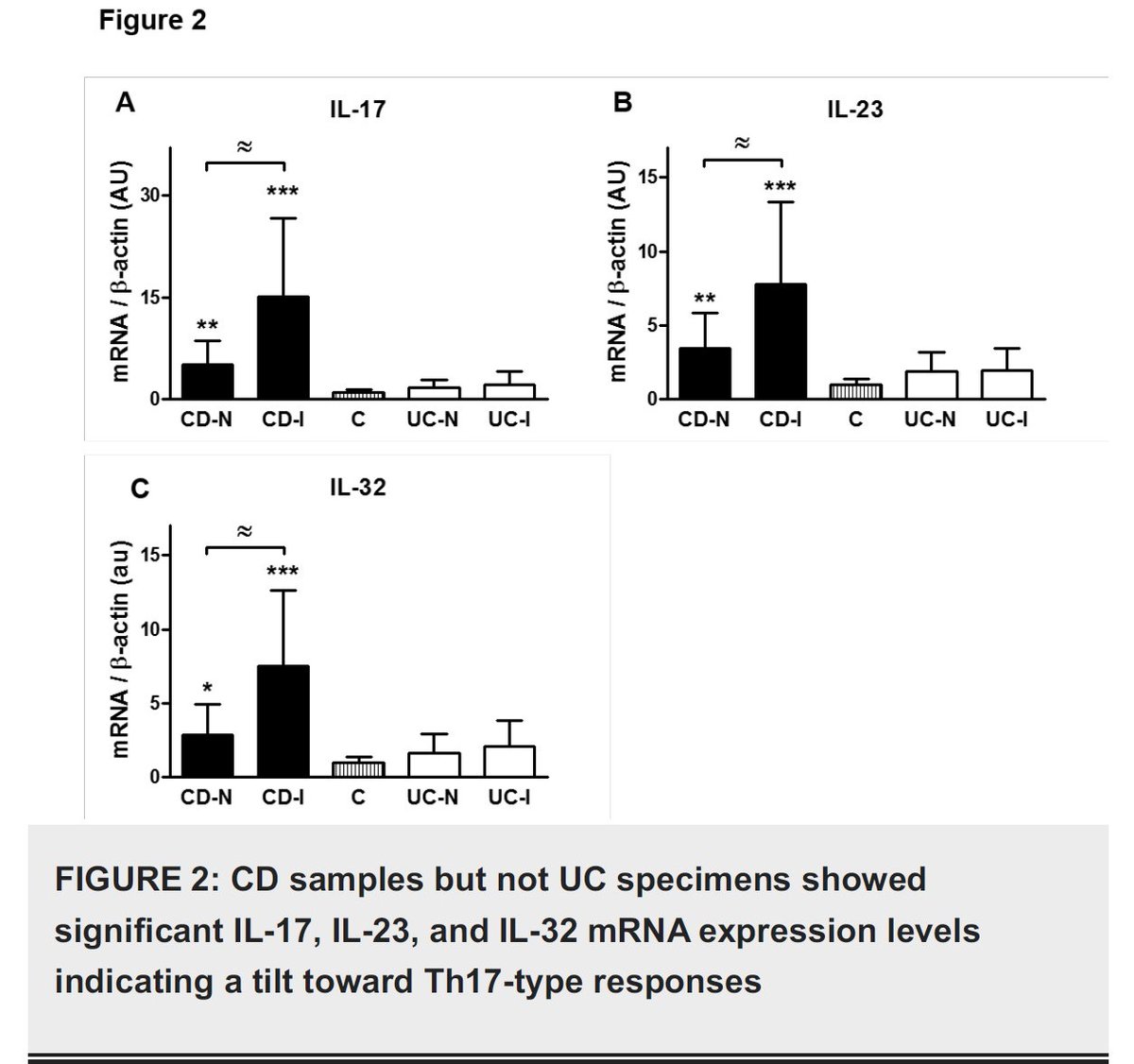
CD = Th1 driven: elevated cytokines relative to UC are IL-17, IL-23, and IL-32. Note: These cytokines trend toward a Th17 response subsequent to Th1 driven response (1)
CD = Th1 driven: elevated cytokines relative to UC are IL-17, IL-23, and IL-32. Note: These cytokines trend toward a Th17 response subsequent to Th1 driven response (1)
5/
UC = Th2 driven: elevated cytokines relative to CD are IL-5, IL-13, IL-33 (induces Th2 cytokines), and IL-15 (regulates T-cell homeostasis) (1)
UC = Th2 driven: elevated cytokines relative to CD are IL-5, IL-13, IL-33 (induces Th2 cytokines), and IL-15 (regulates T-cell homeostasis) (1)

6/
The Th1 pathway seems to amplify innate immune response via nucleotide-binding oligomerization domain proteins (NOD2)-dependent pathway (1)
The Th1 pathway seems to amplify innate immune response via nucleotide-binding oligomerization domain proteins (NOD2)-dependent pathway (1)
7/
Yadav et al. used wild type and knockout mice for genes encoding Nod2 & IL-10, which were differentially exposed to smoke. Presence of these genes were both protective of intestinal homeostasis in response to smoking (as measured by levels of IFN-gamma transcripts)(2)
Yadav et al. used wild type and knockout mice for genes encoding Nod2 & IL-10, which were differentially exposed to smoke. Presence of these genes were both protective of intestinal homeostasis in response to smoking (as measured by levels of IFN-gamma transcripts)(2)
8/
Nod2 expression is lower in the small intestine, which could offer one explanation for increased risk of CD in Nod2 deficient mice exposed to smoke (2)
Nod2 expression is lower in the small intestine, which could offer one explanation for increased risk of CD in Nod2 deficient mice exposed to smoke (2)
9/
Yadav et al. identified 6 HLA alleles that have suggestive gene-smoking interaction in IBD. HLA-B*57:01 being unique to CD risk, and HLA-DQB1*02:02 being unique to UC risk (2).
Yadav et al. identified 6 HLA alleles that have suggestive gene-smoking interaction in IBD. HLA-B*57:01 being unique to CD risk, and HLA-DQB1*02:02 being unique to UC risk (2).
10/
So again, why does smoking have a protective effect in UC and a deleterious effect in CD?
So again, why does smoking have a protective effect in UC and a deleterious effect in CD?
11/
Turns out there’s still a lot we don’t understand about these two diseases, however, the answer seems to be multifactorial, albeit not completely understood: The epigenetics of smoking, the genetics of IBD, and the resultant alteration of each disease’s inflammatory milieu.
Turns out there’s still a lot we don’t understand about these two diseases, however, the answer seems to be multifactorial, albeit not completely understood: The epigenetics of smoking, the genetics of IBD, and the resultant alteration of each disease’s inflammatory milieu.
12/
The interplay between genetics/epigenetics, and resultant downstream changes to the immune response is complex. If we can pinpoint crucial effectors in the disease processes, we may be able to apply more targeted therapies.
The interplay between genetics/epigenetics, and resultant downstream changes to the immune response is complex. If we can pinpoint crucial effectors in the disease processes, we may be able to apply more targeted therapies.
Loading suggestions...